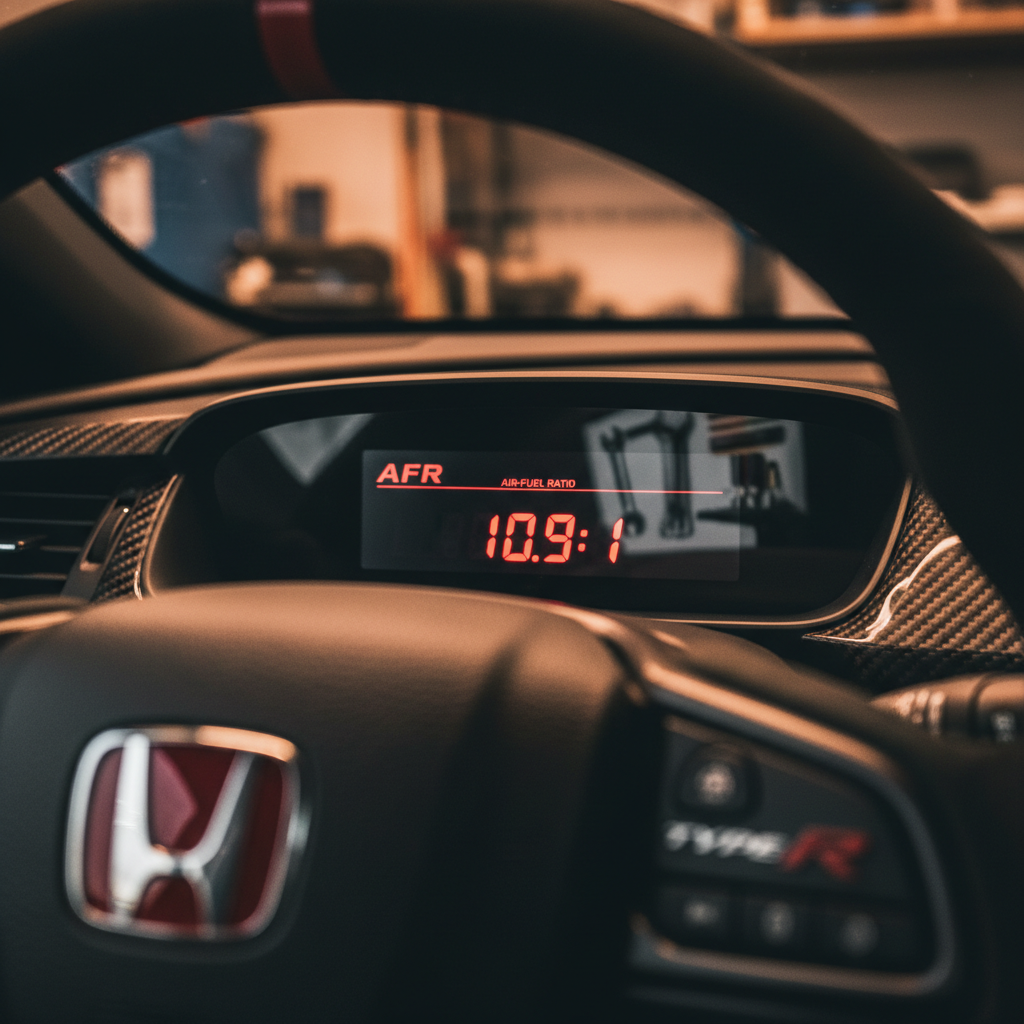
E85 vs Pump Gas AFR: Why 11.5:1 Is Wrong for Both Fuels
E85 makes peak power at 10.8-11.2:1 AFR, not the 11.5:1 most tuners target. Pump gas needs 11.8-12.2:1 for knock resistance. The difference isn’t just about fuel properties, it’s about how each fuel responds to timing advance and how AFR changes your knock threshold.
- E85 optimal AFR: 10.8-11.2:1 with 4-6 degrees more timing than pump gas
- Pump gas optimal AFR: 11.8-12.2:1 with conservative timing to avoid knock
- 11.5:1 AFR works for neither fuel and leaves 15-25hp on the table
- E85’s higher octane allows richer mixtures without knock penalty
- Pump gas timing must be pulled 6-8 degrees compared to E85 at same load
Air-fuel ratio (AFR): The mass ratio of air to fuel entering your engine, measured by your wideband O2 sensor. On forced induction applications, AFR directly impacts knock resistance, power output, and thermal management.
Why E85 and Pump Gas Need Different AFR Targets
The 11.5:1 AFR target comes from old-school pump gas tuning where safety margins mattered more than peak power. E85 changed the game. With an octane rating of 100-105 compared to pump gas at 91-93, E85 can handle significantly more aggressive tuning without knock.
Your Civic Type R’s K20C1 responds differently to each fuel because of how combustion timing interacts with mixture strength. E85 burns slower than gasoline, which means you can run more timing advance and richer mixtures simultaneously. Pump gas forces a trade-off: run lean enough to avoid knock, or pull timing and accept the power loss.
The cooling effect matters too. E85 has a higher latent heat of vaporization, dropping intake temps by 15-20°C compared to pump gas at the same boost level. Lower intake temps mean higher knock resistance, which opens up timing and AFR options that would grenade your motor on 93 octane.
Most importantly, E85’s stoichiometric ratio is 9.8:1, not 14.7:1 like gasoline. When you see 10.8:1 on your wideband, you’re not as rich as you think relative to what the fuel actually wants for complete combustion.
What Your Datalog Actually Shows
Pull logs from a properly tuned Type R on both fuels and the differences jump out immediately. On E85 at 22 PSI (152 kPa) boost, you’ll see AFR holding steady at 10.9-11.1:1 with timing around 18-20 degrees BTDC. Knock count stays at zero because the fuel can handle it.
Switch to 93 octane at the same boost level and timing has to drop to 12-14 degrees BTDC, with AFR climbing to 11.9-12.1:1 to maintain knock resistance. Even then, you might see occasional knock counts of 1-2 on hot days or aggressive pulls.
The power difference shows up in your logs too. Peak torque on E85 typically lands 40-60 lb-ft higher than pump gas, with the gap widening as boost increases. That’s not just from the fuel’s octane rating, it’s from being able to optimize both AFR and timing together instead of compromising one for the other.
Watch your intake air temps in the logs. E85 keeps IAT 15-20°C cooler at the same ambient temperature and boost level. This isn’t just helping with knock resistance, it’s increasing volumetric efficiency. Cooler, denser air makes more power even before you factor in the improved fuel properties.
Your fuel trims tell the story too. E85 requires 25-30% more fuel volume to hit target AFR, but the energy density difference means you’re actually delivering more combustible mixture to the cylinders.
How to Tune AFR for Maximum Power
Start with fuel type and build your strategy around it. For E85, target 10.8-11.2:1 AFR under full boost with timing as aggressive as your knock sensors allow. Most Type Rs can handle 18-20 degrees BTDC on good E85 without knock activity.
For pump gas, prioritize knock resistance over peak power. Target 11.8-12.2:1 AFR and keep timing conservative, 12-15 degrees BTDC depending on your specific setup and fuel quality. The leaner AFR helps prevent knock, but you’re trading power for reliability.
Don’t tune them the same way with different fuel. The timing and AFR relationship changes completely between fuels. E85 lets you run rich and aggressive because the octane rating handles it. Pump gas forces you to pick one or the other.
Monitor your knock sensors religiously during tuning. Real knock counts above 3-4 mean you’re pushing too hard. Occasional counts of 1-2 are acceptable on pump gas, but E85 should run clean knock counts of zero under most conditions.
Temperature matters more than most people realize. Your AFR targets might need adjustment based on intake temps. On hot days above 35°C ambient, consider enriching slightly or pulling timing, especially on pump gas where knock margins are already tight.
What Goes Wrong When You Miss the Target
Running 11.5:1 AFR on both fuels is the most common mistake. On E85, you’re leaving power on the table because the fuel can handle richer mixtures and more aggressive timing. On pump gas, you might be too rich for optimal knock resistance, forcing you to pull timing unnecessarily.
The bigger mistake is not adjusting timing strategy with fuel type. Tuners who keep the same timing tables and just change AFR targets miss the fundamental difference between fuels. E85’s knock resistance is its biggest advantage, but only if you use it.
Ignoring intake temperatures kills power on both fuels. If your intercooler isn’t doing its job and IAT climbs above 50°C, even E85 needs more conservative AFR and timing targets. Heat soak affects fuel properties regardless of octane rating.
Some tuners go too rich on E85, thinking richer always equals safer. Below 10.6:1 AFR, you’re washing cylinders and losing power without gaining meaningful protection. E85 doesn’t need the same safety margins as pump gas because its knock resistance is fundamentally better.
The worst mistake is switching between fuels without retuning. Your pump gas tune will run dangerously lean on E85 because of the stoichiometric difference. Your E85 tune will knock immediately on pump gas because the timing is too aggressive for the lower octane rating.
What AFR should I target for E85 vs pump gas on a turbo Honda?
E85 optimal AFR is 10.8-11.2:1 under full boost, allowing aggressive timing advance of 18-20 degrees BTDC on most setups. Pump gas needs 11.8-12.2:1 AFR with conservative timing around 12-15 degrees BTDC to avoid knock. The leaner pump gas AFR compensates for lower octane rating and helps maintain knock resistance when you can’t run as much timing.
Why do most tuners use 11.5:1 AFR for both fuels?
11.5:1 AFR became a default “safe” target from older pump gas tuning practices, before E85 became common. Many tuners apply this same target to both fuels without understanding that E85’s different stoichiometric ratio (9.8:1 vs 14.7:1) and higher octane rating allow much richer, more aggressive tuning. Using 11.5:1 for both fuels leaves significant power on the table with E85 and may not provide optimal knock resistance on pump gas.
How much more power can proper AFR tuning unlock?
Proper AFR optimization typically unlocks 15-25 additional horsepower on E85 compared to generic 11.5:1 tuning, primarily from running richer AFR with more aggressive timing. On pump gas, the gains are smaller but still meaningful, usually 8-15hp from finding the sweet spot between knock resistance and power output. The bigger gain comes from being able to run higher boost levels safely when AFR and timing are properly matched to fuel type.
Can I switch between E85 and pump gas with the same tune?
Never switch fuels without retuning. Your pump gas tune will run dangerously lean on E85 due to stoichiometric differences, potentially causing engine damage. Your E85 tune will knock immediately on pump gas because timing advance that’s safe at 100+ octane will detonate 91-93 octane fuel. Always have separate tune files for each fuel type, with proper AFR targets and timing maps for each.
Getting AFR targets right for your fuel choice is the difference between a good tune and a great one. The data doesn’t lie, your wideband sensor shows exactly what’s happening in real time. Whether you’re chasing every last horsepower on E85 or building a reliable daily on pump gas, matching your AFR strategy to your fuel choice is non-negotiable. TorqueMetrics makes it easy to compare your AFR and timing data across different fuel types and spot the differences that matter for your specific setup.