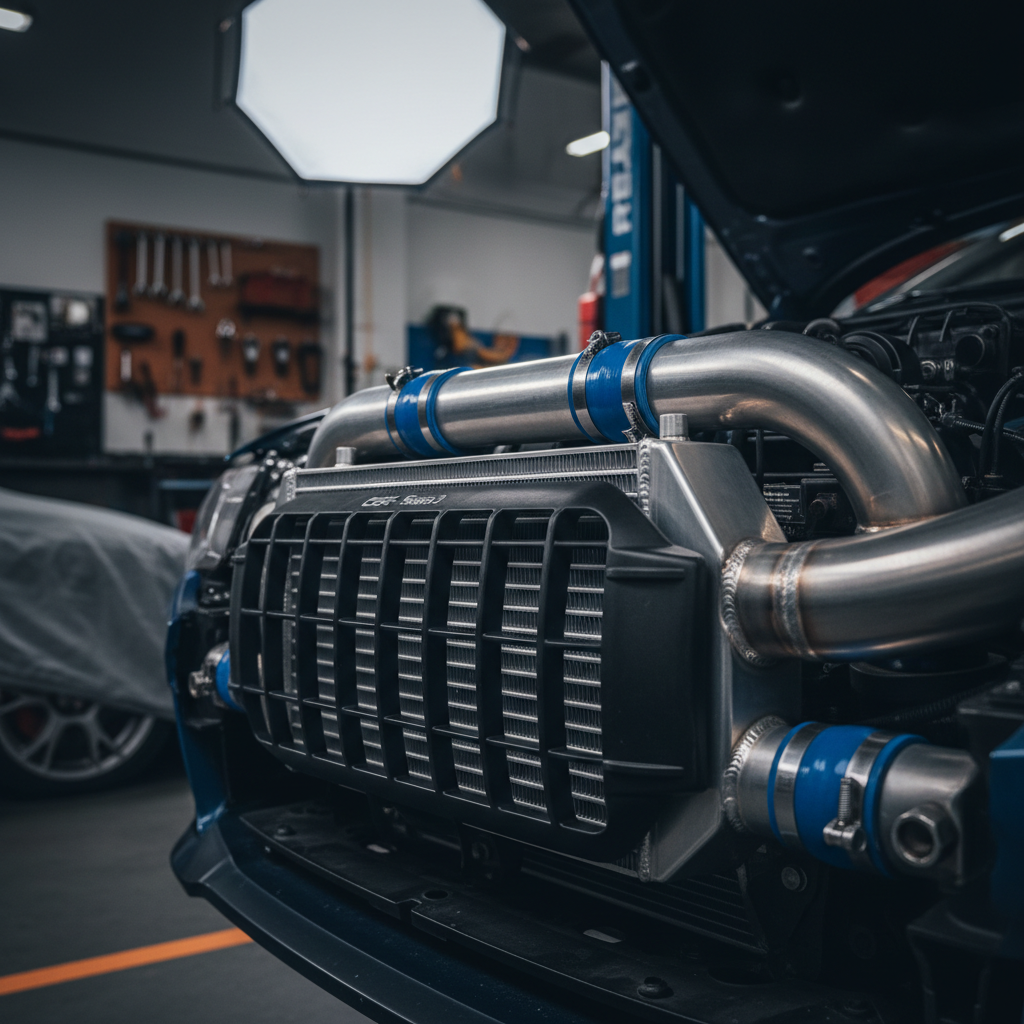
Why Bigger Intercoolers Don’t Always Make More Power
Bigger intercoolers don’t automatically make more power, and summer track season is about to teach that lesson the expensive way. The data consistently shows that a properly positioned smaller core with good airflow outperforms an oversized unit crammed into poor placement.
Quick Answer
- Intercooler efficiency depends more on airflow and placement than raw core size
- Oversized cores in poor positions create boost lag and heat soak under sustained load
- Pressure drop across the core matters more than absolute cooling capacity for street and track use
- Ambient airflow, not just core volume, determines real-world cooling performance
- Track sessions reveal intercooler weaknesses that dyno pulls miss
Intercooler efficiency: The measure of how effectively an intercooler reduces charge air temperature while minimizing pressure drop and boost lag. Size alone doesn’t determine efficiency, airflow and placement do.
What Intercooler Efficiency Actually Means
Real intercooler efficiency comes from three factors working together: heat transfer, pressure drop, and response time. The biggest core you can physically fit usually fails at least one of these. Heat transfer needs airflow, not just surface area. That massive front-mount blocking your radiator might have 40% more core volume, but if ambient air can’t flow through it properly, you’re just creating a heat sink that soaks and holds temperature.
Pressure drop kills response. Every PSI you lose across the intercooler is PSI your turbo has to work harder to replace. A 2.5 inch inlet/outlet core that drops 3 PSI under full boost hits your midrange harder than a smaller core with 1 PSI drop. Your boost gauge might read the same at WOT, but your actual cylinder pressure and torque curve tell the real story.
Response time separates street cars from track toys. That giant intercooler has internal volume your turbo needs to fill before you see boost. More volume equals more lag. On a road course where you’re constantly on and off throttle, boost response matters more than ultimate cooling capacity. The data from back-to-back track sessions proves this every time.
What the Data Actually Shows
Real-world testing consistently shows the same pattern. A properly sized intercooler with good airflow will maintain charge temps within 15-20°C of ambient during sustained load. An oversized core in poor placement often sees 35-40°C deltas under the same conditions, despite having more cooling capacity on paper.
Pressure drop numbers tell the story clearly. A well-designed setup typically shows 1-2 PSI drop across the core at 20 PSI boost. Poor implementations often hit 4-5 PSI drop, which your ECU compensates for by running more boost to hit target manifold pressure. Higher boost means higher compressor discharge temperatures, creating more heat for the intercooler to remove. You’re fighting yourself.
Boost response data reveals the hidden cost. A smaller, well-placed core typically hits 14.5 PSI (100 kPa) at 3200 RPM in second gear. The oversized alternative might not hit the same pressure until 3600 RPM. That 400 RPM difference represents a significant chunk of your powerband, especially on a road course where you’re using that midrange constantly.
Track session data exposes what dyno pulls hide. A dyno pull lasts 20 seconds with the intercooler starting at ambient temperature. A track session runs the intercooler at sustained high load for 20-minute stretches. Heat soak becomes the limiting factor, not peak cooling capacity. The smaller core that flows air properly often maintains consistent performance while the oversized unit heat soaks and starts pulling timing.
How to Actually Choose the Right Intercooler
Start with your airflow situation, not core dimensions. Look at where ambient air enters your intercooler and where it exits. If you’re blocking radiator airflow or creating turbulence behind the core, size won’t save you. Measure the actual airflow path and design around that constraint.
Calculate pressure drop at your target boost level. Most manufacturers publish flow bench data. Look for pressure drop numbers at your expected airflow rate, not just core efficiency ratings. Aim for under 2 PSI drop at your maximum boost level. Higher pressure drop costs you more power than marginal cooling gains provide.
Match core thickness to your application. Street cars and short track sessions can use thicker cores for maximum cooling efficiency per square inch of frontal area. Endurance racing or extended track use needs thinner cores that flow air easier and respond faster to changes in heat load.
Consider your piping routing carefully. Sharp bends and sudden diameter changes kill flow efficiency. A smaller core with smooth, large-radius piping often flows better than a larger core connected with tight bends and reducers. Your charge air doesn’t care about the core if it can’t get there efficiently.
Test with actual track conditions, not just pulls. Log charge air temperatures during sustained high-load driving, not just peak power runs. Real cooling efficiency shows up under extended load when ambient temperatures climb and airflow becomes critical.
What Goes Wrong When You Chase Size
The most expensive mistake happens when builders focus on core dimensions instead of system design. You end up with an intercooler that looks impressive but creates more problems than it solves. Boost lag increases, heat soak gets worse under sustained load, and pressure drop kills your midrange torque.
Radiator airflow gets compromised when oversized intercoolers block too much frontal area. Your engine cooling suffers, which increases overall underhood temperatures, which makes your intercooler work harder. It’s a cycle that gets worse under track conditions when ambient temperatures climb and track speeds reduce ram air effect.
Mounting becomes a nightmare with oversized cores. Poor mounting creates vibration, which leads to piping failures. Inadequate support causes core damage. Rushed mounting solutions often block airflow or create turbulence that kills efficiency. The installation ends up costing more than the part.
Tuning becomes more difficult because the system doesn’t respond predictably. Boost lag varies with temperature, pressure drop changes with load, and heat soak creates inconsistent performance. Your tuner spends more time compensating for intercooler problems instead of optimizing engine performance.
What’s the ideal pressure drop across an intercooler?
Aim for 1-2 PSI pressure drop across the core at your maximum boost level. Higher pressure drop forces your turbo to work harder to maintain manifold pressure, increasing discharge temperatures and reducing efficiency. Most quality intercoolers achieve under 2 PSI drop at 20 PSI boost levels when properly sized for the application. Pressure drop above 3 PSI typically indicates poor core selection or piping design.
How do I know if my intercooler is heat soaking?
Monitor charge air temperatures during extended high-load driving, not just peak power pulls. A properly functioning intercooler maintains charge temps within 15-20°C of ambient temperature under sustained boost. Heat soak shows up as climbing charge temps that don’t stabilize, often reaching 35-40°C above ambient after 10-15 minutes of hard driving. Your ECU will start pulling timing to compensate, which shows up as reduced power output despite stable boost pressure.
Does intercooler placement really matter more than size?
Absolutely. An intercooler needs airflow to function, and poor placement kills airflow regardless of core size. A smaller core with direct ambient airflow consistently outperforms a larger core in a heat-soaked location or blocked by other components. Placement determines both the quality of inlet air and the effectiveness of heat rejection. The best intercooler cores become paperweights without proper airflow design around them.
What’s the difference between intercooler efficiency on the dyno versus the track?
Dyno testing starts with the intercooler at ambient temperature and runs for 15-30 seconds maximum. Track conditions subject the intercooler to sustained heat load for 15-20 minute sessions with reduced ram air effect at lower speeds. Heat soak, which rarely appears on dyno testing, becomes the primary limiting factor during track use. Many intercoolers that test well on the dyno fail to maintain performance during actual track sessions due to inadequate sustained cooling capacity or airflow design.
Summer track season is coming, and your cooling system preparation matters more than your power mods. Get your airflow right before chasing bigger numbers. TorqueMetrics helps you analyze the real cooling performance data that separates effective setups from expensive mistakes.