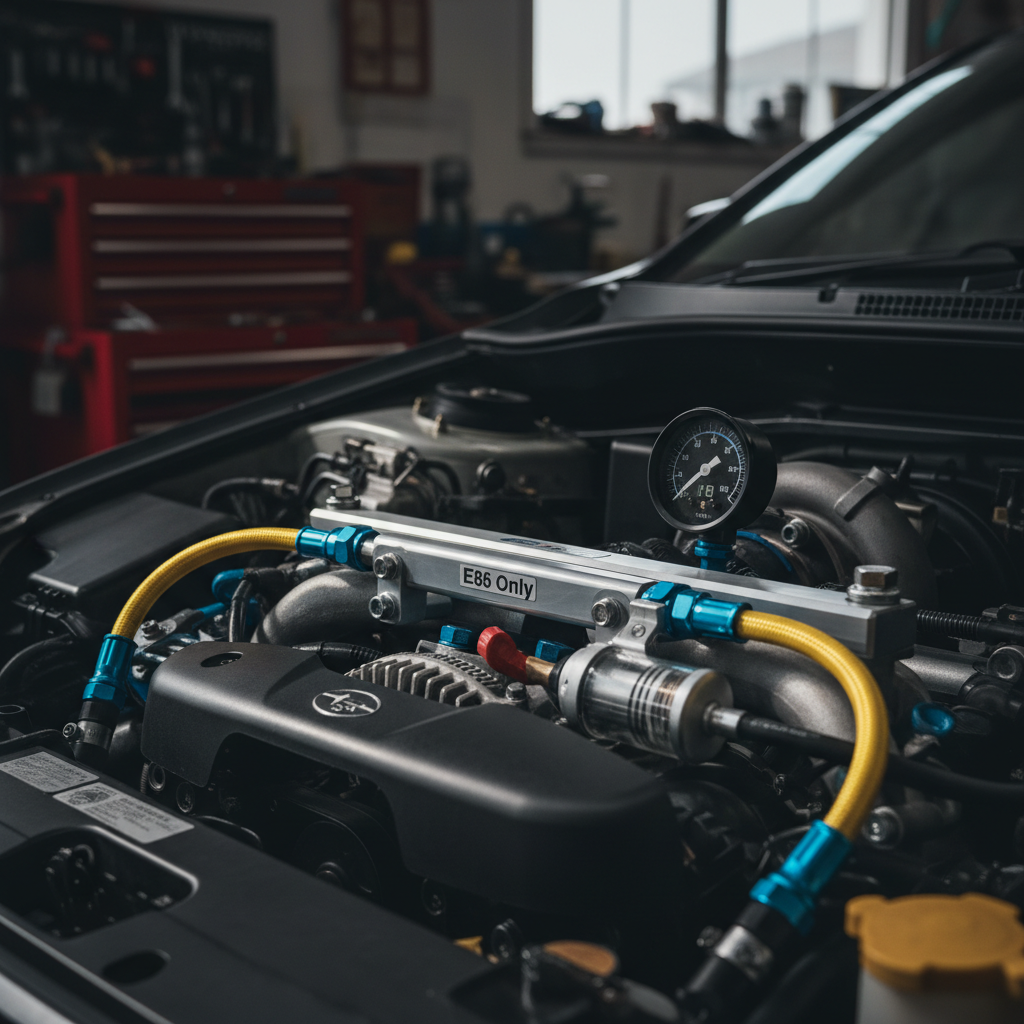
Why WRX Knock Sensors Go Crazy on E85 (It’s Not Octane)
Your knock sensor going ballistic on E85 isn’t a fuel problem, it’s a tuning problem. E85’s 105 octane rating doesn’t mean you can run pump gas AFR targets and timing curves. Most WRX owners switching to ethanol make the same mistake: they adjust for the fuel’s properties without understanding how combustion actually changes.
Quick Answer
- E85 requires 10.8-11.2 AFR under boost, not the 11.5-12.0 AFR used for 93 octane
- Ethanol burns 20-30% slower than gasoline, requiring advanced timing maps
- Higher fuel flow demands often exceed stock WRX injector capacity at 85% duty cycle
- Knock events increase when AFR goes lean past 11.3 on ethanol, regardless of octane rating
- EGT readings drop 50-80°C on proper E85 tune compared to pump gas
E85 knock events: Detonation occurring on ethanol fuel despite its high octane rating, typically caused by incorrect air-fuel ratios or timing maps designed for gasoline combustion characteristics.
What E85 Actually Does to Your WRX’s Combustion
E85 isn’t just high-octane gasoline. It’s a completely different fuel with different combustion properties, and your EJ25 or FA20 doesn’t know the difference until it starts knocking.
Ethanol has a slower flame front speed than gasoline. Where pump gas might complete combustion in 15-20 degrees of crank rotation, E85 needs 25-30 degrees. This slower burn means you need more aggressive timing advance to achieve peak cylinder pressure at the right moment. Most WRX owners dump in E85 and run their 93 octane timing maps, which leaves power on the table and can cause knock as the combustion event extends too far past TDC.
The fuel also requires 30-40% more volume than gasoline to achieve the same power output. Your stock 565cc injectors that were fine on pump gas might max out at 85% duty cycle trying to feed an E85 tune. When injector duty cycle hits that threshold, you’re not delivering enough fuel regardless of your target AFR. Lean conditions create knock, period.
E85’s cooling effect drops intake air temps 10-15°C compared to pump gas, but that doesn’t automatically prevent knock if your tune is wrong. Lower IATs help, but they can’t compensate for fundamental fueling or timing errors.
What Your Datalog Actually Shows on E85
Pull a proper WRX datalog on E85 and you’ll see specific patterns. AFR readings at WOT should sit between 10.8 and 11.2 under full boost. Anything above 11.3 and you’re asking for trouble, especially on stock internals pushing 18-20 PSI (124-138 kPa).
Ignition timing on E85 typically runs 3-5 degrees more aggressive than your 93 octane map. A WRX making 300whp on pump gas at 16 degrees of timing might see 19-21 degrees on ethanol at the same power level. The key difference: timing advance needs to be progressive. You can’t just add 4 degrees across the entire map and call it done.
Injector duty cycle becomes critical. Stock WRX injectors hit 85% duty cycle around 280-300whp on E85, depending on fuel pressure and base timing. Once you cross that threshold, fuel delivery becomes inconsistent and AFR goes lean in the worst possible way, under full boost and high RPM.
EGT readings tell the real story. Properly tuned E85 runs 50-80°C cooler than pump gas at the same power level. If your exhaust gas temps aren’t dropping significantly on ethanol, your tune isn’t taking advantage of the fuel’s properties.
How to Actually Tune E85 Without Destroying Your WRX
Start conservative and work up. Begin with your 93 octane timing map minus 2 degrees, then add timing incrementally while monitoring knock counts. E85 loves timing, but it needs to be added carefully and with proper fuel delivery.
Target 10.9 AFR under full boost initially. Once your tune is stable and knock-free, you can lean it out slightly toward 11.1, but never past 11.2. The power difference between 10.9 and 11.1 AFR on E85 is minimal, maybe 5-8 whp. The safety margin is worth more than those numbers.
Verify your fuel system can handle the demand. Calculate required injector duty cycle at your target power level. If you’re pushing past 80% duty cycle on stock injectors, upgrade before tuning. Running injectors at max capacity is how you get inconsistent fuel delivery and lean conditions that cause knock.
Map your timing advance progressively across the RPM range. E85 typically wants more timing in the midrange (3000-5000 RPM) where the slower burn rate really shows. At redline, the timing delta between pump gas and E85 narrows because there’s less time for the slower flame front to matter.
What Goes Wrong When WRX Owners Get E85 Tuning Wrong
The most common mistake is treating E85 like high-octane pump gas. Owners dump ethanol in their tank, add 3-4 degrees of timing across the map, and wonder why their knock sensor is going crazy. E85 requires a complete retune, not just timing adjustments.
Running too lean destroys the benefits of ethanol’s octane rating. An AFR of 12.0 on E85 creates the same knock conditions as 13.0 on pump gas. The cooling effect and octane rating can’t overcome fundamentally lean conditions, especially under boost.
Inadequate fuel system upgrades cause intermittent knock that’s hard to diagnose. Injectors maxing out don’t fail consistently, they deliver inconsistent fuel volume. Your AFR might read 11.0 most of the time but spike to 12.5 when injectors can’t keep up, causing knock events that seem random.
Ignoring the fuel’s seasonal variations causes problems year-round. Winter E85 blends drop to E70 or lower, changing combustion characteristics enough to require tune adjustments. Summer E85 at true E85 concentration burns differently than winter’s E70 blend, but most WRX owners run the same tune regardless.
Frequently Asked Questions
Why does my WRX knock on E85 when ethanol has higher octane than pump gas?
Higher octane doesn’t prevent knock if your air-fuel ratio or timing is wrong for the fuel. E85 requires different AFR targets (10.8-11.2 vs 11.5-12.0 for pump gas) and different timing curves because it burns slower than gasoline. Running pump gas tune parameters with ethanol creates the lean conditions and poor timing that cause knock, regardless of octane rating. The fuel’s properties matter more than just its octane number.
What AFR should I target on my WRX E85 tune?
Target 10.8-11.2 AFR under full boost on E85, with 10.9 being the sweet spot for most WRX builds. This is significantly richer than the 11.5-12.0 AFR used for 93 octane tunes. Going leaner than 11.3 AFR on ethanol creates knock conditions despite the fuel’s high octane rating. The richer mixture is necessary because E85 requires more fuel volume to achieve complete combustion and maintain the cooling effect that prevents detonation.
Can I run E85 on stock WRX injectors?
Stock 565cc WRX injectors max out around 280-300whp on E85 due to the fuel’s higher flow requirements. At 85% duty cycle, fuel delivery becomes inconsistent and creates lean conditions that cause knock. If you’re targeting more than 280whp or want safety margin, upgrade to 1000cc or larger injectors. Running maxed-out injectors on ethanol is how you get random knock events that are hard to diagnose because fuel delivery becomes intermittent under high demand.
How much more timing can I run on E85 compared to pump gas?
E85 typically allows 3-5 degrees more timing advance than 93 octane, but it must be added progressively across the RPM range. Start with your pump gas timing minus 2 degrees, then add timing incrementally while monitoring knock counts. E85’s slower burn rate means it benefits most from additional timing in the 3000-5000 RPM range. At redline, the timing difference narrows because there’s less time for the slower flame front propagation to matter. Never add timing globally without proper tuning and knock monitoring.
Getting E85 right in your WRX means understanding it as a different fuel, not just high-octane gasoline. The data doesn’t lie, proper AFR and timing targets prevent knock regardless of octane rating. Want to see exactly what your E85 tune is doing? TorqueMetrics helps you analyze the datalogs that matter, showing you the AFR, timing, and knock patterns that make the difference between a good tune and a grenaded motor.