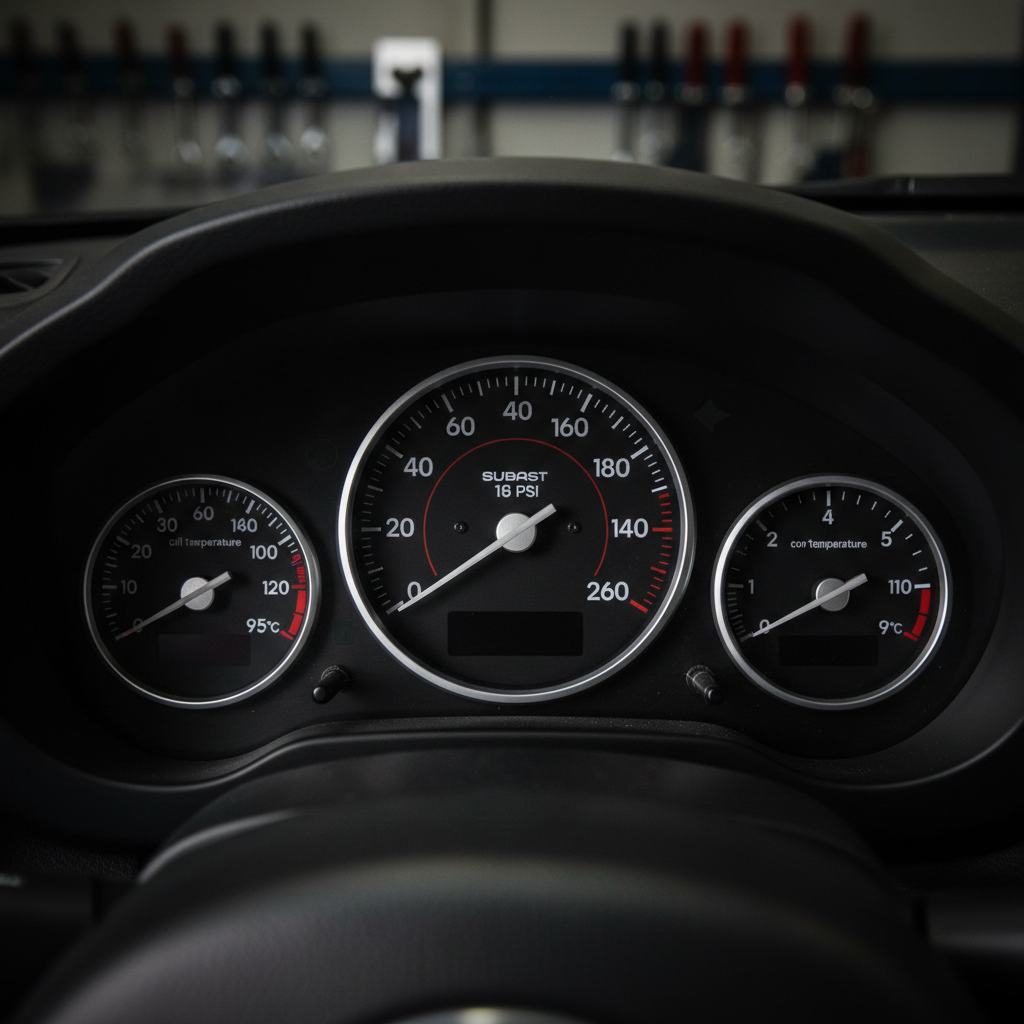
5 Critical WRX Gauges Your Dealership Never Mentioned
Your dealership sold you a WRX with 268 horsepower and a smile, but they conveniently forgot to mention the 5 gauges that determine whether you’ll still have that engine in 50,000 miles. While they’re busy explaining the infotainment system, your boxer engine is making decisions about knock retard, fuel trim, and boost control that could cost you thousands.
Quick Answer
- Boost pressure: Should stay under 15.2 PSI (105 kPa) on stock tune, spikes above 16 PSI indicate wastegate issues
- Air-fuel ratio: Target 10.8-11.2 under full boost, anything leaner than 11.5 risks detonation
- Knock count: Zero tolerance policy, any sustained knock above -1.41 degrees needs immediate attention
- Oil temperature: Keep under 110°C, sustained temps above 115°C break down oil viscosity
- Coolant temperature: Normal range 85-95°C, anything above 100°C indicates cooling system problems
Critical engine monitoring: The real-time data parameters that show whether your WRX is running safely or slowly destroying itself from the inside out.
Why These 5 Gauges Matter More Than Your Speedometer
The factory gauge cluster shows you speed, fuel level, and a basic temperature needle that’s about as useful as a chocolate teapot. Meanwhile, your ECU is tracking dozens of parameters that actually determine engine longevity. These 5 gauges represent the difference between a WRX that hits 150,000 miles and one that needs a rebuild at 60,000.
Boost pressure tells you if your turbo system is working correctly. AFR shows whether you’re getting the right fuel mixture for power and safety. Knock count reveals if your engine is trying to destroy itself. Oil temperature indicates whether your lubrication system can handle the heat you’re generating. Coolant temperature shows if your cooling system is keeping up with demand.
Most WRX owners drive by feel until something catastrophic happens. The data shows problems weeks or months before you feel them in the seat of your pants. A slight lean condition at high boost doesn’t feel different until your ringlands are scattered across the oil pan.
What the Numbers Actually Tell You
Boost pressure on a stock WRX should peak around 14.7-15.2 PSI (101-105 kPa) and hold steady. If you’re seeing spikes above 16 PSI or pressure that won’t hold steady, your wastegate actuator is failing or you have a boost leak. Sustained overboosting kills engines faster than any other single factor.
Air-fuel ratios under full boost should stay between 10.8 and 11.2 on premium pump gas. Anything leaner than 11.5 and you’re in the danger zone for knock and detonation. The factory ECU will pull timing to compensate, but it’s fighting a losing battle against physics. Rich isn’t necessarily safe either, anything below 10.5 is washing your cylinder walls and diluting your oil.
Knock count should be zero, period. The factory ECU reports knock retard in degrees of timing pulled. Occasional light knock (-1.41 degrees) on a hot summer day isn’t panic time. Sustained knock retard above -2.8 degrees means your engine is begging for help. Anything above -5.6 degrees and you need to stop driving immediately.
Oil temperature climbs fast under boost. Normal driving keeps oil temps around 85-95°C. Hard driving pushes temps to 100-110°C, which is acceptable for short bursts. Sustained temperatures above 115°C start breaking down oil viscosity and protective additives. Above 125°C and you’re cooking the oil into carbon deposits.
Coolant temperature should stay rock steady between 85-95°C under normal conditions. The factory thermostat opens at 82°C and the fans kick in around 95°C. If you’re seeing temps above 100°C during normal driving, your cooling system has problems. Above 105°C and you risk head gasket damage from thermal expansion.
How to Actually Monitor These Parameters
The factory gauge cluster is useless for serious monitoring. You need an OBD2 scanner that can log data in real time. Popular options include the Cobb AccessPort, which gives you boost, AFR, knock, and temps in real time. For less money, a basic OBD2 adapter with Torque Pro will pull the same data to your phone.
Set up alerts for critical thresholds: boost pressure above 16 PSI, AFR leaner than 11.5, sustained knock retard below -2.8 degrees, oil temps above 110°C, coolant temps above 100°C. These aren’t suggestions, they’re the numbers that separate engines that last from engines that don’t.
Log your drives, especially spirited ones. Pull the data afterward and look for patterns. Does your AFR lean out in third gear? Is knock count climbing on hot days? Are oil temps spiking after 10 minutes of hard driving? The patterns tell you where problems develop before they become expensive.
Real-time monitoring beats reactive maintenance every time. It takes 30 seconds to glance at your gauges and see that oil temps are climbing toward the danger zone. It takes 30 hours of labor to rebuild an engine that overheated because you trusted the factory temperature light.
What Happens When You Ignore the Data
The most expensive lesson new WRX owners learn is that these engines don’t fail gradually, they fail catastrophically. Ringland failure happens when sustained knock finally cracks the piston rings. One day you’re making full boost, the next day you’re looking at a $8,000 rebuild quote.
Lean AFRs under boost create detonation that sounds like marbles in a coffee can. The factory knock sensors try to compensate by pulling timing, but they’re reactive, not predictive. By the time knock retard shows up in your logs, detonation has already started hammering your pistons and rings.
Oil temperature abuse shows up as bearing wear and turbo failure. Oil temps above 125°C break down viscosity modifiers and turn your 5W-30 into something closer to water. The turbo’s center cartridge relies on oil for cooling and lubrication. Cooked oil equals cooked turbo, and turbo replacement starts around $3,000.
Cooling system neglect leads to head gasket failure, the WRX’s other notorious weak point. Sustained high coolant temps cause thermal expansion that warps the aluminum heads. Once the head gasket starts leaking, you’re looking at a complete top-end rebuild to fix the problem properly.
Frequently Asked Questions
What’s the most important gauge to monitor on a stock WRX?
Knock count is the most critical parameter because it’s the only one that shows immediate engine damage in progress. Boost spikes, lean AFRs, and high temperatures create conditions for knock, but knock retard shows you when those conditions are actually hurting your engine. A few degrees of knock retard on a hot day isn’t panic time, but sustained knock above -2.8 degrees means you need to back off immediately. Most ringland failures start with ignored knock retard that compounds over time.
How often should I check these gauges while driving?
During spirited driving, glance at your critical parameters every 30-60 seconds, similar to checking your mirrors. Focus on knock count and oil temperature first, then boost pressure and AFR. Set up audio or visual alerts for dangerous thresholds so you don’t have to constantly watch the screen. During normal commuting, a quick check every few minutes is sufficient. The key is making it habitual rather than reactive.
Can I rely on the factory warning lights instead of monitoring these gauges?
Factory warning lights are designed to protect the manufacturer from warranty claims, not to preserve your engine’s longevity. The oil temperature light doesn’t illuminate until temps reach dangerous levels, usually above 125°C. The coolant temperature light activates around 115°C, which is already hot enough to risk head gasket damage. By the time factory warnings appear, you’re often looking at expensive repairs rather than simple preventive measures.
What’s considered normal knock retard for a WRX during summer driving?
On premium pump gas during hot weather, occasional knock retard of -1.41 degrees is normal and nothing to worry about. The factory ECU is conservative and will pull timing as a precaution. However, sustained knock retard above -2.8 degrees indicates a real problem with fuel quality, timing, or engine health. Anything above -5.6 degrees requires immediate attention. Keep in mind that knock sensitivity increases with ambient temperature, altitude, and fuel quality.
Your WRX came with more performance potential than most owners ever use, but that potential comes with responsibility. The difference between a reliable enthusiast car and an expensive project is understanding what the data tells you before problems become failures. Start logging your drives, set up proper monitoring, and learn what normal looks like for your specific car. TorqueMetrics makes it easy to analyze your datalogs and spot patterns that predict problems before they cost you thousands.