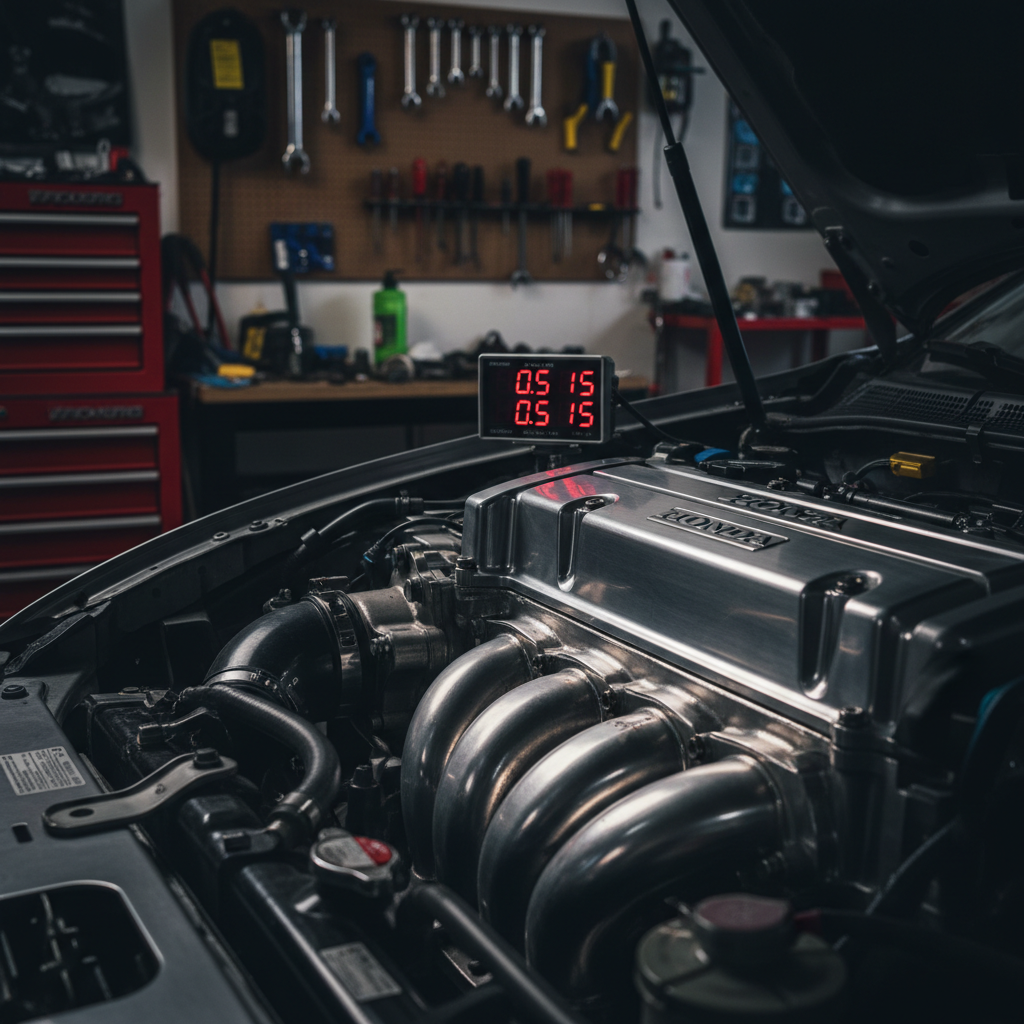
What AFR Should You Run on E85? Honda K20 Data Shows Why 10.5 Kills
Running 10.5 AFR on E85 doesn’t make your K20 safer than 11.5, it’s killing it differently. While everyone’s obsessing over lean conditions after the recent Civic Si engine failures, the data shows that over-fueling on E85 causes cylinder wash and oil dilution that destroys engines just as dead as lean conditions, just slower.
- Optimal E85 AFR for Honda K20 engines: 10.8-11.2 under full boost
- Running 10.5 AFR causes cylinder wash, washing oil off cylinder walls
- Oil dilution from over-fueling leads to bearing failure and ring wear
- Richer isn’t safer, it’s just a different way to kill your engine
- Monitor oil analysis data alongside AFR logs for complete picture
E85 AFR targeting: The air-fuel ratio that provides maximum power and engine protection when running ethanol fuel, typically 10.8-11.2 AFR for turbocharged Honda K20 engines under full boost conditions.
Why 10.5 AFR on E85 Isn’t Actually Safe
The conventional wisdom says richer is safer. That’s true to a point, but past 10.8 AFR on E85, you’re not buying safety, you’re buying different problems. When you dump that much fuel into the cylinder, physics doesn’t care about your good intentions.
Here’s what happens at 10.5 AFR on E85: excess fuel that can’t combust efficiently condenses on cylinder walls. This liquid fuel washes away the oil film that protects your cylinder walls and rings from metal-on-metal contact. Your engine doesn’t seize immediately like it would from detonation, but you’re grinding away at your ring package and cylinder walls every time you hit boost.
The data from recent K20 teardowns shows this clearly. Engines that failed after running 10.5 AFR for extended periods showed excessive ring wear, scored cylinder walls, and oil that tested positive for significant fuel dilution. These aren’t lean failures, these are wash failures. Different cause, same dead engine.
E85’s cooling properties don’t require the excess fuel that pump gas does. You can run 10.8-11.2 AFR and get better power with proper engine protection. Going richer than that starts working against you.
What the Datalog Actually Shows at Different AFR Targets
Real dyno data from multiple K20 Si builds reveals the sweet spot clearly. At 10.8 AFR on E85 with 18 PSI (124 kPa) of boost, you’ll see peak torque numbers with EGTs holding steady around 820-850°C post-turbo. Timing stays stable at 22-24 degrees advance without knock retard.
Drop to 10.5 AFR and watch what happens: power drops 8-12 whp, EGTs actually climb to 870-890°C because you’re not burning efficiently, and your lambda sensor readings start showing inconsistency as unburned fuel hits the exhaust. The engine isn’t running cooler, it’s running worse.
Push up to 11.5 AFR and you’re asking for trouble on the other end. EGTs spike over 950°C, timing gets pulled 4-6 degrees under load, and knock counts start appearing in your logs above 15 PSI (103 kPa). This is where the recent Si failures happened, owners chasing that last 5 whp by leaning out past the safety margin.
The data consistently shows 11.0-11.2 AFR as the reliability sweet spot for daily driven Si builds. You get 95% of peak power with a safety margin that protects against both knock and cylinder wash. Professional tuners working with these platforms for years keep coming back to this range because it works.
How to Actually Set AFR Targets for E85 on Your K20
Start with your base map at 11.2 AFR across the board for E85. This gives you room to optimize without going dangerous in either direction. Once you’re making clean power at that AFR, you can lean out the cruise areas to 12.0-12.5 for better fuel economy and pull timing out of low-load cells.
Under full boost, dial in 10.8-11.0 AFR depending on your setup. Stock internals with a conservative tune should stay at 11.0. Built motor with forged internals can safely run 10.8 if your injectors can keep up without maxing out. Never go richer than 10.8 unless you’re chasing a specific power target and monitoring oil samples religiously.
Your wideband placement matters here. Post-turbo bungs read differently than pre-turbo locations, especially on E85 where unburned fuel can skew readings. Most reliable setups use a post-turbo bung 18-24 inches downstream from the turbine housing, away from any heat sources that could create false lean readings.
Monitor your logs for consistency. Stable AFR readings that don’t swing more than 0.2 points under steady load indicate good fuel delivery and proper targeting. Wild swings suggest injector issues, fuel pressure problems, or MAP sensor errors that will bite you regardless of your AFR target.
The Hidden Damage from Running Too Rich on E85
Oil analysis tells the real story about over-fueling damage. Engines running 10.5 AFR on E85 show fuel dilution levels of 3-5% in oil samples after just 3,000 miles. That doesn’t sound like much until you realize it drops your oil’s viscosity enough to compromise bearing protection.
The fuel washing effect creates another problem: carbon buildup. Excess fuel that doesn’t burn completely leaves carbon deposits on valves and combustion chambers. These deposits create hot spots that promote knock and reduce compression over time. You end up with an engine that makes less power and needs more aggressive timing to maintain performance.
Cylinder wall scoring from fuel wash doesn’t announce itself with dramatic symptoms. Your oil pressure stays normal, coolant temps look fine, but every dyno session shows slightly less power than the last. Ring seal deteriorates gradually until you’re burning oil and losing compression. By the time you notice, you’re looking at a rebuild.
The bearing damage happens the same way. Fuel-diluted oil can’t maintain the hydrodynamic film that separates moving parts. Rod bearings take the worst of it, developing wear patterns that show up as metallic particles in oil analysis long before you hear any noise. This is why engines tuned too rich on E85 often fail during tear-down for “unrelated” modifications.
What AFR should I target for E85 on a stock turbo K20?
Run 11.0-11.2 AFR under full boost for maximum reliability on stock internals. This provides excellent power while maintaining proper cylinder lubrication and avoiding both knock and fuel wash. Cruise areas can run 12.0-12.5 AFR for better fuel economy. Avoid going richer than 10.8 AFR even under peak boost conditions.
How do I know if I’m running too rich on E85?
Watch for inconsistent AFR readings in your logs, elevated EGTs despite rich conditions, and black smoke from the exhaust under boost. Oil analysis showing fuel dilution above 2% indicates over-fueling problems. Power that drops when you go richer is another clear sign you’ve passed the optimal AFR range.
Can running 10.5 AFR on E85 actually damage my engine?
Yes, running 10.5 AFR causes cylinder wash that removes oil from cylinder walls and dilutes your crankcase oil. This leads to accelerated ring wear, cylinder wall scoring, and eventual bearing failure. The damage accumulates slowly but is just as terminal as lean-induced knock damage. Oil analysis will show fuel dilution and metallic particles indicating internal wear.
Why do some tuners still recommend 10.5 AFR for E85 safety?
Many tuners learned on pump gas where richer always meant safer from knock. E85’s different combustion characteristics and cooling properties change this equation. Professional tuners working with E85 extensively have moved to 10.8-11.2 AFR targets because the data shows better power and reliability in that range. Outdated information persists because over-fueling failures take longer to manifest than lean failures.
Getting your E85 AFR targets right means understanding that more fuel isn’t automatically safer. The sweet spot for K20 engines sits at 10.8-11.2 AFR under boost, where you get maximum power without the hidden damage of cylinder wash or the obvious risks of running lean. TorqueMetrics makes it easy to analyze your AFR data alongside EGTs, knock counts, and timing to dial in the perfect balance for your setup.