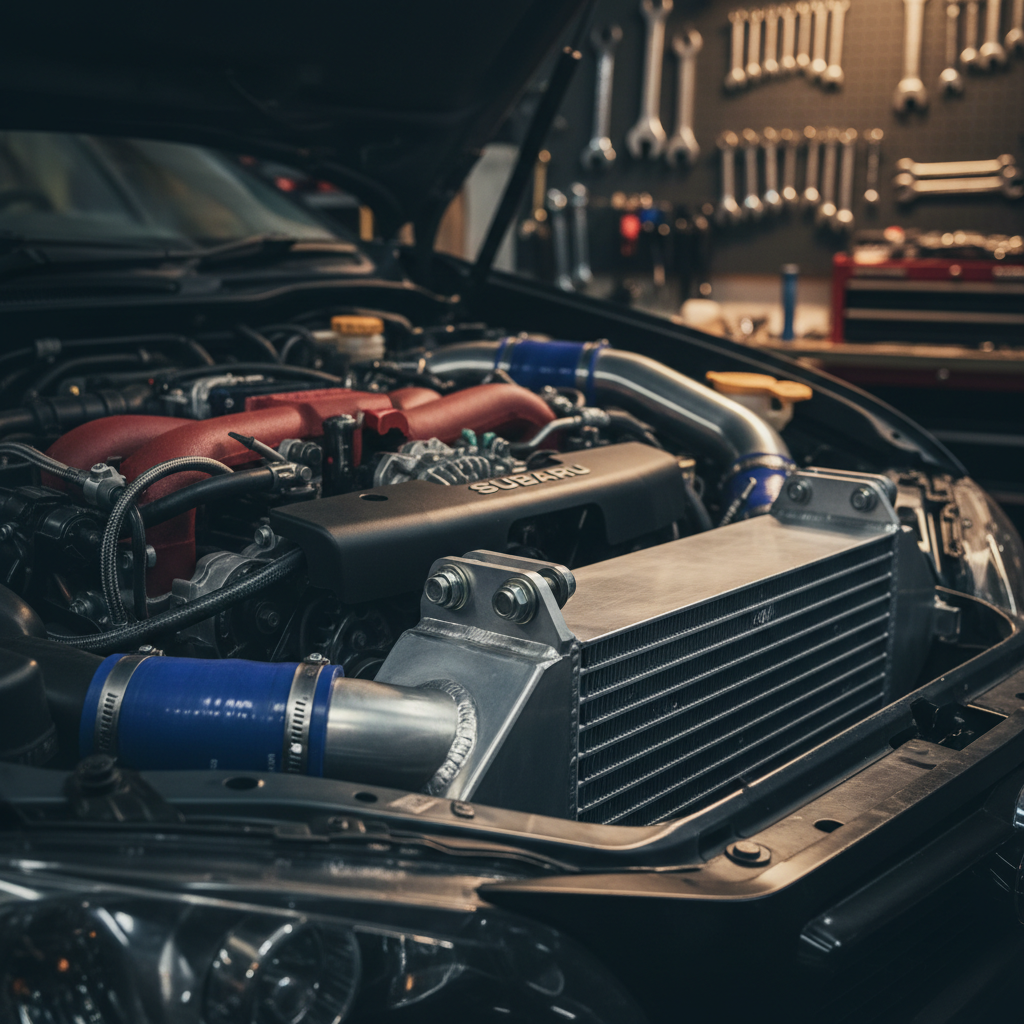
Why Aftermarket Intercoolers Cause False Knock in STI Engines
Your aftermarket front-mount intercooler is doing its job perfectly, intake temps dropped 20°C, AFRs are sitting at textbook 11.2:1 under boost, but your knock sensors are registering events that shouldn’t exist. The culprit isn’t your tune or fuel system, it’s the fundamental change in how vibrations travel through your engine bay after swapping that heavy stock top-mount for a lightweight front-mount setup.
Quick Answer
- Aftermarket intercoolers alter engine bay mass distribution, changing natural vibration frequencies
- STI knock sensors detect vibrations in the 6-8 kHz range, which shifts when intercooler placement changes
- False knock shows as random, low-count events (1-3 counts) across multiple cylinders simultaneously
- Real knock concentrates in specific cylinders and correlates with boost/load conditions
- Proper knock sensor recalibration or relocation often solves the issue permanently
False knock detection: When knock sensors register vibration events that aren’t actually detonation, typically caused by changes in engine bay resonance frequencies that shift the sensor’s detection range away from true knock signatures.
What Actually Happens When You Swap Intercoolers
The EJ25 knock detection system relies on piezoelectric sensors tuned to detect specific frequency signatures between 6-8 kHz. These sensors are calibrated from the factory based on the stock intercooler’s mass and mounting position. When you remove 15 pounds of aluminum and piping from the top of your engine and relocate it to the front bumper, you fundamentally alter how vibrations propagate through the engine bay.
Your engine block becomes the primary mass in a system that previously included the top-mount intercooler as a vibration dampener. This changes the resonant frequency of the entire assembly. What used to be filtered out as normal engine noise now falls within the knock sensor’s detection window. The result is phantom knock events that show up in your logs even when everything else looks perfect.
The timing is rarely random. Most STI owners see this issue appear within the first few hundred miles after intercooler installation, often during the first serious pull session when they’re finally seeing those improved intake temps pay off. The irony is brutal: your engine is running better than ever, but the knock detection system thinks it’s falling apart.
Reading the Data: False vs Real Knock Signatures
Real knock has a signature in your datalogs that’s unmistakable once you know what to look for. It concentrates in specific cylinders, typically cylinder 4 first since it runs hottest, and correlates directly with boost and load conditions. You’ll see knock counts climb as boost builds, especially in higher gears under sustained load. Real knock also responds predictably to timing changes: pull 2 degrees and it disappears.
False knock from intercooler swaps behaves completely differently. It appears randomly across all cylinders, often showing 1-2 counts simultaneously on cylinders that have no business knocking together. The counts don’t correlate with boost levels, intake temps, or AFR changes. Most telling, false knock often appears during steady-state cruising at 2-3 PSI of boost where detonation is physically impossible.
In your logs, false knock events typically show up as scattered single-count events rather than the climbing pattern of real knock. You might see cylinder 1 register one count, then cylinder 3 two counts, then nothing for several seconds, then cylinder 2 and 4 together. Real knock builds predictably: cylinder 4 gets 3 counts, then 5, then 8 as conditions worsen.
The AFR and timing data surrounding false knock events will look perfect. You’ll see 11.0-11.3 AFR under boost with timing advance holding steady at your target values. Real knock events coincide with lean spikes, excessive timing advance, or high intake air temps, none of which appear in false knock scenarios.
Fixing False Knock Detection After Intercooler Swaps
The most effective solution is knock sensor recalibration through your engine management system. Professional tuners can adjust the frequency response windows and sensitivity thresholds to account for the new vibration characteristics. This typically involves datalog analysis during controlled knock conditions (yes, intentionally inducing light knock) to establish the new baseline signatures.
Physical relocation sometimes works better than recalibration. Some tuners relocate knock sensors to different positions on the block where they’re less affected by the altered vibration patterns. The key is finding mounting points that maintain sensitivity to real knock while filtering out the new false signatures.
Adding strategic mass back to the engine bay can restore some of the original dampening characteristics. This doesn’t mean reinstalling your top-mount, but rather adding vibration dampening materials or relocating other components to restore some mass distribution balance. Some shops install small dampening weights on the intake manifold or valve covers.
Quick diagnostic test: if your knock counts disappear when you temporarily reduce knock sensor sensitivity by 20-30%, you’re dealing with false positives. Real knock will still register even with reduced sensitivity, but false signals from vibration issues often fall below the threshold.
What Goes Wrong When People Ignore This Problem
The worst outcome is overcompensation. Owners see knock counts in their logs and start pulling timing aggressively, dropping from 18 degrees advance to 12 degrees trying to make the phantom knock disappear. You end up with a tune that’s 50-60 wheel horsepower down from where it should be, all to chase ghosts in the knock detection system.
Some owners go the opposite direction and disable knock protection entirely, assuming all their knock events are false. This is catastrophic if you actually do encounter real knock conditions. One session with bad fuel or a boost leak can destroy your engine when knock protection is defeated.
The middle-ground mistake is constantly second-guessing your tune. Owners spend months chasing perfect logs, changing maps every few hundred miles, never realizing the issue is mechanical rather than calibration-based. This leads to inconsistent performance and unnecessary wear from constant retuning.
Professional diagnosis gets expensive when the root cause isn’t identified. Some owners spend thousands on dyno time and custom tuning trying to eliminate knock that was never real to begin with. The vibration frequency issue is often missed because it’s not widely documented in tuning guides.
Why doesn’t this happen with all aftermarket intercoolers?
The mass difference between stock and aftermarket setups varies dramatically between manufacturers. A lightweight tube-and-fin FMIC might only weigh 8 pounds compared to the stock unit’s 15 pounds, creating significant mass distribution changes. Heavier bar-and-plate designs closer to stock weight cause fewer vibration issues. The mounting method also matters: solid-mounted intercoolers transfer vibrations differently than rubber-mounted units, affecting how frequency changes propagate to the knock sensors.
Can you prevent this issue during installation?
Pre-installation knock sensor baseline logging helps identify changes immediately after the swap. Some experienced installers add vibration dampening materials during intercooler installation, particularly around knock sensor mounting areas. Choosing intercoolers with mounting systems that minimize vibration transfer can reduce the likelihood of false knock issues. However, the mass distribution change is unavoidable with any top-mount to front-mount conversion, so some degree of recalibration is often necessary regardless of precautions taken.
How long does professional recalibration take?
Knock sensor recalibration typically requires 2-3 hours of dyno time for proper baseline establishment and validation testing. The tuner needs to induce controlled knock conditions to map the new frequency signatures, then verify the calibration across different load and boost conditions. Most shops charge $300-500 for this service, which includes the recalibration and verification pulls. DIY recalibration through standalone ECUs can take several weeks of careful logging and adjustment to achieve professional-level results.
Does this affect other Subaru models besides the STI?
WRX models with similar EJ engines experience the same issue, though the frequency changes may differ slightly due to engine mount differences and knock sensor positioning. Legacy GT and Forester XT models also show this problem after intercooler swaps, particularly the 2004-2008 models with similar knock detection systems. Non-turbo Subaru models don’t experience this issue since they lack the knock sensors and intercooler systems that create the problem. The FA20 engines in newer WRX models have different knock detection calibrations and show less sensitivity to intercooler-related vibration changes.
Understanding false knock signatures in your datalogs saves you from chasing problems that don’t exist and helps you tune for actual performance instead of phantom issues. TorqueMetrics can help you identify these patterns in your logs and distinguish real knock events from vibration-induced false positives, giving you the confidence to tune for maximum performance safely.