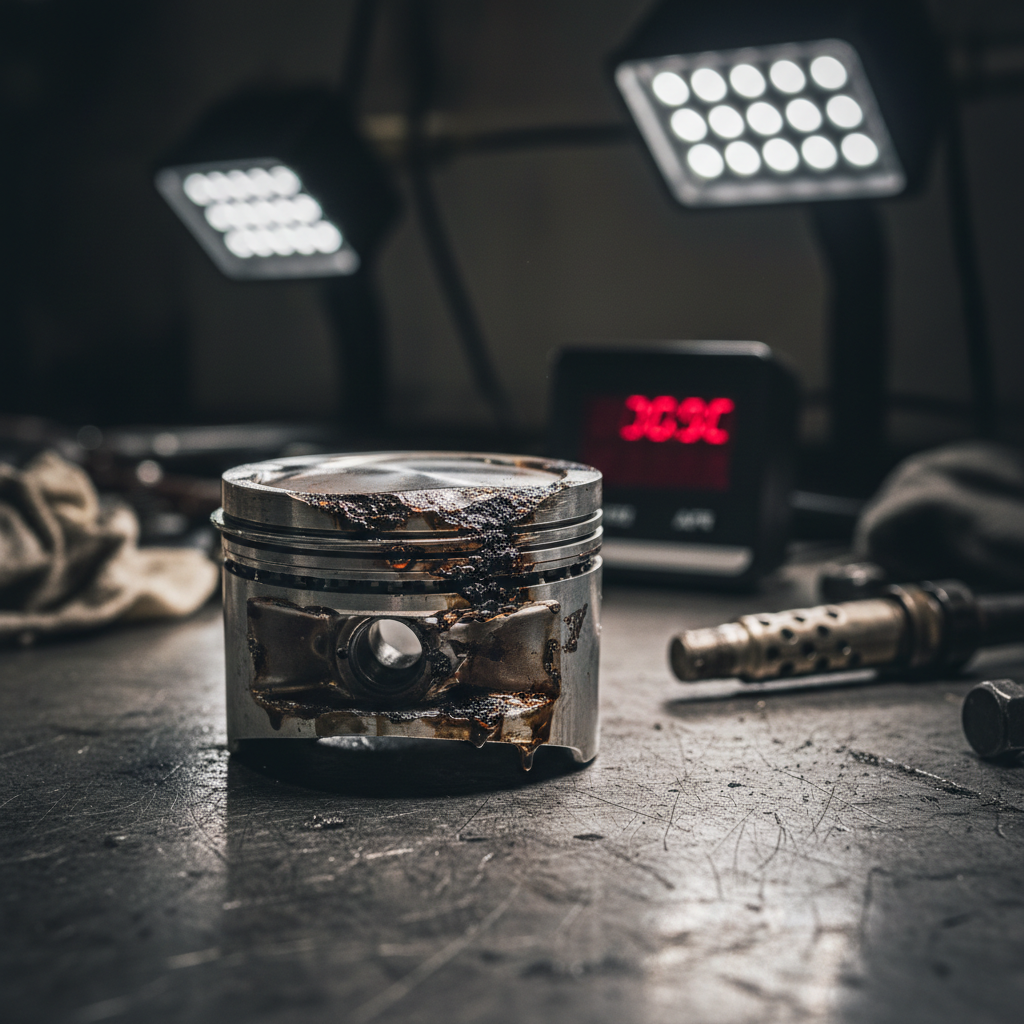
Why Cheap ECU Tunes Cause Expensive Engine Damage
Cheap ECU tunes destroy more turbocharged engines than boost leaks and bad gas combined. The typical scenario: someone saves $500 on a tune, runs lean under boost for a few hundred miles, then faces an $8,000 engine rebuild when the pistons decide they’ve had enough.
Quick Answer
- Proper AFR monitoring during tuning catches lean conditions that destroy engines within minutes under boost
- Target AFR for turbocharged engines: 10.8-11.2 under full boost, 11.5-12.5 at cruise
- Knock monitoring is non-negotiable — 4+ degrees of timing retard means your tune is damaging your engine
- Real-time wideband logging costs $200-400 but prevents thousands in rebuild costs
- Mail-order tunes without proper logging data are gambling with your engine’s life
ECU tuning failure: When an engine control unit modification lacks proper air-fuel ratio monitoring or knock detection, causing the engine to run dangerously lean or with excessive timing advance under load, typically resulting in piston damage, bearing failure, or complete engine destruction.
What Actually Happens When Tunes Go Wrong
The physics are brutal and predictable. Your engine needs approximately 14.7 parts air to 1 part fuel for complete combustion at atmospheric pressure. Under boost, you need significantly more fuel, not just for power but for cooling. When your AFR climbs past 12.5:1 under 15+ PSI of boost, you’re running lean enough to melt pistons.
Here’s what the data shows right before things go sideways: intake air temps climbing past 60°C, AFR readings bouncing between 12.8-13.5:1 under full boost, and knock counts accumulating faster than your ECU can pull timing. Most ECUs will retard timing 6-8 degrees trying to save themselves, but by then the damage is already happening.
The failure mode is consistent across platforms. Piston crown temps exceed 300°C, the aluminum starts to soften, and you get micro-seizures between the piston and cylinder wall. Rod bearings follow next, starved of oil as the clearances change and oil pressure drops. The engine doesn’t just stop, it destroys itself from the inside out.
I’ve seen this exact scenario play out on everything from modified WRXs to built 2JZs. The tune looked fine on the dyno for 20 minutes, but real-world sustained boost revealed the truth. No amount of octane or quality fuel can save an engine that’s fundamentally running too lean under load.
What the Data Actually Shows During Tuning
Proper tuning requires continuous AFR monitoring, not spot checks. Your wideband sensor should be logging at 10Hz minimum during dyno pulls. On a healthy turbocharged tune, you’ll see AFR drop from 14.0:1 at idle to 11.0-11.2:1 the moment boost builds past 5 PSI.
The numbers tell the story immediately. Safe boost tuning shows AFR staying between 10.8-11.2:1 from 3,000 RPM to redline under full load. Timing advance should be 18-22 degrees at peak torque, with knock retard staying under 2 degrees total. Intake air temps need to stay below 50°C for consistent power, below 40°C for aggressive timing.
Dangerous tunes show different patterns. AFR readings above 12.0:1 under boost, timing retard accumulating past 4 degrees, and IAT climbing above 70°C during sustained pulls. These aren’t minor tuning issues, they’re warnings that your engine is operating outside safe parameters.
The expensive lesson most people learn too late: mail-order tunes can’t account for your specific setup. Your intercooler efficiency, fuel pump capacity, and injector flow rates all affect the final AFR. A tune that works perfectly on a stock fuel system can run dangerously lean with upgraded injectors if the scaling isn’t adjusted properly.
How to Prevent Expensive Tuning Failures
Install a wideband oxygen sensor before you touch the tune. This isn’t optional equipment, it’s insurance. A proper wideband setup costs $300-400 and provides real-time AFR data that prevents thousands in damage. Mount it 18-24 inches downstream from the turbo, never in the downpipe right at the housing.
Log everything during the tuning process. Your datalog should capture AFR, timing advance, knock retard, boost pressure, and intake air temperature at minimum. Most ECUs can log at 10-20Hz, which gives you enough resolution to catch brief lean spikes that destroy engines.
Set conservative targets initially. Start with AFR at 10.5:1 under boost and gradually lean it out while monitoring knock. Most engines make peak power around 11.0-11.2:1, but finding that sweet spot safely requires methodical testing with proper instrumentation.
Work with a tuner who uses your actual data, not generic maps. Professional tuners will request logs from your specific car before writing custom calibrations. They’ll ask about your fuel system, intercooler setup, and intended use. Anyone offering a tune without this information is guessing.
Never skip the knock detection calibration. Your ECU needs to know what knock sounds like on your specific engine. This requires setting up the knock sensor properly and often involves adjusting sensitivity tables for your engine’s acoustic signature.
What Goes Wrong When People Cut Corners
The most expensive mistake is trusting a tune without verification. I’ve seen too many builds destroyed by owners who installed a mail-order tune, drove it hard immediately, and never checked the actual AFR under boost. The tune might have been perfect for the original car, but injector tolerances, fuel pump variations, and altitude differences can shift AFR by 0.5-1.0 points.
Running without knock detection is gambling with physics. Even premium 93 octane fuel can’t prevent knock if your timing maps are too aggressive for your setup. Ethanol blends help, but E85 still requires conservative timing if your intercooler can’t keep intake temps reasonable. I’ve seen engines knock themselves to death on E85 because the tuner assumed the fuel would handle anything.
Ignoring intake air temperatures destroys more engines than most people realize. Heat soak from inadequate intercoolers can push IAT above 80°C during back-to-back pulls. At those temperatures, your effective octane rating drops significantly, and even conservative timing becomes too aggressive.
The false economy of cheap tuning becomes expensive quickly. A $300 tune that destroys a $5,000 engine costs $4,700 more than doing it right the first time. Professional tuning with proper instrumentation typically runs $800-1,500, but it includes the data logging and verification that prevents catastrophic failure.
How do I know if my tune is running too lean under boost?
Install a wideband oxygen sensor and log AFR during full-throttle pulls. Safe AFR under boost should be 10.8-11.2:1 on gasoline, 10.5-11.0:1 on E85. If you’re seeing readings above 12.0:1 under sustained boost, stop driving immediately. Also monitor knock retard, intake air temps, and exhaust gas temperatures if available. Consistent knock retard above 3-4 degrees indicates your tune is too aggressive for your setup.
What data should my tuner request before writing a custom calibration?
A professional tuner needs logs showing your current AFR under various load conditions, boost pressure curves, intake air temperatures, and knock activity. They should also ask about your specific modifications including fuel system upgrades, intercooler setup, exhaust configuration, and intended fuel type. Any tuner offering custom calibration without requesting this baseline data is working blind and putting your engine at risk.
Can a mail-order tune safely work on my modified turbo engine?
Mail-order tunes can work, but only with proper verification and safety margins built in. The tune should run conservatively rich (10.5-10.8:1 AFR under boost) to account for variations in fuel systems and environmental conditions. You must verify the actual AFR with a wideband sensor and monitor knock retard continuously. Never assume a mail-order tune is safe without confirming the actual air-fuel ratios on your specific setup.
What’s the difference between dyno tuning and street tuning for reliability?
Dyno tuning optimizes for peak power under controlled conditions, but street tuning accounts for real-world variables like heat soak, altitude changes, and fuel quality variations. Street tunes typically run slightly richer AFR targets (11.0-11.2:1 vs 10.8-11.0:1 on the dyno) and more conservative timing to handle these variables. Both approaches require proper wideband monitoring and knock detection, but street tunes prioritize longevity over maximum power output.
Your engine build represents thousands of dollars and hundreds of hours. Protecting that investment requires proper tuning with real-time monitoring, not gambling on cheap solutions. TorqueMetrics can help you analyze your tuning data and identify potential issues before they become expensive failures.