Why Your $3000 Turbo Makes Less Power Than Expected: ECU Limits
Your $3000 turbo upgrade just dyno’d at 20hp less than expected, and you’re staring at the numbers wondering what went wrong. The problem isn’t your turbo, your intercooler, or even your tune, it’s your ECU hitting hard-coded limitations that choke airflow calculations when you exceed factory parameters.
Quick Answer
- Stock ECUs calculate fuel delivery using airflow tables that max out around 85-90% of factory boost targets
- Going beyond these limits forces the ECU into “limp mode” fuel delivery, cutting timing and richening the mixture
- A reflash costs $500-800 but unlocks the full potential of your hardware upgrades
- Standalone ECUs eliminate these restrictions entirely but require custom tuning and harness work
- Data logging reveals the exact moment your ECU hits these limits through timing pull and fuel trim corrections
ECU airflow limitations: Hard-coded restrictions in factory engine management that prevent proper fuel and timing calculations when modifications exceed the original design parameters, forcing conservative fueling that kills power gains.
What ECU Airflow Limits Actually Mean for Your Build
Every factory ECU calculates fuel delivery using lookup tables based on airflow measurements from your MAF or MAP sensor. These tables are sized for the factory turbo’s maximum output plus a safety margin, typically ending around 85-90% of the stock boost ceiling. When your bigger turbo pushes airflow beyond these table limits, the ECU doesn’t extrapolate, it defaults to the last known good value and adds massive fuel corrections.
The result looks like this in your datalog: timing gets pulled 4-6 degrees, your fuel trims go rich by 15-20%, and boost tapers off early even though your turbo has more to give. Your expensive hardware is physically capable of making power, but the ECU is actively preventing it. This isn’t a tuning problem you can fix with an off-the-shelf map. The limitation is baked into the ECU’s operating system.
Most people blame the tune when they see flat power curves after big turbo swaps. The tune is working exactly as designed, the ECU just can’t see past its own programming limits. This is why a stock location turbo upgrade with 30% more flow capacity might only net you 15% more power. The ECU is cutting your gains in half.
What Your Datalog Shows When You Hit ECU Limits
The telltale signs show up clearly in your logs if you know what to look for. Airflow readings will flatline around 280-320 g/s on most turbo four-cylinders, even though your turbo is flowing another 50-80 g/s that the ECU can’t measure. Your short-term fuel trims (STFT) will peg rich at +25% or more, and long-term trims follow suit within a few pulls.
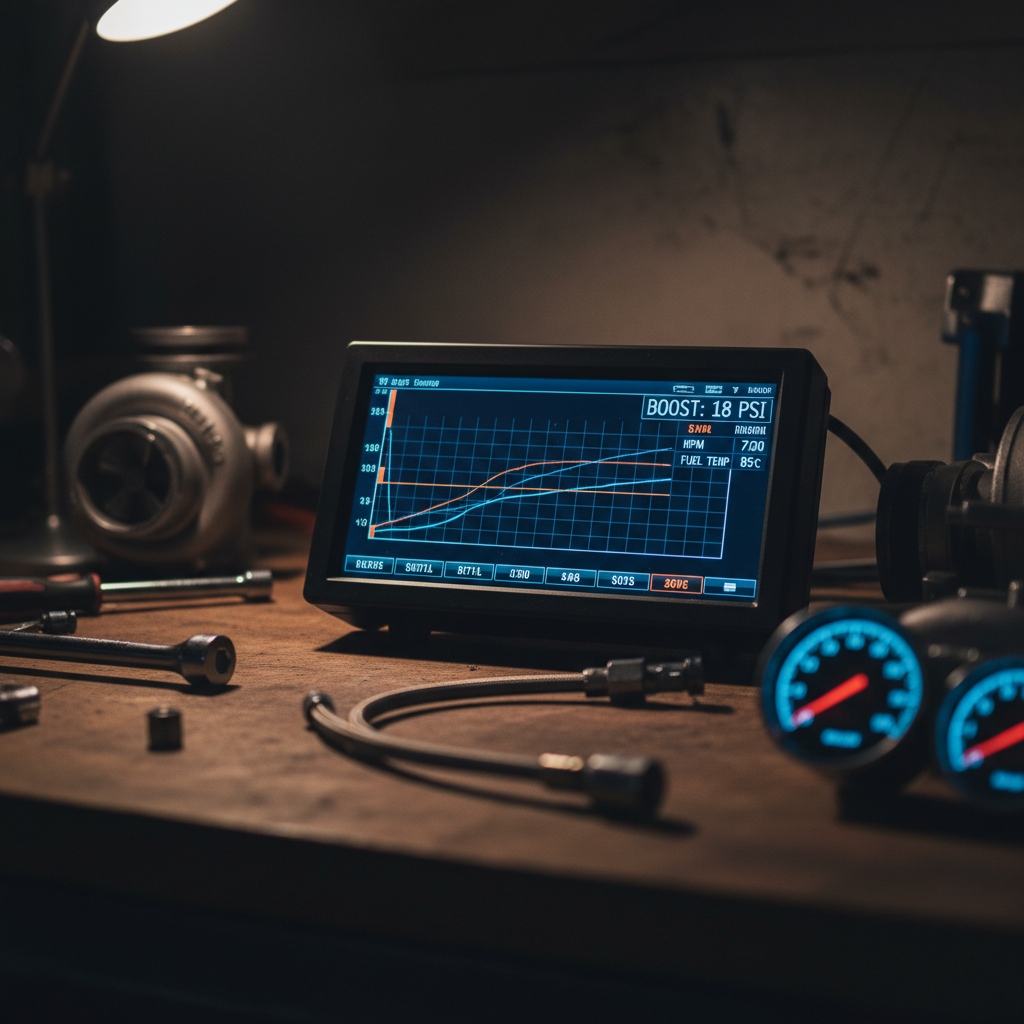
Timing advance starts getting pulled aggressively, not because of knock but because the ECU thinks it’s running dangerously lean when it’s actually rich. You’ll see 6-8 degrees of timing pull at peak torque, sometimes more. Boost pressure hits a wall around 18-20 PSI (124-138 kPa) and won’t climb further despite your wastegate being set higher.
The most revealing data point is the relationship between your calculated load and actual airflow. Stock ECUs typically max out calculated load around 95-98%, even when actual airflow suggests you should be seeing 110-120%. That missing 15-25% of load calculation directly translates to lost power. Your engine is moving more air than the ECU knows how to fuel properly.
Temperature corrections also get weird when you exceed ECU limits. Intake air temperature readings might show normal values while your intercooler outlet is actually 15-20°C hotter than the ECU thinks. This happens because the temperature compensation tables assume certain airflow ranges, and extrapolation beyond those ranges produces garbage data.
How to Fix ECU Limitations and Unlock Your Hardware
A reflash solves most ECU limitation issues for $500-800, depending on your platform. The tuner extends the airflow tables, adjusts the load calculations, and recalibrates the fuel maps to handle your new flow rates. This isn’t just a tune, it’s actually rewriting the ECU’s operating parameters to recognize higher airflow values as normal operating conditions.
Platform matters here. Subarus and Mitsubishis respond well to reflashes because their ECU architecture allows table extensions. German cars, especially VAG products, often hit hard limits that can’t be easily modified. BMW and Mercedes have sophisticated anti-tamper systems that make reflashing more complex and expensive.
Standalone ECUs eliminate these problems entirely but require more work. A Haltech, AEM, or Link ECU doesn’t have factory airflow restrictions because you’re building the maps from scratch. You’ll spend $2000-3500 for the ECU, harness, and initial tune, but you get unlimited scalability. Your $3000 turbo can finally make the power it was designed for.
Data logging becomes crucial during the reflash process. Your tuner needs to see exactly where the factory limits kicked in to know how far to extend the tables. Without proper logging, they’re guessing at the boundaries, which usually means leaving power on the table or pushing into unsafe territory.
Common Mistakes That Waste Money and Kill Reliability
The biggest mistake is assuming a bigger turbo automatically means more power with just a tune. You’ll spend $3000 on hardware and another $800 on tuning, only to find your ECU can’t support the modification properly. The gains are there, but they’re trapped behind factory limitations that require more than just fuel and timing adjustments.
Running higher boost to compensate for ECU limitations makes things worse. When your ECU can’t calculate load properly, it defaults to rich fueling and conservative timing. Adding more boost just makes the ECU more confused, pulling more timing and adding more fuel. You end up with higher EGTs, more heat, and less power despite the extra pressure.
Another common error is mixing budget modifications with expensive turbo upgrades. Your stock fuel system, factory intercooler, and OEM downpipe create additional bottlenecks that compound the ECU limitations. The ECU gets bad data from inadequate supporting modifications and responds with even more conservative fueling strategies.
Ignoring the ECU limitations and just “sending it” leads to inconsistent performance and eventual failure. The ECU’s safety systems are still active, they’re just confused about what’s actually happening. You get random power cuts, inconsistent boost control, and eventually limp mode activation when the ECU decides something is seriously wrong.
Why doesn’t my new turbo make the advertised power?
Your stock ECU has airflow tables that max out around 85-90% of factory boost levels. When your bigger turbo exceeds these limits, the ECU defaults to conservative fueling and timing, killing power gains. The turbo is capable of the advertised power, but your ECU can’t manage the extra airflow properly. A reflash or standalone ECU solves this by extending the airflow calculations beyond factory limits.
Can I just turn up the boost to make more power with ECU limitations?
No, adding more boost when your ECU can’t calculate load properly makes things worse. The ECU will pull more timing, add more fuel, and eventually trigger safety systems. You’ll see higher EGTs and less power despite the extra pressure. The solution is fixing the ECU’s airflow calculations, not overwhelming them with more boost.
How much does it cost to fix ECU airflow limitations?
A reflash costs $500-800 and solves most ECU limitation issues on popular platforms like Subaru and Mitsubishi. More complex ECUs like VAG, BMW, and Mercedes may require standalone systems costing $2000-3500 including installation and tuning. The investment pays for itself by unlocking the full potential of your existing hardware modifications.
What platforms have the worst ECU limitations for turbo upgrades?
German cars typically have the most restrictive ECU limitations, especially VAG products with sophisticated anti-tamper systems. BMW and Mercedes use complex load calculation methods that don’t respond well to simple table extensions. Japanese platforms like Subaru, Mitsubishi, and Nissan are generally more modification-friendly with ECUs that allow easier reflashing and table extensions.
Your expensive turbo upgrade deserves an ECU that can actually manage it properly. TorqueMetrics helps you identify exactly where your factory ECU hits its limits, so your tuner knows precisely what needs to be fixed. Stop leaving power on the table because your ECU can’t see what your hardware is actually doing.