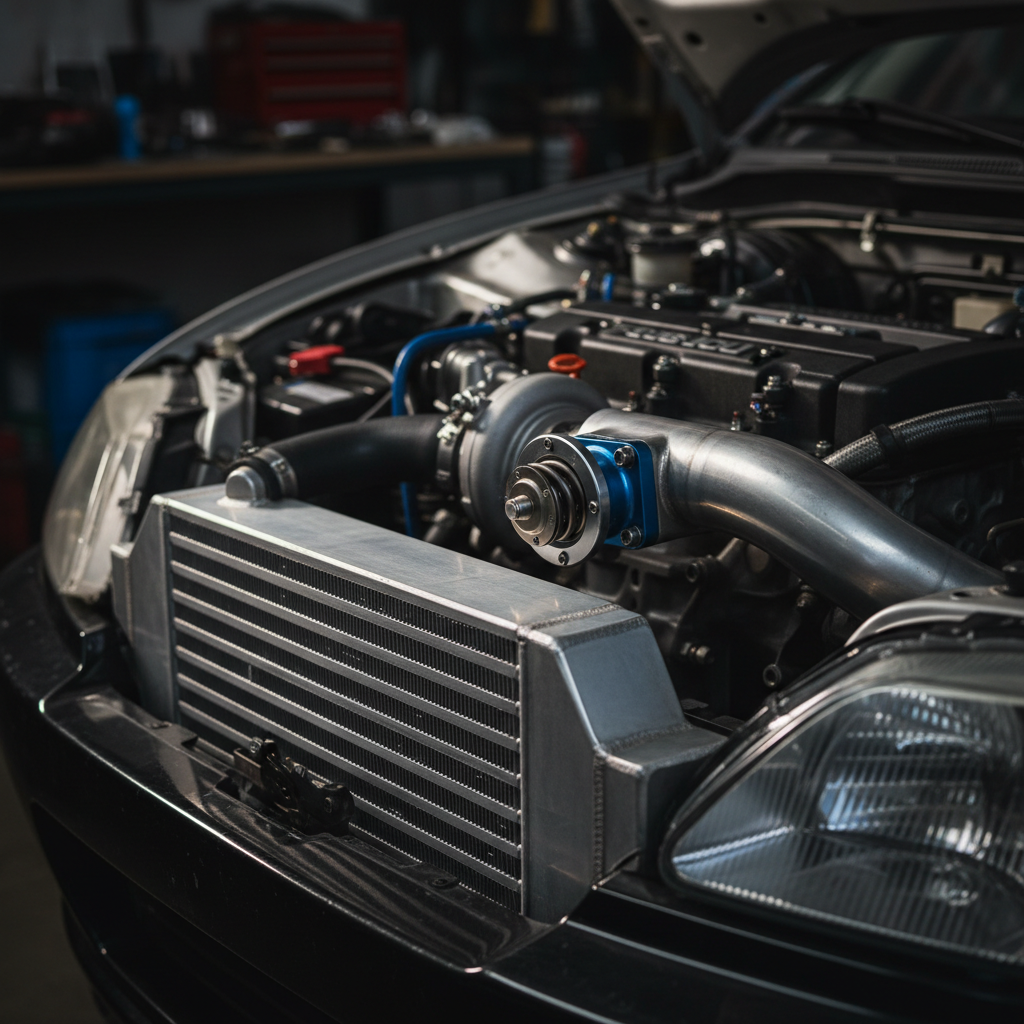
Honda Civic Si Boost Creep After Intercooler Upgrade: Fix Guide
Your upgraded intercooler is probably causing boost creep on your Honda Civic Si turbo build. Better cooling creates denser air charge, which means more backpressure in the exhaust, which pushes boost past your wastegate spring pressure even when the gate should be controlling it.
- Upgraded intercoolers reduce intake temps by 40-60°C, creating 15-20% denser air charge
- Denser air creates more exhaust backpressure, overwhelming stock wastegate springs rated for 14.7 PSI (101 kPa)
- Boost creep shows up as 2-4 PSI over target in logs, usually in 3rd-4th gear pulls
- Fix requires stiffer wastegate spring (18-20 PSI) or external wastegate upgrade
- Ignoring it leads to knock, timing pull, and potential engine damage
Boost creep: When actual boost pressure exceeds wastegate spring pressure due to increased exhaust backpressure, causing uncontrolled boost rise that can damage your engine.
Why Your Intercooler Upgrade Creates Boost Control Problems
The stock Civic Si intercooler is deliberately undersized. Honda runs intake air temps around 60-80°C under boost to keep the air charge less dense. When you install a proper front-mount intercooler, you drop those temps to 20-30°C above ambient. That’s the good news.
The bad news is physics. Cooler air is denser air. A 50°C temperature drop increases air density by roughly 17%. More dense air means more oxygen molecules per combustion cycle. More oxygen means more fuel. More fuel means bigger combustion events. Bigger combustion events create more exhaust gas volume and pressure.
Your wastegate spring was calibrated for the stock intercooler’s mediocre cooling performance. When exhaust backpressure jumps 20-30% due to your intercooler upgrade, that 14.7 PSI (101 kPa) spring can’t hold the wastegate open against the increased pressure. The turbine keeps spinning faster, boost keeps climbing, and your ECU starts pulling timing to prevent knock.
This isn’t a tuning issue. It’s a mechanical limitation that no amount of boost control solenoid duty cycle can fix once you’re past the spring’s holding power.
What Boost Creep Looks Like in Your Datalogs
Boost creep shows distinct patterns in your logs. Target boost might be set to 18 PSI (124 kPa), but actual boost climbs to 21-22 PSI (145-152 kPa) in higher gears. The deviation gets worse as RPM climbs because exhaust gas velocity increases with engine speed.
Look for these specific signatures: boost overshoots target by 2-4 PSI in 3rd and 4th gear pulls. The ECU commands maximum wastegate duty cycle (usually 95-100%) but boost keeps climbing anyway. You’ll see timing retard of 3-6 degrees as the knock sensors pick up the increased cylinder pressure from the extra boost.
Intake air temperatures will look great, often 15-25°C above ambient instead of the 50-70°C you had before. But exhaust gas temperatures climb because you’re making more power than the tune expects. Lambda readings might show slightly rich conditions as the ECU adds fuel to compensate for the extra boost.
The telltale sign is consistent overboost in the same RPM range across multiple pulls. If boost occasionally spikes and comes back down, that’s different, probably a boost control solenoid or hose issue. True boost creep is repeatable and predictable.
The Wastegate Spring Fix Most Builders Miss
The solution is mechanical, not electronic. You need a stiffer wastegate spring that can hold against the increased backpressure your intercooler creates. For most Civic Si builds with front-mount intercoolers, a 18-20 PSI (124-138 kPa) spring handles the increased exhaust pressure without overcomplicating things.
Tial and Turbosmart make drop-in replacements for the stock internal wastegate. The install takes about three hours if you’re comfortable with turbo work. Remove the downpipe, unbolt the wastegate actuator, swap the spring, reassemble. No fabrication required.
After the spring swap, your tuner needs to recalibrate the boost control maps. The stronger spring changes the baseline pressure, so the duty cycle tables need adjustment. Expect to spend another hour on the dyno dialing in the new control strategy.
Alternative solution is an external wastegate, but that requires custom piping and fabrication. Unless you’re planning big power upgrades later, the spring swap handles most street builds running 18-22 PSI (124-152 kPa) target boost.
What Happens When You Ignore Boost Creep
Boost creep kills engines through knock and excessive cylinder pressure. The ECU pulls timing to compensate, but timing retard reduces power and increases exhaust gas temperatures. Higher EGTs stress your turbine housing and can crack exhaust manifolds on the Si’s already marginal cast iron design.
Worse, the ECU’s knock protection has limits. Severe boost creep can overwhelm the knock sensors’ ability to detect detonation, especially if you’re running 91 octane pump gas. Once you get actual knock, you’re gambling with ring lands and pistons.
The financial reality is brutal. A $200 wastegate spring prevents a $4000-6000 engine rebuild. Most builders find this out the expensive way because boost creep develops gradually. First drive after the intercooler install feels great. After a few hundred miles of heat cycling and carbon buildup, the backpressure increases and boost creep gets worse.
Data doesn’t lie. If your logs show consistent overboost after an intercooler upgrade, address it immediately. The extra 3-4 PSI feels good for exactly as long as it takes to melt something expensive inside your engine.
Why does my boost creep get worse in higher gears?
Higher gears mean higher RPM at the same road speed, which increases exhaust gas velocity and backpressure. The wastegate spring that might hold 18 PSI at 4000 RPM gets overwhelmed by backpressure at 6500 RPM. This is why boost creep typically shows up in 3rd and 4th gear pulls rather than lower gear, lower RPM testing.
Can I fix boost creep with just tuning and boost control solenoid adjustments?
No, not if you have true boost creep from increased backpressure. The boost control solenoid works by bleeding air from the wastegate actuator to delay its opening, but it can’t hold the wastegate shut against exhaust pressure that exceeds the spring rating. Once backpressure overcomes spring pressure, electronic boost control becomes irrelevant. You need a mechanical solution.
How do I know if I need a stronger wastegate spring or an external wastegate?
If you’re targeting under 25 PSI (172 kPa) on a street build, a stronger internal spring usually handles it. Above 25 PSI or if you plan significant future power upgrades, an external gate makes more sense. The internal wastegate on the Si’s turbo maxes out around 22-24 PSI even with aftermarket springs, while external gates can handle 35+ PSI reliably.
Will a larger intercooler make boost creep worse than a smaller one?
Yes, more effective cooling creates denser air and higher backpressure. A massive front-mount that drops intake temps 60°C will create more boost creep than a smaller unit that only drops temps 30°C. This is the intercooler sizing paradox, bigger isn’t always better for boost control, though it’s usually better for power and reliability once you fix the wastegate spring.
Understanding boost creep saves you from expensive mistakes and helps you make power safely. When you’re ready to analyze your own boost control data properly, TorqueMetrics gives you the tools to spot these issues before they become problems.