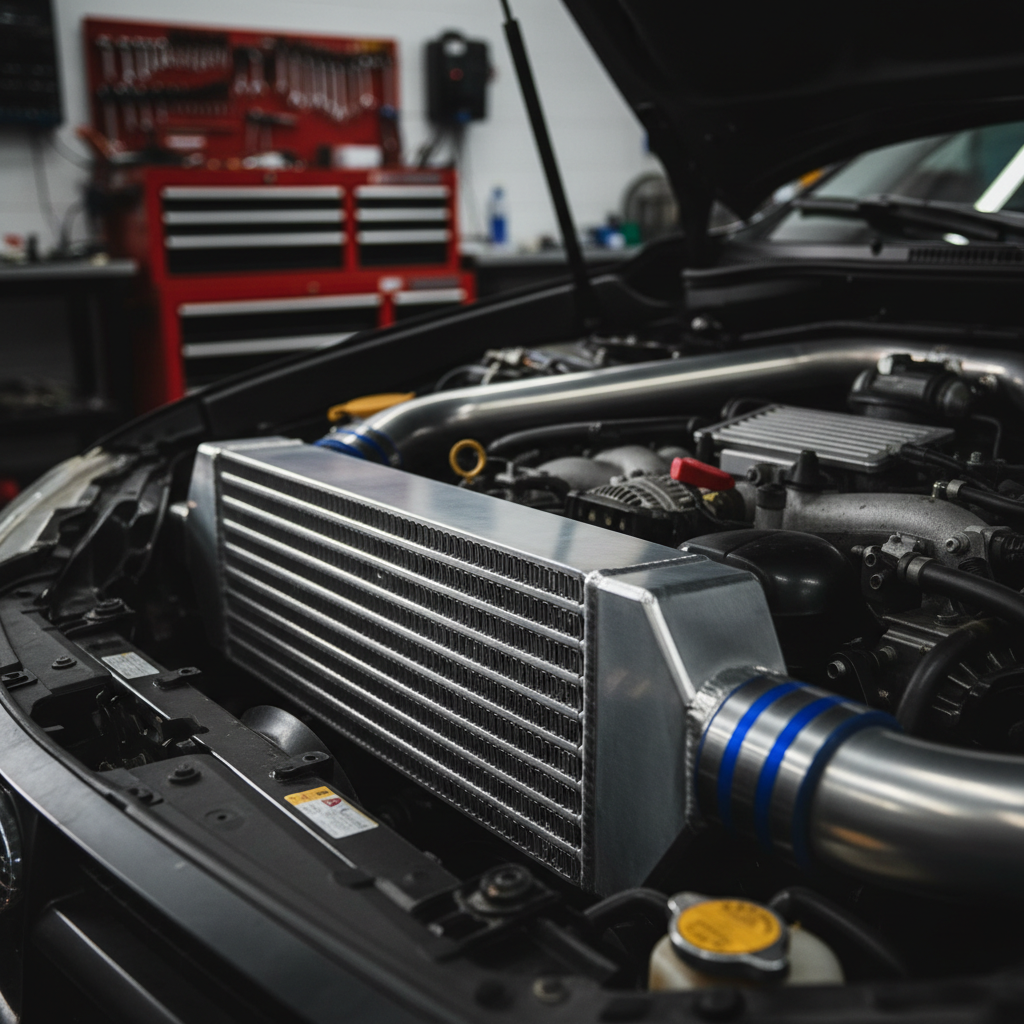
Why Do Big Intercoolers Kill Power? The Pressure Drop Problem
Big intercoolers kill power when pressure drop exceeds the benefit of lower charge air temperatures. The sweet spot is keeping pressure drop under 2-3 PSI (14-21 kPa) while achieving meaningful temperature reduction. Most STI owners chase the biggest core they can fit and wonder why they lost 10-15hp despite “better” charge temps.
- Pressure drop above 2-3 PSI (14-21 kPa) typically costs more power than temperature reduction gains
- Cylinder fill depends on absolute pressure at the intake manifold, not just charge air temperature
- Core thickness matters less than internal flow path design and end tank efficiency
- Stock location intercoolers often outperform massive front-mounts on street builds under 400hp
- Your tune needs to account for the new pressure drop characteristics or you’ll lose torque everywhere
Intercooler efficiency: The balance between charge air temperature reduction and pressure drop across the core, measured as the net effect on volumetric efficiency and cylinder fill at a given boost level.
What Pressure Drop Actually Does to Your Engine
Pressure drop is the difference between boost pressure at the turbo outlet and what actually reaches your intake manifold. Your ECU reads manifold pressure, not compressor outlet pressure. When you’re seeing 18 PSI (124 kPa) on your boost gauge but the intercooler is dropping 3 PSI (21 kPa), your cylinders are only getting 15 PSI (103 kPa) worth of air density.
The math is straightforward. Cylinder fill depends on absolute pressure and temperature. Drop the pressure by 3 PSI and you need to compensate with lower temperatures to maintain the same air mass. The problem? Most intercooler upgrades don’t drop charge temps enough to offset significant pressure losses. A typical “big” front-mount might reduce charge temps from 60°C to 35°C under sustained load, but if it’s costing you 3.5 PSI (24 kPa) of pressure, you’re still behind on air density.
This shows up immediately in your datalogs as reduced load values at the same boost levels. Your tuner sees this as lower cylinder fill efficiency. The ECU compensates by requesting more boost to hit the same load targets, which pushes your turbo further up its efficiency map and creates more heat. You end up chasing your own tail.
The Data Behind Intercooler Pressure Drop
Real dyno data from STI builds shows the 2-3 PSI pressure drop threshold consistently. Stock top-mount intercoolers typically show 0.8-1.2 PSI (5.5-8.3 kPa) pressure drop at 18 PSI boost levels. A well-designed aftermarket top-mount stays under 1.8 PSI (12.4 kPa). Aggressive front-mount setups often hit 3.5-4.2 PSI (24-29 kPa) pressure drop at the same boost levels.
The temperature story is more complex than most people think. Charge air temps depend heavily on ambient conditions, vehicle speed, and heat soak. That massive front-mount dropping temps from 55°C to 30°C in a wind tunnel doesn’t help much when you’re sitting in traffic on a hot day. Under real driving conditions, the temperature advantage often shrinks while the pressure drop remains constant.
Load cell data shows this clearly. An STI making 280whp through a stock intercooler at 1.1 PSI pressure drop will typically lose 8-12whp when switching to a front-mount with 3.2 PSI pressure drop, even with 20°C lower charge temps. The tuner has to add 2-3 PSI more boost to recover the same load values, which increases compressor outlet temperatures and partially negates the intercooler’s cooling benefit.
The sweet spot for street builds under 350whp is usually a quality top-mount or modest front-mount that keeps pressure drop under 2 PSI while providing 15-25°C temperature reduction compared to stock. This maintains cylinder fill while adding safety margin for timing and knock resistance.
How to Choose an Intercooler That Actually Adds Power
Start with your power goals and driving conditions, not core size. A 400hp street build has different requirements than a 500hp track car. For most STI builds staying under 380whp, a well-designed top-mount intercooler gives better net performance than a front-mount setup.
Core thickness is overrated. Internal flow design and end tank efficiency matter more. A 2.5″ thick core with straight-through internal fins and efficient end tanks will outflow a 4″ thick core with restrictive internal passages. Look for pressure drop specifications at your target boost levels, not just core dimensions.
End tank design is where most “big” intercoolers fail. Those massive tube-and-fin cores with tiny end tanks create turbulence and flow restrictions that kill the core’s efficiency. The best intercoolers have end tanks sized to match the core’s flow capacity with smooth internal transitions.
Test data before buying. Reputable manufacturers publish pressure drop curves at various flow rates. If they don’t have this data, find a different intercooler. You want to see pressure drop under 2.5 PSI (17 kPa) at your target boost and airflow levels.
Remember that your tune needs to account for the new pressure characteristics. A good tuner will retarget boost levels to optimize for the intercooler’s flow characteristics rather than just copying the previous map. This usually means running slightly higher boost to compensate for pressure drop while taking advantage of the improved charge cooling for more aggressive timing.
Common Intercooler Mistakes That Kill Performance
The biggest mistake is choosing based on looks rather than flow data. That massive front-mount might look impressive, but if it’s choking your engine with 4+ PSI pressure drop, you’ve made your car slower while spending $1,500. This happens constantly with STI owners who prioritize core size over flow efficiency.
Poor piping design compounds intercooler restrictions. Sharp bends, diameter mismatches, and excessive piping length all add pressure drop. A moderately restrictive intercooler with clean, short piping often outperforms a high-flow core with poor routing. Keep bends gradual, minimize piping length, and match diameters to your turbo’s compressor outlet.
Ignoring ambient temperature effects leads to disappointment. That intercooler performing great in winter weather might struggle in summer heat. Front-mounts are particularly sensitive to airflow and ambient temps. If you’re not seeing adequate temperature reduction in real-world conditions, you’re not getting the benefit that justified the pressure drop.
Tuning for the wrong parameters costs power. Many tuners focus on hitting the same boost numbers as the previous setup without considering the new pressure drop characteristics. The optimal approach is retuning boost targets to maximize cylinder fill while taking advantage of improved charge cooling for timing advance. This often means running 1-2 PSI more boost than the stock intercooler setup.
Frequently Asked Questions
How much pressure drop is too much for an STI intercooler?
Pressure drop above 3 PSI (21 kPa) typically costs more power than it gains through temperature reduction on street builds under 400hp. The sweet spot is 1.5-2.5 PSI pressure drop with 15-25°C charge temperature reduction compared to stock. This maintains cylinder fill while providing knock resistance benefits. Track cars with higher power levels can justify slightly higher pressure drops if the cooling benefit supports more aggressive timing maps.
Do front-mount intercoolers always make more power than top-mounts?
No, front-mount intercoolers often lose power on moderate builds due to excessive pressure drop and heat soak in traffic. Quality top-mount intercoolers typically outperform front-mounts on STI builds under 350-380whp because they maintain better airflow with lower pressure drop. Front-mounts become advantageous on higher power builds where the cooling capacity justifies the flow restrictions, typically above 400whp where charge air temperatures become the limiting factor.
Can I fix intercooler pressure drop with bigger piping?
Piping diameter affects pressure drop, but oversized piping creates other problems like reduced velocity and poor throttle response. The optimal piping diameter matches your turbo’s compressor outlet, typically 2.5-3″ for most STI setups. Focus on smooth bends, minimal length, and proper end tank design rather than maximum diameter. A 2.5″ system with clean routing usually outflows a poorly designed 3.5″ setup while maintaining better transient response.
Why did my dyno numbers drop after installing a bigger intercooler?
Your intercooler likely has excessive pressure drop that reduces cylinder fill more than the temperature reduction helps. Check your boost pressure at the manifold versus pre-intercooler. If you’re losing 3+ PSI across the intercooler, that’s reducing air density enough to cost power despite lower temperatures. The solution is either accepting the power loss for better reliability, or switching to a more efficient intercooler design with lower pressure drop.
Understanding intercooler efficiency means looking beyond core size and temperature drops to actual airflow characteristics. The data tells the real story, and TorqueMetrics helps you see exactly what your intercooler upgrade is doing to cylinder fill, load values, and overall performance.