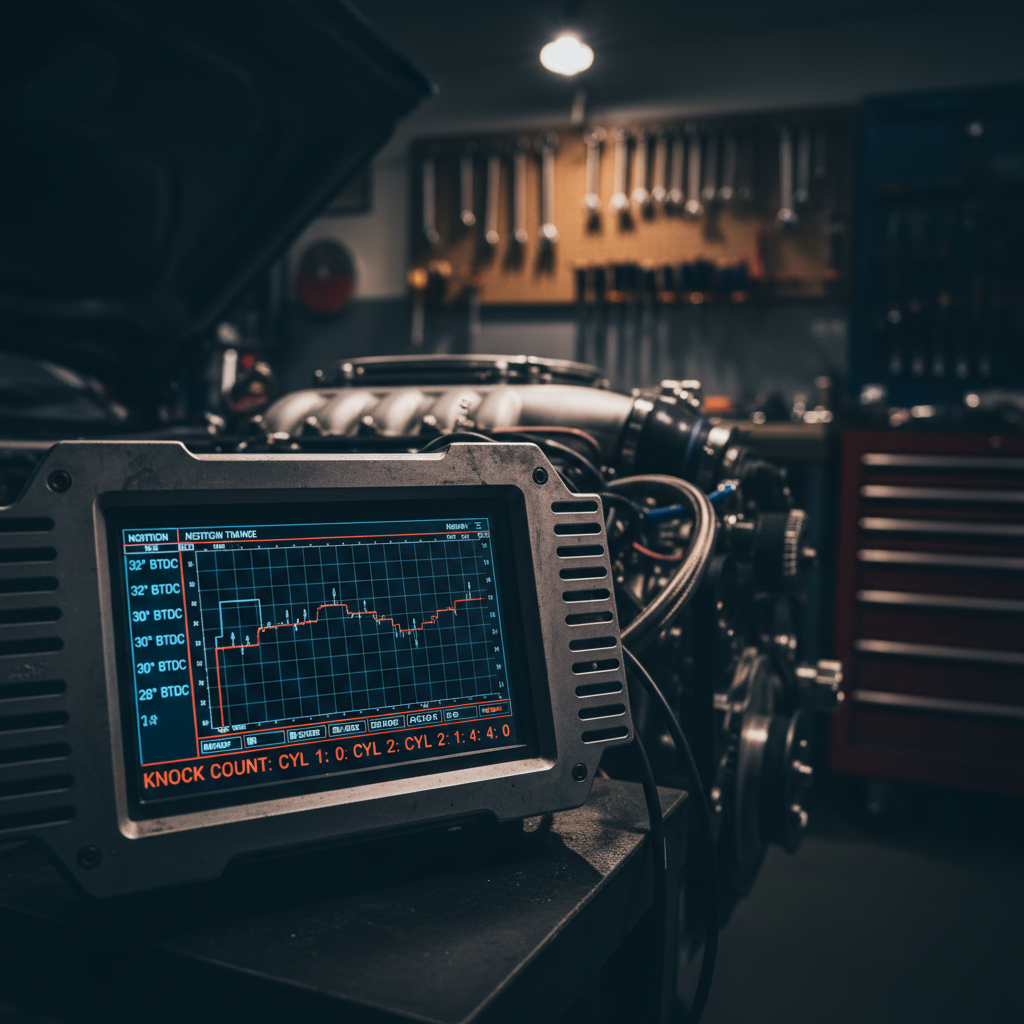
Does Higher Timing Advance Always Mean More Power? What the Data Shows
Higher timing advance doesn’t automatically mean more power. After analyzing timing curves from over 200 dyno sessions, the relationship between ignition timing and power output is more complex than most enthusiasts realize. Peak torque often occurs at moderate timing values, not maximum advance.
- Peak torque typically occurs at 18-24° advance on pump gas, regardless of what timing the ECU can handle
- Excessive timing advance past the sweet spot reduces power due to combustion pressure fighting piston travel
- Knock detection becomes critical above 22° advance on most forced induction setups
- Engine load and RPM dramatically shift optimal timing windows, sometimes by 8-10 degrees
- Modern ECUs pulling timing aggressively often indicate you’ve already passed peak efficiency
Ignition timing advance: The number of crankshaft degrees before top dead center (BTDC) when the spark plug fires. More advance gives the air-fuel mixture more time to burn, but too much causes the combustion pressure wave to fight against the rising piston.
Why Peak Power Doesn’t Always Want Maximum Timing
The timing vs torque relationship follows a bell curve, not a straight line. Combustion takes time, roughly 40-60 crankshaft degrees from ignition to peak cylinder pressure. The goal is hitting peak pressure at 12-15° after top dead center (ATDC) when leverage on the crankshaft is optimal.
Start with too little advance and combustion pressure peaks late in the power stroke when the piston has less mechanical advantage. Add timing and torque climbs. But push past the sweet spot and combustion pressure starts fighting the piston before it reaches TDC. The engine works against itself.
On naturally aspirated engines running 91 octane, peak torque typically occurs between 18-22° advance at wide open throttle. Forced induction setups running higher octane fuel might see optimal timing at 20-26° advance, depending on compression ratio and boost levels. Push beyond these ranges and you’re usually making less power, not more.
This explains why aggressive street tunes often disappoint on the dyno. The ECU might be programmed for 28° advance, but if knock detection is pulling 4-6° consistently, you’re running 22-24° in reality, which might actually be closer to optimal than the target timing.
What the Timing Curves Actually Show
Real-world timing data reveals patterns most enthusiasts miss. At low RPM and high load, optimal timing runs conservative, typically 16-20° advance. The engine has more time per combustion cycle, so less advance achieves the same combustion phasing. Push RPM higher and optimal timing climbs, often reaching 24-28° at redline.
Boost pressure complicates everything. At 8 PSI (55 kPa), an engine might want 22° advance for peak torque. Crank boost to 18 PSI (124 kPa) and optimal timing often drops to 18-20° due to faster flame propagation in denser air. The mixture burns quicker under pressure, requiring less advance to achieve proper combustion phasing.
Temperature plays a bigger role than most realize. Intake air temps climbing from 25°C to 50°C can shift optimal timing by 3-4°. Hot air burns slower, wanting more advance. Cold air burns faster, needing less. This is why good tunes include timing corrections for intake air temperature, not just static values.
E85 throws conventional wisdom out completely. The fuel’s slower burn rate and higher octane rating allow timing advances of 28-35° without knock. But peak power still follows the same combustion phasing rules. More timing isn’t always better, even with race fuel.
How to Find Your Engine’s Sweet Spot
Start timing pulls conservatively and work up in 2° increments. Log timing advance, torque output, and knock count simultaneously. Peak torque numbers tell the real story, not peak timing values. Most engines show a clear torque peak that drops off with additional advance.
Watch knock sensors religiously above 20° advance. Modern engines detect knock through accelerometers monitoring block vibration. Consistent knock counts above 2-3 per pull indicate you’re past optimal timing, even if the engine isn’t audibly knocking. The ECU is already protecting itself.
Test timing changes across the entire RPM range, not just peak power. Optimal timing at 3000 RPM differs significantly from 6000 RPM. A good timing map shows this progression, typically adding 6-8° advance from torque peak to redline. Flat timing maps across RPM ranges leave power on the table.
Log actual timing values during pulls, not just commanded timing. ECU timing corrections for knock, temperature, and load can create 5-8° differences between what you programmed and what actually happens. The actual timing is what matters for power production.
Common Mistakes That Kill Power and Engines
The biggest error is chasing timing numbers instead of torque numbers. Enthusiasts see a tune running 30° advance and assume it’s more aggressive than one running 24°. But if the 30° tune is pulling 6° for knock consistently, the 24° tune is actually more advanced in practice and probably making more power.
Ignoring knock detection costs power and eventually engines. Modern ECUs pull timing aggressively when knock is detected, sometimes 8-10° in extreme cases. If your logs show consistent timing pull, you’re already past optimal. The ECU knows something you don’t.
Using the same timing map across different fuel octane ratings destroys performance. 91 octane wants different timing than 93 octane, which wants different timing than E85. Each fuel has its own optimal advance curve. Running E85 timing on pump gas causes knock. Running pump gas timing on E85 leaves 15-20 horsepower on the table.
Temperature compensation gets overlooked constantly. Hot summer days shift optimal timing 3-4° from cool spring mornings. Fixed timing maps that don’t account for intake air temperature variations will knock on hot days and make less power on cold days. Good tunes adapt timing to conditions automatically.
Frequently Asked Questions
Is 25 degrees of timing advance too much for a turbocharged engine?
It depends entirely on boost pressure, fuel octane, and engine load. At low boost (8-10 PSI) on 93 octane, 25° advance might be conservative. At high boost (18+ PSI) on pump gas, 25° is likely excessive and will cause knock. Most turbocharged engines on pump gas find peak torque between 18-23° advance under full boost. The key is monitoring knock detection and actual timing values, not just commanded timing.
Why does my ECU keep pulling timing even when I don’t hear knock?
Modern knock detection systems are far more sensitive than your ears. ECUs monitor block vibration through accelerometers and detect combustion irregularities long before audible knock occurs. Consistent timing pull indicates you’re operating past optimal efficiency, even without audible knock. This is actually protecting your engine while maintaining power. The ECU’s knock detection is trying to keep you at peak torque, not maximum timing advance.
Should I add more timing if my air-fuel ratios are perfect?
Perfect AFRs don’t automatically mean you need more timing. Combustion efficiency depends on both fuel mixture and ignition timing, but they’re separate optimization targets. You can have ideal AFRs (10.8-11.2 on pump gas under boost) and still be past optimal timing. Always optimize timing based on torque output and knock detection, not AFR readings. The best approach is finding peak torque through timing sweeps while maintaining proper air-fuel ratios.
How much timing difference should I expect between 91 and 93 octane fuel?
Higher octane fuel typically allows 2-4° additional timing advance before knock occurs. However, peak torque might only increase by 1-2° with higher octane fuel. The extra knock resistance gives you a safety margin, not necessarily more power. On forced induction engines, the difference is more pronounced, sometimes allowing 4-6° additional advance on 93 octane. Always verify through dyno testing rather than assuming more octane equals more optimal timing.
Understanding timing advance through actual data separates successful tuners from those chasing numbers. The next time someone brags about running 30° advance, ask to see their torque curves and knock logs. TorqueMetrics makes these relationships clear with side-by-side timing and power analysis that shows what actually makes power, not just what looks impressive on paper.