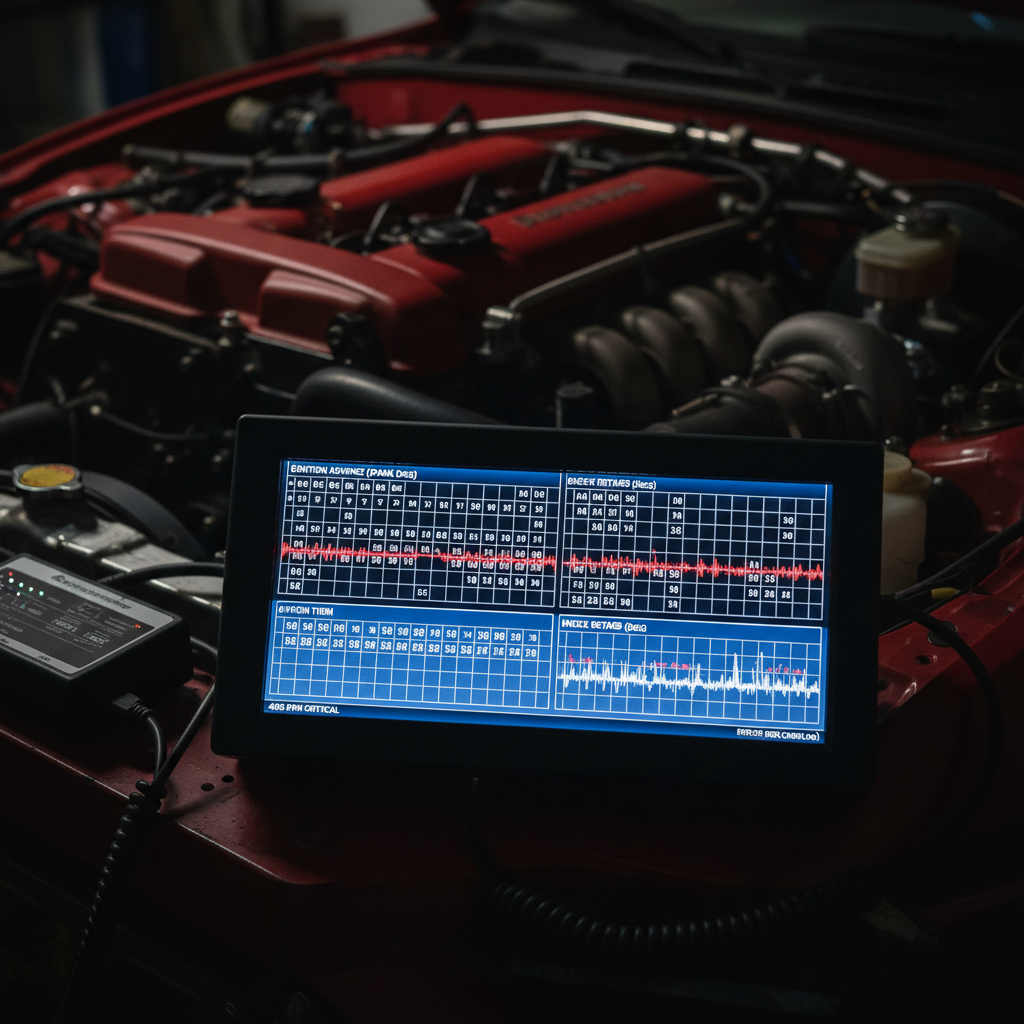
Why Turbo Miatas Knock at 4500 RPM: Fixing the Timing Map
Turbo Miata builds consistently knock at 4500 RPM because the stock ignition timing map assumes naturally aspirated conditions. When you add 10 PSI (69 kPa) of boost to an engine calibrated for atmospheric pressure, the timing advance that worked perfectly NA becomes dangerously aggressive under boost.
- Stock Miata timing maps advance aggressively at 4500 RPM for NA power, but this timing causes knock under boost
- The factory ECU doesn’t compensate for manifold pressure changes in ignition timing calculations
- Proper turbo timing maps require 8-12 degrees less advance at peak torque RPM under boost
- Knock retard values above 3 degrees at 4500 RPM indicate unsafe timing advance
- Custom ignition tables based on manifold pressure solve the issue permanently
Knock at 4500 RPM: A predictable ignition knock event that occurs in turbocharged Miata builds when stock naturally aspirated ignition timing maps encounter boost pressure, typically manifesting as 4-8 degrees of timing retard and audible detonation.
What Your Miata’s Stock Timing Map Actually Does
The factory 1.8L Miata timing map assumes one thing: atmospheric pressure in the intake manifold. At 4500 RPM under natural aspiration, the ECU advances timing to 32-35 degrees BTDC because it’s chasing torque in the midrange. This aggressive timing works when you’re pulling vacuum or at atmospheric pressure.
Add a turbo pushing 10 PSI (69 kPa), and that same timing becomes a recipe for detonation. The cylinder pressure spike from forced induction combined with aggressive timing advance creates peak pressures that exceed what pump gas can handle. Your knock sensor starts pulling timing, but the base map keeps trying to add it back.
The ECU doesn’t know you’ve added a turbo. It sees 4500 RPM and atmospheric throttle position, then applies the same timing it would for an NA engine. The knock control system becomes your safety net, but it’s reactive, not preventive. You’re essentially relying on controlled detonation to manage timing, which is backwards.
This explains why the knock consistently hits at 4500 RPM specifically. It’s not your tune, your fuel, or your intercooler efficiency. It’s the fundamental mismatch between an NA ignition strategy and forced induction cylinder pressures.
What the Datalog Actually Shows You
Pull a third gear log from 3000 to 6500 RPM under full boost and you’ll see the pattern clearly. Timing advance climbs steadily through 4000 RPM, hits that aggressive 32-degree peak around 4500 RPM, then knock retard spikes to 6-8 degrees. The ECU pulls timing hard, torque drops, and your power curve flattens exactly where it should be climbing.
Look at your manifold pressure trace alongside ignition timing. At atmospheric pressure or under vacuum, that 32-degree timing advance produces smooth power. The moment MAP pressure crosses into positive territory, knock events start registering. By 10 PSI (69 kPa), you’re seeing consistent knock retard of 4-6 degrees every time you hit that RPM range.
The knock intensity correlates directly with cylinder pressure, not just boost pressure. Higher compression engines show more severe knock at lower boost levels. A 9.5:1 compression 1.8L will knock harder at 8 PSI (55 kPa) than a 8.5:1 engine at 12 PSI (83 kPa). The timing advance remains the primary variable, but effective compression ratio amplifies the problem.
Temperature data tells the secondary story. Intake air temps above 50°C make the knock worse, but even with perfect intercooling, that 4500 RPM timing spike still causes issues. It’s not a heat problem masked as a timing problem. It’s purely ignition timing running ahead of what the fuel can support under cylinder pressure.
How to Fix Your Ignition Map Properly
The solution requires building a proper boost-referenced timing map. Instead of a single timing table based on RPM and load, you need timing values that account for manifold pressure directly. Most aftermarket ECUs handle this with 3D timing maps that reference MAP sensor readings.
Start by pulling 8-10 degrees of timing from your 4000-5500 RPM range under boost conditions. Where the stock map shows 32 degrees at 4500 RPM, run 22-24 degrees initially. This seems conservative, but you’re establishing a safe baseline before optimizing for power.
The key insight: timing advance should decrease as manifold pressure increases. At atmospheric pressure, run near-stock timing. At 5 PSI (34 kPa), pull 4-6 degrees. At 10 PSI (69 kPa), you’re looking at 8-12 degrees less advance than the NA map. At 15 PSI (103 kPa), the reduction can reach 15 degrees in the midrange.
Optimize from that conservative base by adding timing back in 1-degree increments while monitoring knock sensors. The correct timing produces maximum torque without knock retard. If you’re seeing any consistent knock retard above 1-2 degrees, you’re still too aggressive. The goal is zero knock events under normal operating conditions.
What Goes Wrong When You Ignore the Data
Running on borrowed time with knock-limited timing eventually catches up. The ECU’s knock control can only react so fast, and acoustic knock detection has limitations. You’ll get away with it for a while, then suddenly you won’t. Piston damage from detonation happens quickly once it starts.
Many builders try to solve timing knock with more fuel, bigger intercoolers, or higher octane. These help, but they’re treating symptoms. E85 will mask timing problems temporarily because of its knock resistance, but the fundamental timing map issue remains. You’re still running inappropriate timing advance, just getting away with it because of better fuel.
The worst case scenario is intermittent knock that doesn’t trigger consistent retard. Light detonation that occurs randomly based on fuel quality, temperature, or load conditions can cause cumulative damage without obvious symptoms. Your engine runs fine until it doesn’t, and by then the damage is done.
Attempting to tune around stock timing maps instead of replacing them leads to compromised performance everywhere else. You end up rich on fuel to prevent knock, conservative on boost to avoid timing issues, and ultimately making less power than a properly calibrated setup would produce safely.
Frequently Asked Questions
Why does my turbo Miata only knock at certain RPM ranges and not others?
Stock Miata timing maps are most aggressive in the 4000-5500 RPM range where the naturally aspirated engine needs timing advance to make torque. Below 4000 RPM, timing is more conservative for drivability. Above 5500 RPM, timing backs off for high RPM reliability. The midrange timing spike that works for NA becomes problematic under boost, creating that predictable knock window.
Can I fix turbo knock issues by just running higher octane fuel instead of changing timing?
Higher octane fuel will reduce knock severity but doesn’t solve the fundamental timing map mismatch. Even on race fuel, you’re still running timing advance designed for atmospheric pressure under boost conditions. The knock resistance buys you safety margin, but optimal power and reliability require proper timing calibration. Race fuel should enable more aggressive tuning, not compensate for inappropriate base timing.
How much timing should I pull from the stock map when adding a turbo?
Start with 8-12 degrees less timing in the 4000-5500 RPM range under boost conditions. The exact amount depends on boost pressure, compression ratio, and fuel quality. At 10 PSI (69 kPa) on pump gas with stock compression, expect to run 22-26 degrees timing where the stock map shows 32-35 degrees. Always start conservative and add timing back while monitoring knock sensors for optimization.
Will a standalone ECU automatically fix knock issues on a turbo Miata?
A standalone ECU provides the tools to fix knock issues, but doesn’t automatically solve them. You still need proper calibration with boost-referenced timing maps. Many plug-and-play standalone setups start with modified stock timing maps that retain the same basic problems. The ECU is only as good as its calibration, and turbo applications require fundamentally different ignition strategies than naturally aspirated engines.
Understanding why your turbo Miata knocks at predictable RPM points is the first step toward proper calibration. The data doesn’t lie, and once you see the pattern in your datalogs, the solution becomes clear. Proper timing maps designed for forced induction eliminate the guesswork and deliver both safety and performance. TorqueMetrics can help you visualize these timing and knock patterns clearly, making it easier to dial in your calibration with confidence.