What’s the Optimal Ignition Timing for E85 on Supra and 350Z Builds?
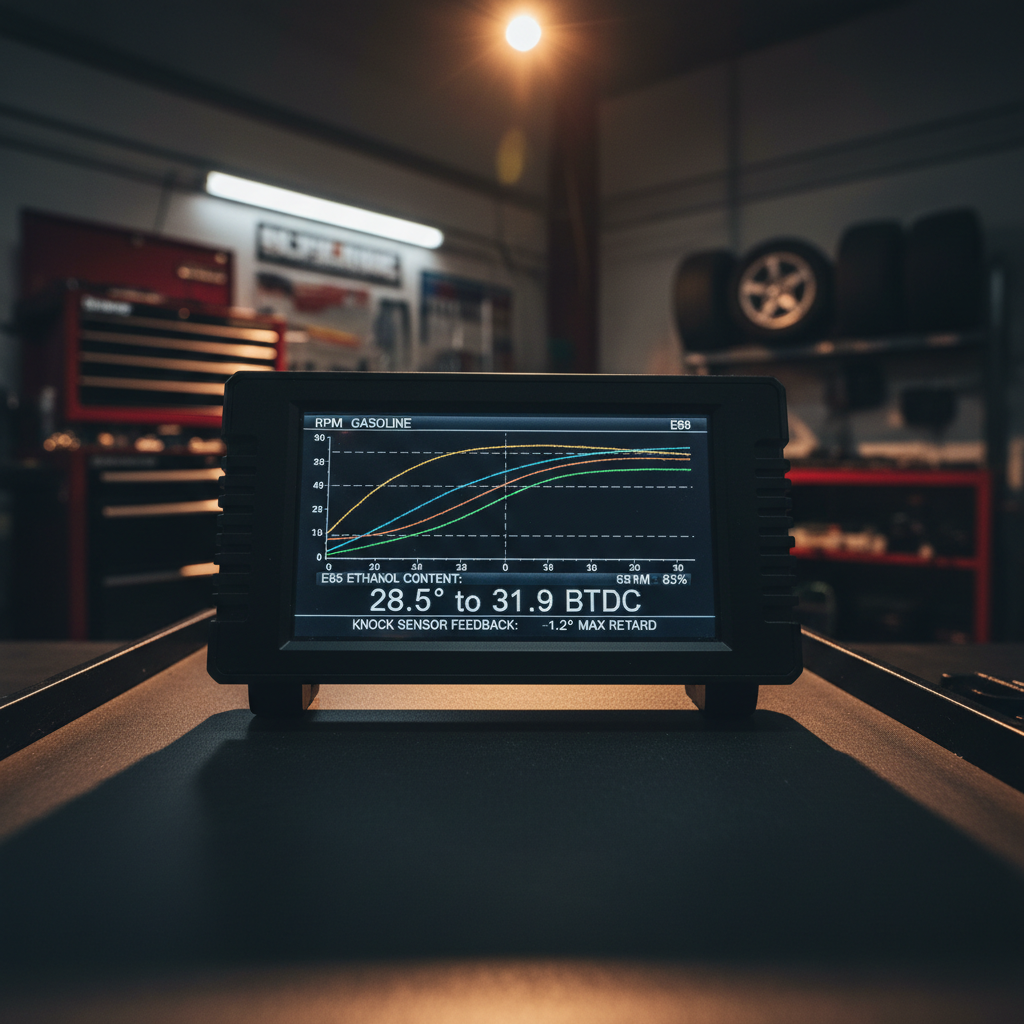
Peak torque on E85-converted Supra and 350Z builds typically occurs between 28-32 degrees of ignition timing, not the aggressive 35+ degrees many tuners chase. While ethanol can handle extreme timing without knock, that doesn’t mean it produces more power there.
Quick Answer: E85 Timing Sweet Spot
- Peak torque zone: 28-32° timing on most Supra 2JZ and VQ35DE builds
- Torque falls off after 32° despite no knock detection
- AFR should be 10.8-11.2 at peak boost with optimized timing
- Cylinder pressure peaks matter more than knock threshold on E85
- Conservative timing often makes 15-25 more ft-lbs than aggressive timing
Optimal ignition timing: The timing advance that produces peak cylinder pressure at the ideal crank angle (typically 12-16° ATDC) for maximum torque output, regardless of knock threshold limits.
Why E85 Timing Optimization Differs From Pump Gas
E85’s 113+ octane rating creates a false sense that more timing equals more power. The reality is more complex. Ethanol’s combustion characteristics change the entire timing equation compared to 93 octane.
On pump gas, you’re often limited by knock before reaching optimal timing. A stock 2JZ-GTE might make peak torque at 18° on 93 octane but start knocking at 16°. You tune around the limitation. E85 removes that limitation entirely, but it doesn’t change the physics of when peak cylinder pressure should occur.
The optimal timing window for maximum torque output remains roughly the same, E85 just lets you reach it without detonation. Peak cylinder pressure still wants to occur 12-16° after top dead center for maximum leverage on the crankshaft. Push timing beyond this window and you’re moving peak pressure too early in the stroke, reducing mechanical advantage regardless of octane rating.
Most tuners see E85’s knock resistance and assume they should advance timing until they hit the mechanical limits of the timing map. The dyno data consistently shows this approach leaves power on the table. A properly tuned 2JZ making 500 whp will typically show peak torque between 29-31° timing, not the 36-38° that the engine can handle without knock.
What the Dyno Data Actually Shows
Real-world dyno pulls from Supra and 350Z E85 conversions reveal a consistent pattern. Power climbs with timing advance up to a point, then plateaus or even decreases despite zero knock counts in the datalog.
A typical 2JZ-GTE single turbo build on E85 will show peak torque at 30° timing. Advance to 34° and torque drops 20-30 ft-lbs across the midrange, even though timing pull remains at zero. The VQ35DE in the 350Z follows similar patterns, with peak output typically occurring between 28-32° depending on compression ratio and boost levels.
The AFR window matters equally. Optimal timing on E85 pairs with 10.8-11.2 AFR under full boost. Richer mixtures (10.5 and below) can mask timing inefficiencies by providing cooling, but you’re trading fuel economy and some power for that safety margin. Leaner mixtures (11.4+) start showing real knock susceptibility even on E85, especially with aggressive timing.
EGT data supports the timing conclusions. Optimal timing typically shows exhaust gas temperatures in the 1500-1650°F range under full load. Push timing beyond peak torque and EGTs climb into the 1700°F+ range as combustion efficiency decreases. The engine works harder to make less power.
Boost response also changes with timing optimization. Conservative timing that hits peak torque produces better transient response than aggressive timing that chases peak horsepower numbers. The engine builds boost more efficiently when combustion timing matches the mechanical realities of the rotating assembly.
How to Find Your Actual Timing Sweet Spot
Start conservative and work up methodically. Begin timing pulls at 24° and advance in 2° increments while monitoring torque output across the entire RPM range, not just peak numbers. Peak horsepower often occurs at different timing than peak torque, and torque wins races.
Log cylinder pressure if your setup allows it. Peak pressure should occur 12-16° ATDC for optimal mechanical advantage. If you’re seeing peak pressure before 10° ATDC, you’re over-advanced regardless of knock detection. If peak pressure occurs after 18° ATDC, you’re leaving torque on the table.
Watch EGT trends closely. Rising exhaust temperatures with advancing timing usually indicate you’ve passed optimal combustion phasing. The engine is working harder but producing less effective work output. This happens consistently around 33-35° on most E85 builds, well before knock becomes a factor.
Test AFR sensitivity at your optimal timing window. Small changes in fuel delivery (0.2-0.3 AFR) can shift the timing sweet spot by 1-2°. Find the AFR that produces peak torque, then optimize timing at that fuel ratio. Don’t tune timing first and force AFR to match.
Validate your results with multiple dyno pulls. Single pulls can lie due to heat soak, atmospheric changes, or data logging errors. Consistent results across three pulls at the same timing confirm you’ve found the actual sweet spot, not a measurement anomaly.
Why Aggressive Timing Fails Even on Race Fuel
The biggest mistake is confusing knock resistance with power optimization. E85 can handle 40+ degrees of timing without audible knock or timing pull, but that doesn’t mean the engine produces maximum torque there. You’re essentially retarding combustion phasing relative to optimal piston position.
Excessive timing advance moves peak cylinder pressure too early in the piston stroke when mechanical leverage is poor. The connecting rod angle works against you instead of with you. This shows up as flat or declining torque curves despite clean knock sensors and perfect AFR readings.
Heat becomes the enemy with aggressive timing. Even though knock isn’t occurring, combustion temperatures climb significantly. Higher combustion temperatures reduce volumetric efficiency and increase the tendency for pre-ignition events that don’t register as traditional knock. The engine makes less power while working harder and running hotter.
Turbo efficiency suffers with over-advanced timing. Exhaust gas temperatures climb, which reduces turbine efficiency and increases heat soak in the entire system. You end up losing boost response and increasing intake air temperatures, which costs power throughout the entire RPM range.
Component longevity takes a hit even without knock. Higher cylinder pressures and temperatures from mistimed combustion increase wear rates on pistons, rings, and bearings. The engine might not knock, but it’s working harder than necessary to produce suboptimal power output. That’s a losing combination for any performance build.
Frequently Asked Questions
What ignition timing should I start with on a fresh E85 tune?
Start with 24-26° timing and work up in 2° increments while monitoring torque output. Don’t start with pump gas timing maps, as E85’s combustion characteristics require a different approach. Most builds find peak torque between 28-32° depending on compression ratio and boost levels. Always verify with multiple dyno pulls rather than relying on single data points.
Can I run the same timing maps I used on race gas when switching to E85?
No, E85 requires completely different timing optimization even compared to high octane race fuels like VP C16. Ethanol’s combustion speed and flame propagation characteristics change optimal timing windows significantly. Most engines need 3-6° more timing on E85 compared to 100+ octane race gas to reach peak torque, but the ceiling is lower than you might expect.
Why does my car feel slower with aggressive timing on E85 even though it’s not knocking?
Excessive timing moves peak cylinder pressure too early in the piston stroke, reducing mechanical leverage on the crankshaft. This creates higher peak pressures but less effective torque output. The engine works harder while producing less usable power, which you feel as reduced acceleration despite clean knock sensors and datalog readings.
How do I know if my E85 timing is optimized without a dyno?
Monitor EGT trends and boost response during acceleration pulls. Optimal timing typically produces EGTs in the 1500-1650°F range under full load. If temperatures climb above 1700°F with timing advance, you’re likely past peak efficiency. Better boost response and stronger midrange acceleration also indicate properly optimized timing versus peak power chasing.
Getting E85 timing right requires abandoning preconceptions about race fuel capabilities and focusing on actual combustion optimization. The data consistently shows that conservative timing approaches produce more usable power than aggressive timing maps, even when knock isn’t a limiting factor. TorqueMetrics helps you analyze these timing relationships across your entire RPM range, not just peak power numbers.