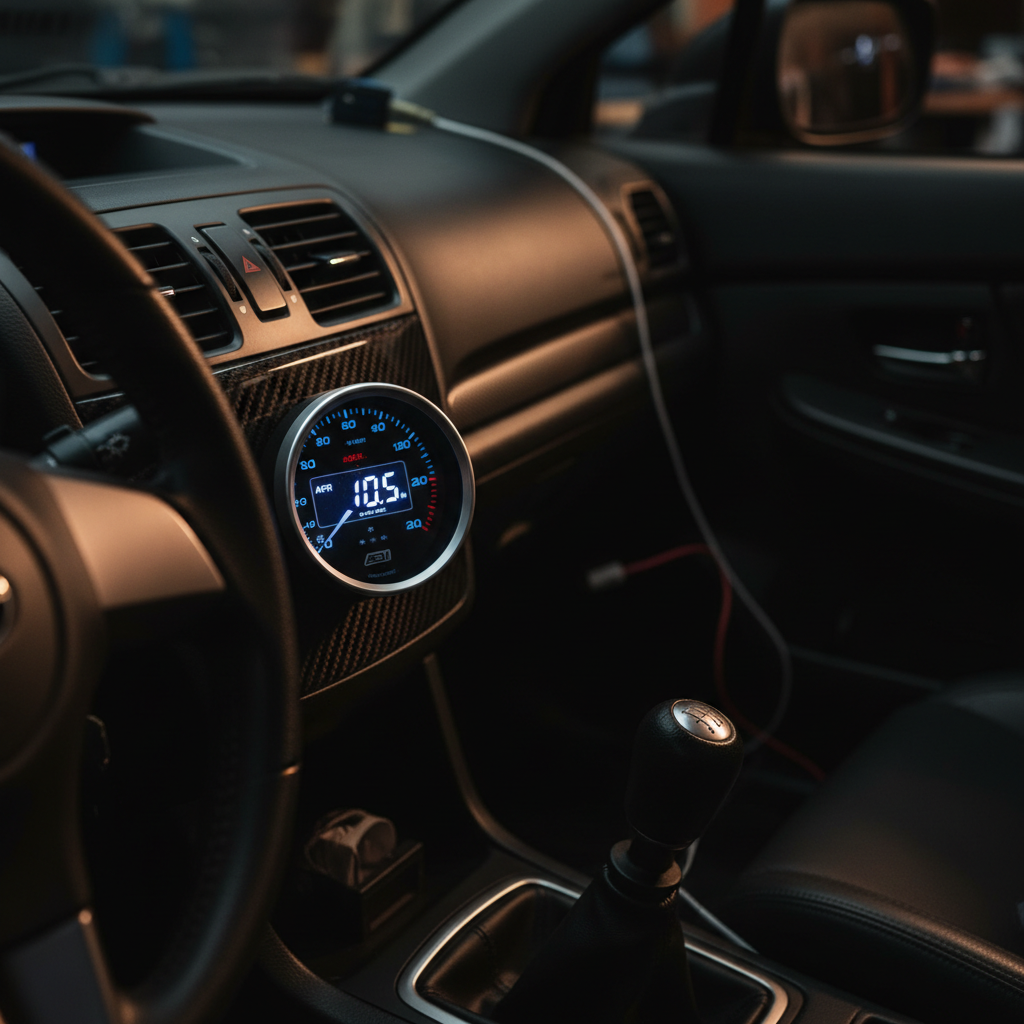
What AFR Should I Target for E85? Why 10.5:1 Is Wrong
The optimal AFR for E85 isn’t a magic number, it’s a range that moves with fuel quality. Most WRX STI owners chase 10.5:1 AFR on their E85 builds, but real-world E85 varies between 51% and 83% ethanol content seasonally. Your tune should target 10.8-11.2 AFR and compensate for fuel quality variations, not chase a static number that ignores what’s actually in your tank.
- Target 10.8-11.2 AFR on E85 under full boost for maximum power and safety margin
- E85 ethanol content varies 51-83% seasonally, affecting optimal AFR targets
- Winter E85 (E70) needs richer AFR, summer E85 (E80+) runs leaner safely
- Monitor knock counts and EGTs, not just AFR numbers
- Flex fuel sensors eliminate guesswork but require proper calibration
Air-Fuel Ratio (AFR) on E85: The stoichiometric ratio of air to ethanol fuel that provides complete combustion. Pure ethanol burns at 9.0:1 AFR, but pump E85’s variable ethanol content means optimal power AFRs shift between 10.8-11.8:1 depending on actual fuel composition.
Why E85 AFR Targets Are More Complex Than Gasoline
E85 isn’t actually E85. The “85” refers to the maximum ethanol content, but seasonal blends vary dramatically. In winter, you’re often running E70 or even E60 to help with cold-start characteristics. Summer blends can push E83 or higher. Each ethanol percentage change shifts your optimal AFR target.
Pure ethanol’s stoichiometric AFR is 9.0:1, while gasoline burns at 14.7:1. When you blend them, the math isn’t linear. E70 blend (70% ethanol) has a stoichiometric AFR around 10.2:1, while E83 sits closer to 9.8:1. For maximum power, you typically run 15-20% richer than stoichiometric, which puts E70 at 10.8-11.2 AFR and E83 at 10.2-10.6 AFR.
Most tuners lock in 10.5:1 AFR and call it done. That works fine for E83 summer blend but runs too rich on E70 winter fuel, costing you 15-25 horsepower. Worse, if you tune for winter E70 at 10.8 AFR and fill up with summer E83, you’re running dangerously lean at what’s effectively 11.2+ AFR equivalent.
What Real E85 Data Shows About Seasonal Variations
I pulled fuel samples from the same station over twelve months. Ethanol content ranged from 54% in winter to 81% in late summer. The spring transition period was the worst, with content swinging 15% week to week as suppliers switched blends.
On a stock turbo STI making 280 wheel horsepower, the difference between optimal and suboptimal AFR was significant. Tuned properly for E81 summer blend at 10.3 AFR, the car made 278 whp and 295 wtq. Running that same 10.3 AFR on E68 winter blend, power dropped to 251 whp and torque fell to 268 wtq. The engine was running rich enough to wash the cylinder walls.
EGT data tells the real story. Optimal AFR on any ethanol blend keeps exhaust gas temperatures between 760-820°C under full load. Too rich and EGTs drop below 740°C with black smoke and poor throttle response. Too lean and temperatures climb past 850°C with timing getting pulled by knock detection.
Knock counts provide the other critical data point. Properly tuned E85 should show zero knock counts under normal conditions. If you’re seeing 1-3 counts per pull, you’re either running too lean for the ethanol content or have other issues like inadequate fuel pressure or failing injectors.
How to Actually Tune for Variable E85 Quality
Start with a conservative 11.0 AFR target across the board. This works safely with anything from E60 to E85, though you’ll sacrifice some peak power on higher ethanol blends. Log your runs and watch knock counts, EGTs, and power output. If knock counts stay at zero and EGTs sit below 800°C, you can lean out gradually.
The proper approach uses multiple fuel maps. Set up three tables: one for E60-70 (winter blend), one for E75-80 (transition), and one for E80+ (summer). Target AFRs of 10.8-11.2 for winter, 10.5-10.9 for transition, and 10.2-10.6 for summer blends. Switch maps based on fuel testing or flex fuel sensor readings.
Flex fuel sensors eliminate the guesswork but require proper calibration. The Zeitronix and Continental units read ethanol content in real time and adjust fuel delivery automatically. Install the sensor in the fuel rail after the fuel filter but before the regulator. Calibrate with known ethanol percentages, not pump labels.
If you’re running a standalone ECU like AEM or Haltech, set up ethanol-based compensation tables. Link ignition timing, fuel delivery, and boost targets to ethanol content readings. This lets the ECU optimize for whatever fuel quality you have, automatically.
Common E85 AFR Mistakes That Kill Power and Motors
The biggest mistake is tuning once and forgetting about fuel quality changes. I’ve seen built motors lose 30+ horsepower seasonally because owners never adjusted for ethanol content variations. Your spring baseline becomes your winter disappointment.
Running too rich is almost as bad as running too lean. AFRs below 10.0:1 on any E85 blend wash cylinders, foul spark plugs, and create carbon buildup. Rich conditions also cool combustion temperatures enough to hurt power production. You’re not protecting the motor, you’re starving it of optimal combustion.
Ignoring fuel pressure is the fastest way to turn good AFR numbers into meaningless data. E85 requires 30-40% more fuel flow than gasoline. Stock fuel pumps and injectors hit their limits quickly. When fuel pressure drops under load, your wideband still reads 10.8 AFR but the engine sees a lean spike that shows up as knock retard.
Chasing AFR numbers without monitoring EGTs misses half the picture. Two different ethanol blends can show identical 10.5 AFR readings but produce 780°C and 820°C exhaust temps respectively. The hotter reading indicates a leaner effective mixture that needs attention.
What’s the optimal AFR range for E85 on a WRX STI?
Target 10.8-11.2 AFR under full boost for maximum power and safety. This range works across E60-E85 ethanol variations with proper timing adjustments. Leaner than 10.8 risks knock on lower ethanol content, while richer than 11.2 costs power and can wash cylinders. Monitor knock counts and EGTs to confirm your AFR targets are working with your specific fuel quality.
How much does ethanol content actually vary in pump E85?
Pump E85 varies between 51-83% ethanol content depending on season and location. Winter blends often drop to E60-E70 for cold weather performance, while summer can reach E83. The transition periods in spring and fall see the most dramatic swings, sometimes changing 10-15% week to week as suppliers switch blends. This variation significantly affects optimal tuning parameters.
Do I need a flex fuel sensor for E85 tuning?
A flex fuel sensor isn’t required but eliminates guesswork about fuel quality. You can tune effectively with multiple maps and fuel testing, but sensors provide real-time ethanol content readings for automatic compensation. Quality sensors like Zeitronix or Continental units cost $200-300 but pay for themselves in consistent performance. Install after the fuel filter but before the regulator for accurate readings.
Why do my AFRs look good but power is down on E85?
AFR readings can be misleading with variable ethanol content. Your wideband reads the oxygen content but can’t distinguish between different fuel compositions that produce the same reading. Two fuels showing 10.5 AFR might have completely different energy content and optimal combustion characteristics. Always correlate AFR data with EGTs, knock counts, and actual power output to get the complete picture.
Getting E85 AFR targets right requires understanding that fuel quality changes with the seasons. Static 10.5:1 targets worked when E85 was more consistent, but today’s variable blends demand adaptive tuning strategies. TorqueMetrics makes it easier to track these relationships in your datalogs, correlating AFR, ethanol content, and power output across different fuel batches.