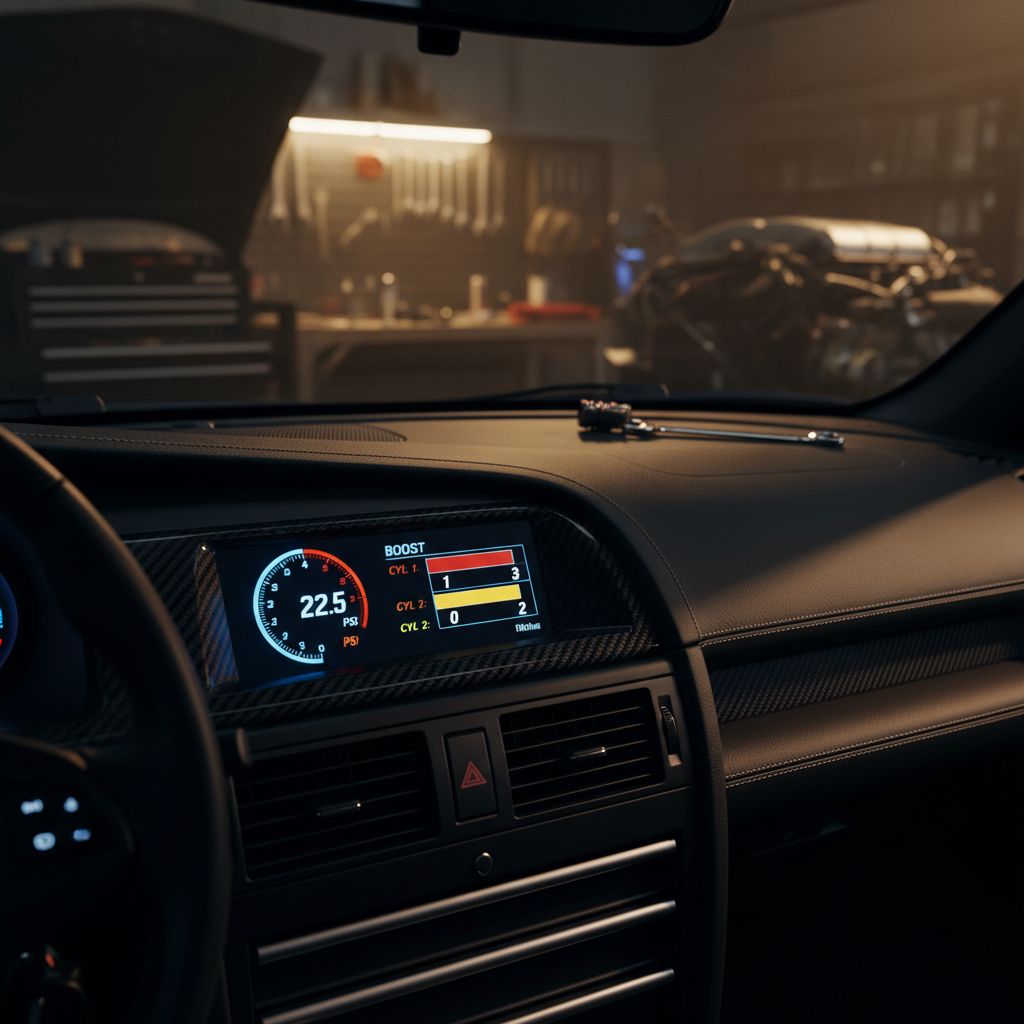
Why Your Knock Sensor Data Doesn’t Match How E85 vs 93 Feels
Your knock sensor data reveals the truth that your seat can’t feel: E85 might deliver more perceived torque, but it’s often masking timing retard that 93 octane wouldn’t trigger. When fuel prices push enthusiasts toward lower octane alternatives, the difference between what you feel and what’s actually happening in the combustion chamber becomes critical for engine longevity.
Key Takeaways:
- E85’s higher octane rating (100-105) allows more aggressive timing, but poor fuel quality or tuning can still trigger knock events
- 93 octane feels “harsher” because the ECU isn’t masking timing pull with extra fuel enrichment
- Knock sensor counts above 20 per pull indicate problems regardless of how smooth the power delivery feels
- Price-driven fuel switching without retuning creates the worst of both worlds: reduced performance and potential engine damage
- Actual power gains require datalogging timing advance, not just measuring seat-of-pants acceleration
Knock sensor sensitivity: The piezoelectric sensor that detects combustion knock operates in frequency ranges (typically 6-8 kHz) that register detonation events your body can’t perceive, especially when ECU strategies mask the symptoms through fuel enrichment and timing adjustments.
What Knock Sensors Actually Detect vs What You Feel
Your knock sensor responds to specific acoustic signatures in the 6000-8000 Hz range that indicate abnormal combustion. These frequencies occur milliseconds before you’d feel any power loss or roughness through the drivetrain. Modern ECUs react within 10-20 milliseconds, pulling timing and adding fuel before the knock becomes mechanically apparent.
This creates a disconnect between perception and reality. That smooth E85 pull where you swear you felt more power? Check your logs. You might find 40+ knock events with 6-8 degrees of timing retard compensated by richer AFRs around 10.2:1. The engine feels strong because the ECU is throwing fuel at the problem, but you’re actually losing the timing advance that E85’s 100+ octane rating should allow.
Meanwhile, 93 octane feels “harsher” precisely because there’s less headroom for the ECU to mask problems. When 93 starts knocking, you feel it immediately, timing gets pulled aggressively, and power drops noticeably. Your butt dyno correctly identifies the power loss, but incorrectly assumes E85 is superior when it might just be hiding worse combustion quality behind fuel enrichment.
Why E85 Data Often Shows More Knock Than Expected
E85’s reputation for knock resistance creates overconfidence in tuning and fuel system adequacy. Real-world E85 varies dramatically in ethanol content (51-83% depending on season and station), and most pump E85 sits closer to E70 during winter months. Your tune optimized for true E85 becomes overly aggressive when running E70, triggering knock events that feel smooth because the ECU compensates with enrichment.
Fuel system limitations compound this issue. E85 requires 30-40% more flow than gasoline, and marginal fuel pumps or injectors create lean spikes under load that register as knock. The sensor can’t distinguish between detonation from insufficient octane and detonation from momentary lean conditions. Both show up as knock counts in your logs, both get “fixed” by timing retard, and both feel acceptable in the seat because the ECU masks the symptoms.
Temperature also plays a role that seat-of-pants evaluation misses entirely. E85’s cooling effect on intake charge temperatures can mask the acoustic signature of light knock while still causing cylinder pressure irregularities that damage rings and bearings over time. You feel the power from cooler, denser air, but miss the combustion quality degradation that shows up clearly in sensor data.
How to Read Your Knock Data Correctly
Effective knock analysis requires understanding both frequency and intensity. Total knock count per pull matters less than sustained patterns and peak intensities. Occasional single-digit counts during transient load changes are normal. Sustained counts above 20 per pull indicate systematic issues regardless of fuel type.
Compare timing advance between fuels, not just knock frequency. Proper E85 tuning should allow 4-6 degrees more timing than 93 octane in the same conditions. If your E85 logs show similar timing to your 93 octane baseline with knock events, you’re getting none of ethanol’s octane benefit. You’re paying more for fuel that’s performing worse than pump gas.
AFR patterns tell the real story about fuel system adequacy. Stable 10.8-11.2 AFRs under full load indicate proper E85 delivery. Richer ratios (10.0-10.5) suggest the ECU is adding fuel to suppress knock rather than optimize power. Leaner spikes above 11.5 point to flow limitations that cause knock regardless of octane rating.
Log intake air temperatures alongside knock data. E85 should consistently deliver 20-30°C cooler charge temps than 93 octane. If temperatures are similar, you’re not getting ethanol’s cooling benefit, and knock resistance will be compromised accordingly.
Common Mistakes That Hide Real Performance Issues
The biggest error is switching fuels without retuning, then judging performance by seat feel alone. Your ECU’s adaptive systems will compensate for the new fuel’s characteristics, but not optimally. You get acceptable performance that feels strong while leaving significant power on the table and potentially creating long-term durability issues.
Many enthusiasts also misinterpret knock sensor sensitivity settings. Turning down knock sensitivity to reduce false positives creates dangerous blind spots where real detonation goes undetected until catastrophic failure occurs. The sensor should be calibrated correctly, not neutered to hide tuning inadequacies.
Price-driven fuel decisions compound these problems. Switching to E85 when gas prices spike, then back to 93 when ethanol gets expensive, creates constant adaptation cycles that prevent proper baseline establishment. Your ECU never stabilizes on optimal parameters for either fuel, resulting in consistently compromised performance regardless of octane rating.
Ignoring fuel quality variations represents another critical oversight. E85 content varies seasonally and regionally, but most enthusiasts assume consistency. Running winter E70 on a summer E85 tune creates lean conditions and knock that feels acceptable because modern ECUs are exceptionally good at damage prevention through conservative adjustments.
Frequently Asked Questions
Why does E85 feel more powerful even when knock sensors show more events?
E85’s higher latent heat of vaporization cools intake charges significantly, increasing air density and torque production. This cooling effect masks combustion irregularities that would feel rough on gasoline. Additionally, ECUs compensate for knock by enriching the mixture, which can actually increase perceived torque in the short term while sacrificing timing advance and long-term reliability. Your butt dyno responds to immediate torque increases but can’t detect the timing retard that’s costing you peak power.
What knock count per pull should trigger concern regardless of fuel type?
Sustained knock counts above 20 events per full-throttle pull indicate systematic issues that require immediate attention. Occasional counts of 5-10 during transient conditions are normal, especially during gear changes or initial throttle application. However, consistent patterns of 15+ counts, peak intensities above manufacturer thresholds, or any knock accompanied by timing retard exceeding 4-6 degrees suggest either inadequate octane, fuel delivery problems, or excessive ignition advance for the current conditions.
Can you safely tune more aggressively on E85 without monitoring knock sensors?
Absolutely not. E85’s higher octane rating provides more headroom for timing advance, but fuel quality varies dramatically between stations and seasons. Real-world E85 ranges from E51 to E83 depending on location and time of year. A tune optimized for true E85 becomes dangerously aggressive on lower ethanol blends. Additionally, E85 requires 30-40% more fuel flow, and inadequate delivery creates lean conditions that cause knock regardless of octane rating. Knock sensor monitoring becomes more critical with E85, not less.
How do I distinguish between real knock and false knock sensor triggers?
Real knock occurs under consistent conditions: high load, advanced timing, elevated intake temps, or lean AFRs. False triggers are random, often coinciding with electrical interference, injector noise, or valve train events. Log knock intensity alongside engine RPM, load, timing, and AFR. Real knock intensifies with increased load and timing advance, while false triggers show no correlation with combustion parameters. Additionally, real knock typically occurs in specific RPM ranges where cylinder pressure peaks coincide with sensor resonant frequencies, usually 3000-5500 RPM under boost.
Understanding what your knock sensors actually detect versus what you feel transforms fuel selection from guesswork into data-driven decision making. The next time fuel prices tempt you toward octane switching, pull some logs first. Your engine’s longevity depends on what the data shows, not what your seat tells you. TorqueMetrics makes this analysis straightforward, turning raw sensor data into actionable insights that protect your investment while maximizing performance.