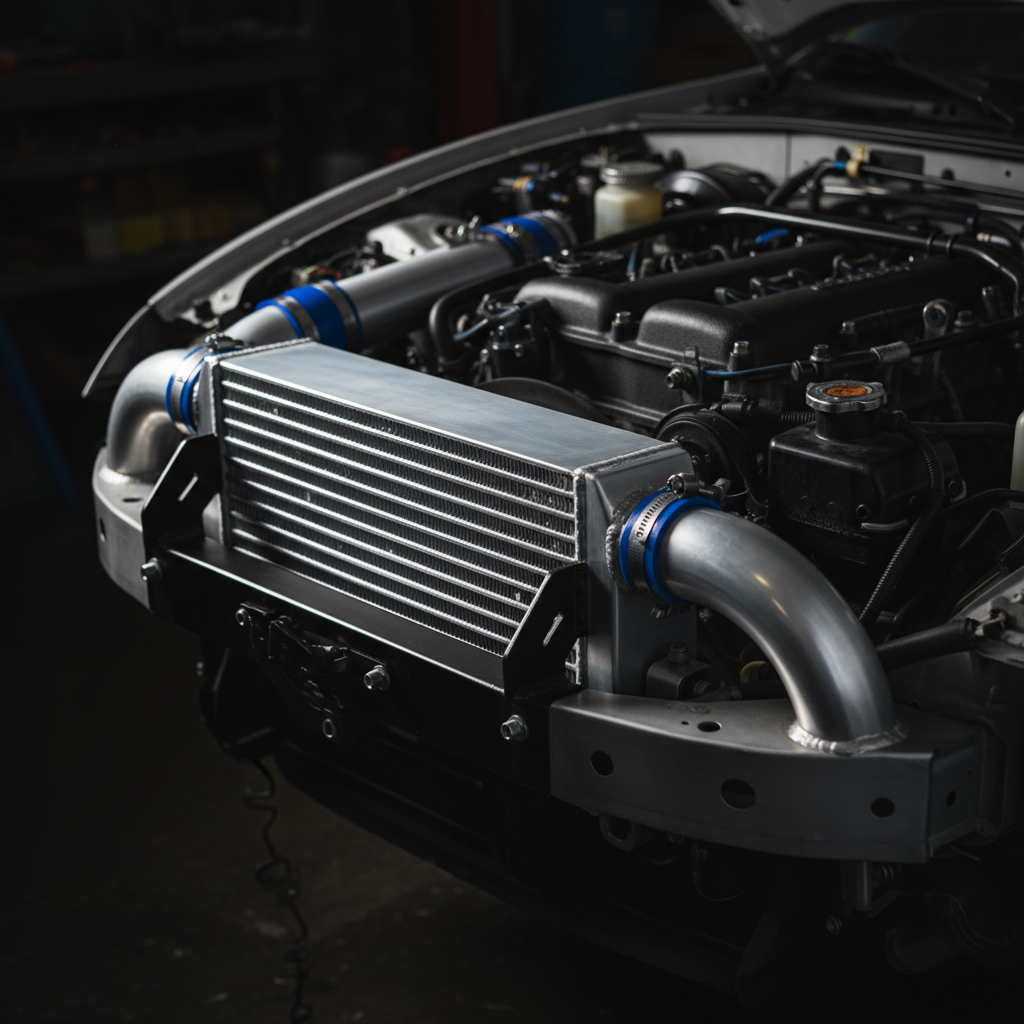
Why Big Front-Mount Intercoolers Kill Turbo Miata Response
Big front-mount intercoolers are killing turbo Miata performance because builders obsess over core size while ignoring charge air recovery time. A large intercooler core takes 3-5 seconds to purge hot air after a pull, leaving you with charge air temperatures above 60°C on your next acceleration run.
Quick Answer
- Large front-mount cores hold 2-4 times more hot air volume than top-mount setups
- Recovery time between pulls increases from 1-2 seconds to 4-6 seconds with oversized cores
- Optimal core volume for street-driven turbo Miatas is 6-12 litres, not 15-20+ litres
- Charge air temps above 50°C trigger timing retard and reduce power output by 8-15%
- Shorter, wider cores outperform tall, deep cores for transient response
Intercooler recovery time: The period required for an intercooler core to purge residual hot charge air and return to baseline temperatures after a high-load event, directly affecting subsequent acceleration performance.
What Core Volume Actually Does to Response Time
Your intercooler isn’t just cooling air, it’s storing it. Every cubic centimetre of core volume holds charge air at whatever temperature your last pull heated it to. When you get back on boost after a spirited run, that hot air gets pushed into your intake manifold before the fresh, cooled charge air arrives.
A typical 600mm x 300mm x 100mm front-mount core holds roughly 18 litres of internal volume. Compare that to a top-mount setup at maybe 4-6 litres. After a third-gear pull that heats your charge air to 80°C, that entire 18-litre volume needs to be displaced before you see proper cooling again. At 300 CFM airflow, that’s 4-5 seconds of compromised performance.
The data backs this up consistently. Log charge air temperature during back-to-back acceleration runs and you’ll see the problem. First pull shows normal 35-40°C temps. Second pull starts at 60-70°C and takes several seconds to drop. Your ECU sees those elevated temps and pulls 2-4 degrees of timing, costing you 15-25 wheel horsepower right when you need it most.
Why Street Driving Exposes This Problem
On the dyno, your intercooler gets continuous airflow and time to stabilize between runs. Real-world driving is different. You’re making pulls, sitting at lights, cruising, then getting back on it. Every traffic light or corner becomes a thermal trap where your massive intercooler core holds heat.
Track days make this worse. Your charge temps might read 45°C at the start of a session, but by lap three they’re sitting at 55-65°C baseline. That extra core volume that looked great on paper is now working against you. The intercooler can’t shed heat fast enough during the brief straight sections, and each corner exit starts with hotter charge air.
Log your intake air temps during a 20-minute session. You’ll see steady climb even with good ambient airflow. A smaller, more efficient core would cycle fresh air faster and maintain lower baseline temperatures. Surface area matters, but only if the core can actually process the air volume quickly enough.
How to Size Your Intercooler Properly
Start with your airflow requirements, not maximum core size. A stock turbo Miata moves 250-350 CFM under full boost. Size your core internal volume to cycle that airflow in 1-2 seconds maximum. That puts you in the 6-12 litre range for internal volume, depending on your specific turbo and target power.
Core dimensions matter more than total size. A 450mm x 230mm x 76mm core outperforms a 600mm x 300mm x 100mm unit for street driving. The smaller core has less internal volume but similar surface area. Result: faster air cycling, lower recovery time, better transient response.
Bar and plate cores work better than tube and fin for this application. The flow characteristics allow for more complete air exchange and less dead volume. You’ll see 5-8°C better recovery temps with a quality bar and plate design sized properly.
End tank design affects this too. Large plenum end tanks create dead zones where hot air sits. Smaller, more direct end tanks force better air movement through the core. Check your pressure drop across the intercooler, aim for 1-2 PSI (7-14 kPa) maximum at full boost.
What Happens When You Get This Wrong
The most common mistake is buying the biggest intercooler that fits. Builders see a massive 700mm x 350mm x 120mm core and assume bigger equals better. Then they wonder why their car feels sluggish after spirited driving or why their dyno numbers don’t match track performance.
Heat soak becomes a major issue with oversized cores. The thermal mass is too large for the available airflow to cool effectively. Your intercooler becomes a heat reservoir instead of a heat exchanger. Charge air temps climb steadily during driving and never fully recover.
Timing retard compounds the problem. Modern ECUs pull timing aggressively when they see elevated intake temps. A few degrees of retard costs power, but it also increases exhaust gas temperatures. Higher EGTs mean more heat into your turbo, which heats the charge air more, creating a thermal spiral.
Turbo lag increases because the ECU runs conservative timing and boost until charge temps drop. What feels like turbo lag is actually the engine management system protecting itself from knock. Your massive intercooler is forcing the ECU into safe mode more often than a properly sized unit would.
How much power loss should I expect from poor intercooler sizing?
Expect 8-15% power loss when charge air temps exceed 50°C due to timing retard and reduced knock threshold. A properly sized intercooler maintains charge temps within 10-15°C of ambient under steady-state conditions. Oversized cores can show 25-35°C above ambient during transient conditions, triggering significant timing pull and power reduction.
What’s the ideal intercooler core volume for a street turbo Miata?
Target 6-12 litres of internal core volume for street-driven turbo Miatas making 200-300 wheel horsepower. This allows for 1-2 second air cycling time at typical airflow rates. Cores larger than 15 litres internal volume create response problems unless you’re running very high boost levels continuously. Calculate internal volume as core length × width × thickness × 0.7 to account for fin density.
Should I choose front-mount or top-mount for better response?
Top-mount intercoolers provide better transient response due to lower core volume and shorter piping routes. Front-mount setups can match top-mount response if sized correctly, but most builders go too large. Top-mount locations also benefit from more consistent airflow and faster heat dissipation. Choose based on your priorities: maximum cooling capacity (front-mount) or best throttle response (top-mount).
How do I measure intercooler recovery time in my datalogs?
Log charge air temperature during back-to-back acceleration runs separated by 10-20 seconds. Recovery time is measured from the end of the first pull until charge temps return to within 5°C of baseline. Good recovery time is under 3 seconds, acceptable is 3-5 seconds, and anything over 5 seconds indicates oversized core volume for your airflow.
Getting your intercooler sizing right transforms how your turbo Miata drives. The difference between a properly sized core and an oversized one shows up in every datalog, every track session, and every spirited drive. TorqueMetrics can help you analyze those charge air temperature patterns and optimize your setup for real-world performance, not just peak numbers.