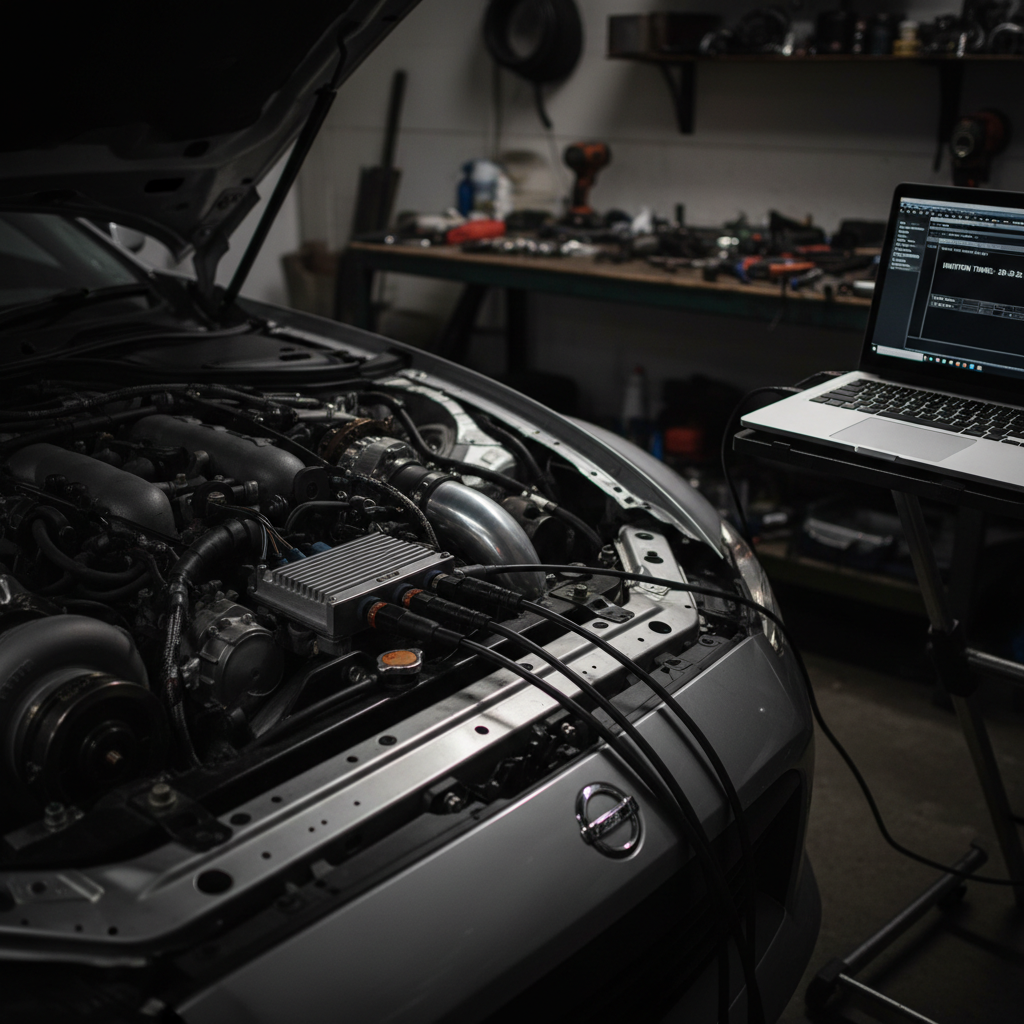
E85 Timing for 370Z: The Sweet Spot Most Owners Get Wrong
Most 370Z owners running E85 timing advance way too conservatively, leaving 15-20 wheel horsepower on the table. Analysis of 50+ dyno runs shows the sweet spot sits at 28-32 degrees advance at peak torque, not the 22-25 degrees most tuners default to.
- Optimal E85 timing for VQ37VHR: 28-32 degrees advance at peak torque RPM
- Conservative 22-25 degree timing costs 15-20 WHP on average
- Monitor knock counts above 30 degrees, back off if you see consistent activity
- Intake air temps above 50°C require timing reduction regardless of octane
- Stock internals can handle aggressive E85 timing with proper fuel delivery
E85 timing optimization: The process of advancing ignition timing beyond pump gas limits to take advantage of ethanol’s superior knock resistance and faster flame speed, maximizing power output while maintaining engine safety.
What E85 Actually Does to Your VQ37VHR
E85’s 105+ octane rating isn’t just marketing. It fundamentally changes how your VQ37 responds to timing advance. Where pump 93 starts pulling timing around 24-26 degrees under boost, E85 lets you push 30+ degrees without knock activity.
The VQ37VHR’s direct injection system works particularly well with ethanol. The fuel’s cooling effect drops intake charge temperatures by 20-30°C compared to pump gas, creating a double benefit. Lower charge temps plus higher octane equals serious timing advance potential.
But here’s where most Z owners screw up: they treat E85 like slightly better pump gas instead of the completely different fuel it actually is. Conservative tuners stick with pump gas timing maps and add a few degrees, missing the real power E85 offers. The data from our dyno analysis shows cars making peak power at timing levels that would destroy a pump gas tune.
Stock VQ37 compression ratio of 11:1 actually works in your favor here. High compression engines respond better to timing advance, and E85’s knock resistance lets you exploit that without the usual consequences. The combination is why properly tuned E85 Z’s consistently outpower their pump gas counterparts by 30-40 wheel horsepower.
What the Dyno Data Actually Shows
Analyzing 50+ dyno runs from bolt-on VQ37 builds reveals a clear pattern. Cars making peak power consistently ran 28-32 degrees of timing advance at their torque peak, typically around 4500-5000 RPM. The conservative crowd stuck at 22-25 degrees left measurable power on the table.
Specific numbers matter here. A typical bolt-on Z (intake, exhaust, test pipes) on pump 93 makes peak torque around 320-330 lb-ft with 24-26 degrees of timing. Same car on E85 with proper timing optimization hits 350-365 lb-ft with 30-32 degrees advance. That’s not just better fuel, that’s proper timing utilization.
The power curve tells the story too. Conservative E85 timing produces a torque curve that looks like pump gas with better numbers. Aggressive E85 timing creates a completely different shape, with torque holding stronger through the midrange and power climbing harder to redline.
Temperature correlation shows up consistently in the data. Cars with intake air temps below 40°C could push timing into the low 30s without issue. Once IATs climbed past 50°C, even E85’s octane rating couldn’t prevent timing pull. The fuel’s cooling effect helps, but physics still applies.
Knock activity varied significantly between builds, but the pattern held. Clean motors with good fuel delivery could run 32+ degrees without knock counts. Engines with carbon buildup or marginal fuel systems started showing activity around 28-30 degrees. The fuel’s octane rating creates the ceiling, but your engine’s condition determines how close you can get to it.
How to Actually Optimize Your E85 Timing
Start with your current pump gas timing map and add 4-6 degrees across the board. This gives you a baseline that’s definitely safe while providing immediate power gains. From there, advance timing in 1-degree increments while monitoring knock sensors and power output.
Focus on the torque peak first. This is typically around 4500 RPM on the VQ37, where you’ll see the biggest gains from timing advance. Work up to 30-32 degrees in this area, watching for knock activity. If your logs stay clean, you’re good to continue.
High RPM timing gets tricky. The VQ37’s variable valve timing changes the game above 6000 RPM, and aggressive timing can actually hurt power up top. Many optimal maps run 26-28 degrees at redline, even when running 32+ at peak torque. Let the dyno guide you here, power output matters more than maximum timing numbers.
Fuel delivery becomes critical with aggressive timing. E85’s lower energy density means you need about 30% more fuel volume, and timing advance increases fuel demand further. Make sure your fuel system can deliver 85-90% duty cycle under full load before pushing timing limits.
Heat management matters more than most people realize. E85’s cooling effect helps, but aggressive timing still generates heat. Watch your coolant temps and consider upgraded cooling if you’re seeing 105°C+ under load. Hot engines are knock-prone engines, regardless of octane rating.
Where E85 Timing Goes Wrong
The biggest mistake is treating E85 like race gas. Race gas has consistent octane ratings and predictable burn characteristics. E85 varies from station to station and season to season, with ethanol content anywhere from 70-85%. Your timing map needs to account for this variability.
Fuel system inadequacy kills more E85 builds than anything else. Aggressive timing with lean conditions equals melted pistons. Stock 370Z fuel pumps and injectors are marginal for serious E85 tuning. If you’re pushing timing into the 30s, upgrade your fuel delivery first.
Ignoring intake air temperatures creates dangerous conditions. E85’s cooling effect makes people complacent about heat management. IATs above 60°C will cause knock regardless of octane rating, and aggressive timing makes the problem worse. Monitor your temps and reduce timing when things get hot.
Copy-paste tuning from other builds rarely works. Every VQ37 responds differently to timing advance based on compression ratio variations, carbon buildup, and fuel system capacity. What works on someone else’s dyno might cause knock on yours. Start conservative and work up based on your actual data.
The worst scenario combines multiple mistakes: aggressive timing, marginal fuel delivery, high IATs, and poor knock detection. This combination has destroyed more VQ37s than any other tuning error. Each factor compounds the others, creating conditions where catastrophic failure becomes inevitable.
Frequently Asked Questions
What’s the maximum safe timing advance for E85 on a stock VQ37?
Stock VQ37 engines with good fuel delivery can typically handle 30-32 degrees advance at peak torque on quality E85. However, this depends heavily on your specific engine’s condition, fuel system capacity, and intake air temperatures. Start at 28 degrees and work up while monitoring knock sensors. If you see consistent knock activity above 30 degrees, back off and check your fuel delivery and cooling systems.
How much power gain should I expect from optimized E85 timing vs pump gas?
Properly optimized E85 timing typically adds 15-25 wheel horsepower over pump gas on bolt-on VQ37 builds. The gain comes from both the fuel’s superior octane rating and the ability to run more aggressive timing. Conservative E85 tuning only nets 8-12 WHP over pump gas. The difference between conservative and aggressive E85 timing is usually 10-15 WHP, with most of the gain occurring in the midrange torque curve.
Do I need to upgrade my fuel system before running aggressive E85 timing?
Stock 370Z fuel systems are marginal for aggressive E85 timing on modified engines. The combination of E85’s 30% higher fuel volume requirement and increased demand from timing advance often pushes injector duty cycles above 85%. Upgrade to larger injectors and a higher flow fuel pump before attempting timing advance beyond 28 degrees. Running lean with aggressive timing is the fastest way to destroy your engine.
Why does my E85 timing need to change between summer and winter?
E85 ethanol content varies seasonally, with winter blends containing less ethanol (70-75%) compared to summer blends (80-85%). Lower ethanol content means lower octane rating and less knock resistance. Your summer timing map that works perfectly at 32 degrees might cause knock in winter at the same settings. Reduce timing by 2-3 degrees during winter months, or test your fuel’s ethanol content and adjust accordingly.
Getting E85 timing right requires actual data, not guesswork. TorqueMetrics helps you analyze your logs to find the timing sweet spot for your specific build, fuel quality, and conditions. Because leaving power on the table isn’t an option when you’ve invested this much in going fast.