Why Your Dyno Tune Isn’t Telling the Whole Story
Your dyno sheet shows 350whp and clean AFRs across the pull. Three weeks later, you’re getting knock retard at part throttle and your AFRs are wandering under load. The dyno didn’t lie, but it only told you what happened during those specific pulls under controlled conditions.
- Dyno tuning captures 2-3 minutes of data under ideal conditions, missing real-world variables like heat soak and varying fuel quality
- Continuous monitoring reveals knock events, AFR drift, and boost irregularities that only show up during daily driving
- Real tuning problems surface at part throttle loads between 2500-4000rpm, ranges often skipped during dyno pulls
- Data collection failures mean missing critical events that happen between formal tuning sessions
- Most reliability issues stem from conditions the dyno never tested, not peak power scenarios
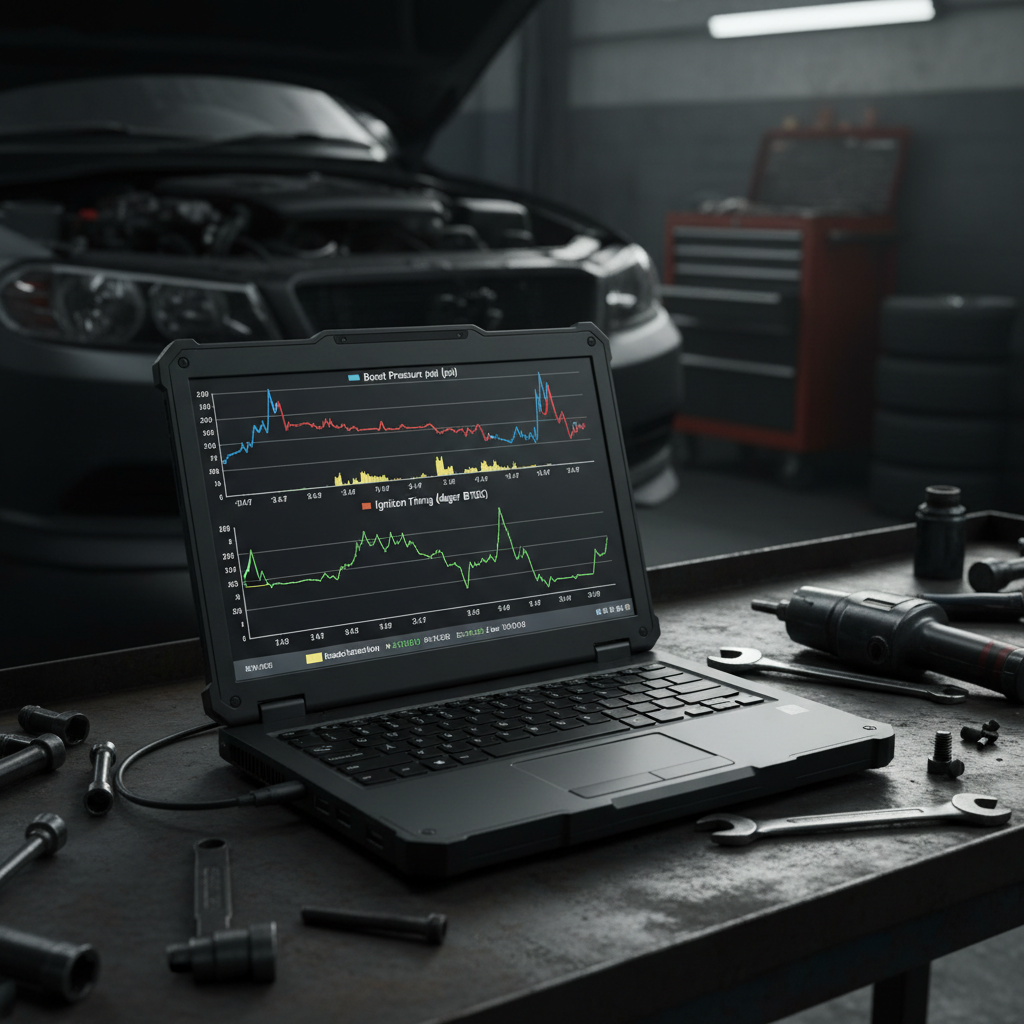
Continuous data monitoring: The practice of logging engine parameters during normal driving conditions, capturing real-world variables that controlled dyno environments can’t replicate. It’s the difference between a snapshot and a full documentary of your engine’s behavior.
What Dyno Tuning Actually Captures
A typical dyno session logs 2-3 minutes of data across 4-6 pulls. You’re seeing peak performance under controlled conditions: consistent intake temps, fresh fuel, optimal atmospheric pressure, and a transmission that’s not heat-soaked from stop-and-go traffic. The dyno operator holds the car at specific RPM points to dial in timing and fueling maps.
This approach works for peak power optimization. Your tune will make clean power at WOT from 4000rpm to redline because that’s what got tested and refined. But your engine spends maybe 1% of its operating time in that zone.
The other 99% happens at part throttle, varying loads, different intake temps, and fuel quality that changes with every fill-up. Your engine sees 15-20 PSI (103-138 kPa) boost spikes during aggressive highway merging that never happened on the dyno. It experiences knock conditions at 3200rpm under 40% throttle when climbing hills in hot weather. These scenarios don’t exist during dyno pulls, so they never get addressed in the tune.
Temperature management is where dyno tuning shows its biggest blind spot. Intake air temps stay consistent with the shop’s ventilation system, but real-world driving sees temperatures swing from 25°C to 65°C depending on traffic and ambient conditions. Your timing maps might be perfect at 30°C but dangerously aggressive at 55°C.
What Real-World Data Actually Shows
Continuous monitoring during daily driving reveals patterns that dyno sessions miss entirely. You’ll discover knock events happening consistently at 2800-3200rpm during highway onramps, not because your tune is bad, but because that load range combined with heat-soaked conditions creates scenarios the dyno never tested.
AFR drift is another common finding. Your dyno pulls show steady 11.8 AFR under boost, but real-world logs reveal drift to 12.4-12.6 after 10 minutes of spirited driving as fuel pumps heat up and voltage drops. This lean condition might only last 30 seconds during aggressive driving, but that’s enough to cause damage over time.
Boost control irregularities show up clearly in continuous data. While the dyno showed clean boost curves to your 18 PSI (124 kPa) target, street driving reveals momentary spikes to 22-23 PSI (152-159 kPa) during rapid throttle transitions. These spikes happen too quickly for dyno operators to catch but occur repeatedly during normal acceleration.
Part-throttle timing issues surface in the 2500-4000rpm range under varying load conditions. The engine might pull 4-6 degrees of timing at 3200rpm when climbing a grade in 4th gear, a scenario that doesn’t exist during dyno pulls that typically test wide-open throttle or specific load points.
Fuel system limitations become apparent under extended load conditions. Your dyno pulls showed adequate fuel pressure, but 15 minutes of aggressive canyon driving reveals pressure drops from 58 PSI to 52 PSI (400 to 358 kPa) as the fuel system heat-soaks and the pump struggles to maintain flow.
How to Set Up Proper Continuous Monitoring
Start logging immediately after your dyno tune. Set your logging parameters to capture knock retard, AFRs, boost pressure, intake temps, fuel pressure, and timing advance at 10Hz minimum. Higher sample rates catch transient events that slower logging misses.
Focus on transition scenarios the dyno couldn’t replicate. Log during highway merging, hill climbing under partial throttle, and extended spirited driving sessions. These situations stress your tune in ways steady-state dyno pulls cannot.
Set up triggered logging for knock events. Configure your system to automatically start detailed logging when knock retard exceeds 2-3 degrees, capturing the conditions that caused the event. Manual logging often misses the critical moments when problems occur.
Monitor fuel system parameters during extended sessions. Log fuel rail pressure, pump duty cycle, and voltage under varying load conditions. Fuel delivery issues often develop gradually and only show up after the system has been working hard for several minutes.
Track intake air temperature correlation with timing retard. Set up your logging to flag when IATs exceed 50°C and monitor how much timing gets pulled. This data helps identify when your tune becomes too aggressive for real-world conditions.
What Goes Wrong When You Skip Continuous Monitoring
Engines develop knock damage from conditions that never occurred during dyno tuning. You leave the shop with a tune that’s perfect for controlled conditions but dangerous when intake temps climb or fuel quality drops. The first sign of trouble often comes as unexplained power loss weeks later when compression has already been compromised.
Fuel system failures catch owners by surprise because dyno pulls don’t stress pumps and injectors for extended periods. Your tune might demand 85% injector duty cycle for 2-3 seconds during dyno pulls, but real-world driving sustains those demands for 30-60 seconds, revealing inadequate fuel flow that wasn’t apparent during testing.
Heat-related timing retard reduces power and efficiency in real-world conditions while maintaining perfect dyno numbers. Your 350whp tune might only deliver 310whp during actual spirited driving due to timing being pulled for elevated intake temps, but you won’t know this without continuous monitoring.
Boost control issues lead to inconsistent power delivery and potential engine damage from momentary overboosting. These spikes happen during aggressive driving scenarios that dyno testing doesn’t replicate, leaving dangerous conditions unaddressed in the tune.
Part-throttle drivability suffers because these operating ranges receive minimal attention during dyno sessions focused on peak power. You end up with an engine that makes great power at WOT but stumbles, knocks, or runs poorly during normal driving conditions.
Frequently Asked Questions
How often should I review my continuous monitoring data?
Review your logs weekly for the first month after any tune changes, then monthly during normal driving. Look for trends in knock events, AFR drift, or boost irregularities that develop over time. Set up automatic alerts for knock retard exceeding 4 degrees or AFRs going leaner than 12.0 under boost. Most reliability issues show warning signs in the data before they cause noticeable performance problems or engine damage.
What logging parameters matter most for catching tune problems?
Prioritize knock retard, AFR, boost pressure actual vs target, intake air temperature, and timing advance. These five parameters catch 90% of real-world tuning issues that dyno sessions miss. Log at 10Hz minimum to capture transient events. Secondary parameters like fuel rail pressure and EGT help diagnose specific issues but aren’t critical for general monitoring. Most problems show up as knock retard combined with one other parameter exceeding normal ranges.
Can continuous monitoring replace dyno tuning entirely?
No, but it’s an essential complement to dyno work. Dyno tuning provides controlled conditions for establishing baseline maps and achieving peak power safely. Continuous monitoring reveals real-world variables that require tune adjustments. The most reliable builds combine both approaches: dyno tuning for initial optimization and ongoing data monitoring for real-world validation and refinement. Street tuning alone lacks the controlled environment needed for safe power optimization, while dyno-only tuning misses critical real-world scenarios.
The data tells the real story of your tune’s performance. Continuous monitoring during daily driving reveals the knock events, AFR drift, and boost irregularities that determine long-term reliability. Your dyno sheet captured peak performance, but your daily logs show whether that performance survives real-world conditions. Tools like TorqueMetrics help you analyze this continuous stream of data, identifying patterns and problems that single dyno sessions simply cannot capture.