Spring ECU Tuning Mistakes That Destroy Engines
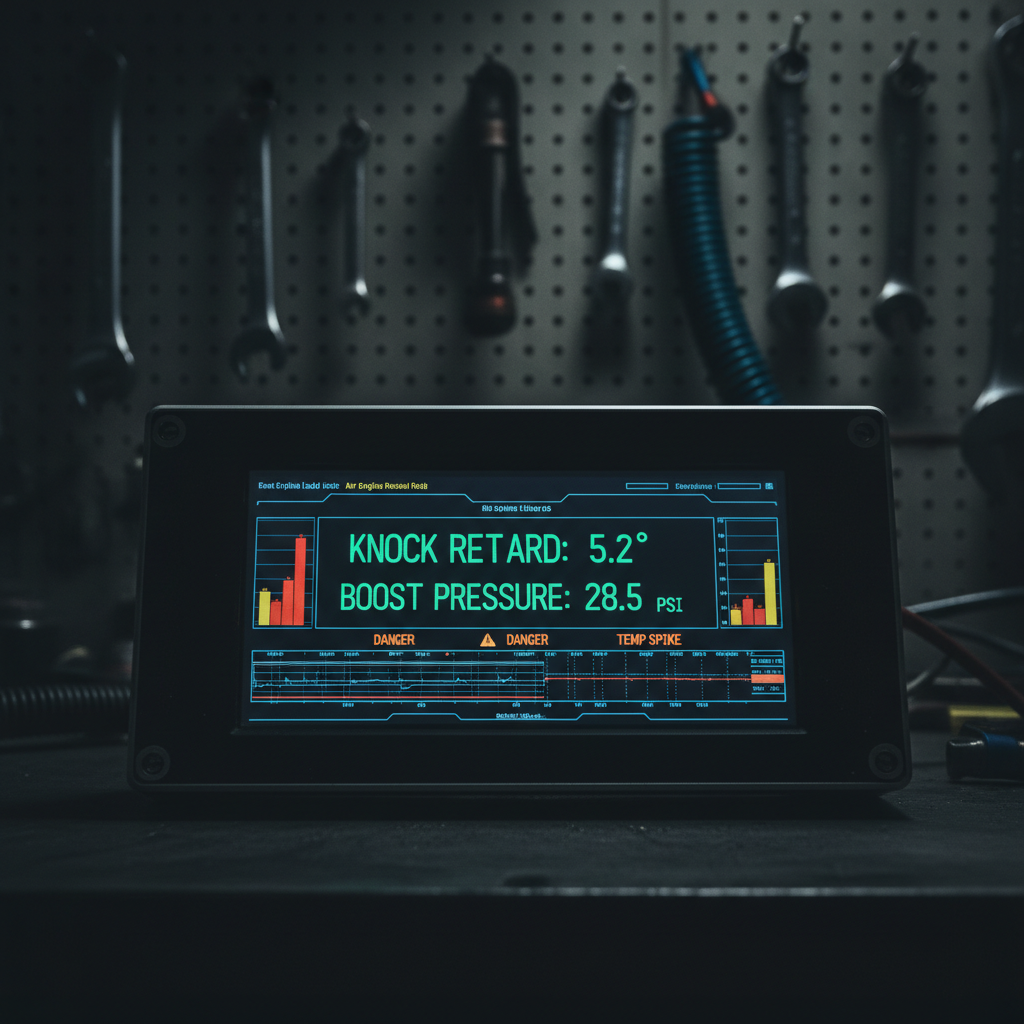
Spring tuning season is here, and the same three expensive mistakes are already destroying engines across the country. The most costly error? Running high boost on stock internals while completely ignoring knock retard values climbing past 4 degrees. Your ECU is screaming that it’s pulling timing to save your engine, but 90% of enthusiasts never look at that data point until they hear the rod knock.
Quick Answer: Top Spring Tuning Mistakes
- Knock retard over 4 degrees sustained: Your ECU is pulling timing to prevent detonation — listen to it or rebuild your engine
- 22+ PSI (151+ kPa) on stock internals: Factory rods and pistons weren’t designed for this abuse, especially with heat soak
- Ignoring intake air temps over 49°C: Hot air makes less power and creates more knock — your tune goes out the window
- Heat soak progression: Spring weather fools you into thinking your cooling system can handle summer abuse
- One critical data point: Monitor knock retard continuously, not just peak power pulls
ECU tuning mistakes: Critical errors in engine calibration or monitoring that lead to catastrophic engine failure, typically involving excessive boost pressure, ignored knock detection, or inadequate cooling system preparation during peak tuning season.
What Spring Weather Does to Your Tune
Spring weather is a tuner’s trap. Those perfect 18°C mornings make every car feel bulletproof, and that’s exactly when people push too hard. Your car made 350whp on a 4°C winter day, so obviously it’ll make the same power when it’s 24°C and sunny, right?
Wrong. Intake air temperatures climb 11 to 17°C just from ambient changes, and that’s before heat soak kicks in. Your intercooler that worked fine in winter suddenly can’t keep up. Charge air temps that were sitting at 32°C in winter are now hitting 49°C on the same tune. Every 5.5°C rise in intake air temp costs you roughly 1% power and increases knock sensitivity.
The data tells the real story. I’ve seen logs where knock retard values that never exceeded 1 to 2 degrees in winter suddenly spike to 6 to 8 degrees on the same tune with warmer weather. Your ECU is doing its job — pulling timing to keep your engine alive. But most people only look at boost pressure and AFR, completely missing the fact that their motor is three degrees of timing pull away from catastrophic failure.
Mistake #1: Ignoring Knock Retard Data
Here’s the number that matters: any sustained knock retard over 4 degrees means you’re living on borrowed time. Not peak retard — sustained retard during power pulls. I’ve seen logs where guys are bragging about their 25 PSI (172 kPa) pulls while their ECU is pulling 8 degrees of timing to keep the motor together.
Stock ECUs are conservative, but they’re not miracle workers. When you see knock retard climbing consistently above 2 to 3 degrees, your tune is asking for more than your setup can deliver. Modern knock detection is sophisticated — it’s not just listening for audible knock. It’s measuring cylinder pressure oscillations and combustion irregularities that precede the kind of knock that breaks things.
The expensive lesson comes when people see those numbers and think “the ECU is just being conservative.” Then they flash a more aggressive tune or bypass knock protection entirely. Six months later they’re posting in forums about their spun bearing, wondering what went wrong. The data told them exactly what was going wrong — they just weren’t listening.
Mistake #2: 22+ PSI on Stock Internals
Spring is when people get greedy with boost. Winter kept things reasonable, but now everyone wants to see what their setup can really do. The magic number where things get expensive is 22+ PSI (151+ kPa) on stock internals, especially on platforms that came with 18 to 20 PSI (124 to 138 kPa) from the factory.
Stock rods and pistons have safety margins, but they’re not infinite. Every manufacturer calculates those margins based on expected operating conditions — not modified boost levels with questionable fuel quality and aftermarket tunes. When you’re pushing 25 PSI (172 kPa) through connecting rods designed for 18 PSI (124 kPa) peak loads, you’re gambling with physics.
The failure mode is predictable. High cylinder pressures create side loads that stock rods can’t handle long-term. Add heat soak, pump gas instead of race fuel, and timing maps that weren’t validated on a dyno, and you’ve created the perfect recipe for rod bearing failure. The engine doesn’t explode dramatically — it just starts making expensive noises at idle six months later.
Heat soak makes this worse because it reduces the effective octane of your fuel. That 98 octane that was fine at 38°C intake temps becomes knock-prone when your charge air hits 54°C. Your ECU starts pulling timing, power drops, and the natural response is to add more boost to compensate. Now you’re running higher cylinder pressures with worse fuel quality and less timing. That’s exactly how connecting rods die.
Mistake #3: Missing Heat Soak Warning Signs
Heat soak kills more engines than pure stupidity because it’s gradual and most people don’t log the right parameters. You need to watch intake air temperature, not just coolant temp. Your cooling system can look perfect while your intercooler is getting overwhelmed.
The warning signs are in your data: intake air temps climbing past 49°C, knock retard values increasing through consecutive pulls, and AFR going rich as the ECU tries to cool cylinders with extra fuel. When you see intake temps hitting 60°C or higher, you’re asking for trouble regardless of your tune.
Spring weather fools people because ambient temps are still reasonable, but heat soak builds differently than in winter. Your intercooler isn’t getting the same cooling efficiency, your radiator isn’t seeing negative 1°C air anymore, and traffic creates heat that didn’t exist during winter pulls on empty roads.
The smart move is establishing baseline logs in controlled conditions, then monitoring how those same parameters change as weather warms up. If your intake air temps are climbing 8 to 11°C compared to winter logs on the same tune, you need to back down boost or improve cooling before pushing harder.
What Goes Wrong When You Miss These Signs
The expensive failures aren’t dramatic. Nobody posts videos of bearings spinning or pistons cracking because it happens gradually, then all at once. The most common scenario: everything seems fine until you’re driving normally some months later and hear a knock at idle that wasn’t there before.
Rod bearing failure starts with sustained high cylinder pressures that exceed the bearing’s load capacity. The bearing wears slightly out of spec, oil clearances increase, and oil pressure drops under load. Eventually the bearing spins, destroys the crank journal, and turns your engine into an expensive paperweight.
Piston failure follows a similar pattern. Ring land cracks don’t happen immediately — they develop from repeated thermal cycling under high cylinder pressures. The crack propagates slowly until the ring land breaks completely, oil consumption skyrockets, and compression disappears in that cylinder.
The rebuild costs are brutal because these failures take other components with them. A spun bearing usually damages the crankshaft, which means machine work or replacement. Ring land failure often scores cylinder walls, requiring boring and new pistons. What started as a $2,000 forged internals upgrade becomes an $8,000+ complete rebuild because the failure wasn’t caught early.
How much boost can stock internals handle safely?
Most stock internals are safe up to 20 to 22 PSI (138 to 151 kPa) depending on the platform, but cylinder pressure matters more than boost pressure alone. High boost with good intercooling and proper timing is safer than moderate boost with heat soak and aggressive timing. Monitor knock retard continuously — sustained values over 4 degrees indicate you’re exceeding safe limits regardless of boost level. Factor in fuel quality, intake air temps, and load duration when determining safe boost levels.
What knock retard values indicate immediate danger?
Sustained knock retard over 6 degrees indicates immediate risk of engine damage, while consistent retard over 4 degrees suggests your tune is too aggressive for current conditions. Peak retard values matter less than sustained patterns — brief spikes to 8 to 10 degrees during transients are less concerning than constant 5-degree retard during steady-state operation. Modern ECUs pull timing aggressively to prevent damage, so high retard values mean the system is working hard to keep your engine alive.
How does spring weather affect engine tuning safety?
Spring weather increases intake air temperatures by 11 to 22°C compared to winter conditions, reducing effective octane and increasing knock tendency. Your intercooler efficiency drops as ambient temperatures rise, making heat soak more likely during consecutive pulls. Traffic and stop-and-go driving create heat buildup that doesn’t occur during winter highway pulls. Monitor intake air temps closely — values over 49°C significantly increase knock risk even on conservative tunes.
What’s the most overlooked parameter in engine datalogs?
Knock retard is the most critical overlooked parameter because it directly indicates when your engine is operating beyond safe limits. Most enthusiasts focus on boost pressure, AFR, and peak power while ignoring the ECU’s real-time assessment of combustion quality. Knock retard values show exactly when your tune becomes dangerous for current conditions. Sustained retard over 4 degrees means immediate tune revision or hardware upgrades are necessary to prevent catastrophic failure.
Spring tuning season doesn’t have to end with expensive rebuild bills. The data tells you everything you need to know about your engine’s safety margins — you just need to know which numbers matter. Start monitoring knock retard on every pull, respect your cooling system’s limits, and remember that stock internals have finite strength regardless of how good your tune looks on paper.