Why Stage 2 Builds Fail: It’s Not The Hardware, It’s The Timing
Stage 2 builds fail because most off-the-shelf tunes run the same aggressive ignition timing map on every engine, completely ignoring individual knock thresholds. Your blown ringlands aren’t a hardware lottery, they’re the predictable result of a timing map that doesn’t respect what your specific engine can handle.
Quick Answer: Why Stage 2 Builds Actually Fail
- Off-the-shelf Stage 2 tunes typically run 18-20° timing advance across the board without individual engine calibration
- Each engine has a unique knock threshold, some handle aggressive timing, others start pulling at 16°
- Hardware upgrades (intake, downpipe, intercooler) don’t change your engine’s fundamental knock sensitivity
- Successful Stage 2 builds require timing maps tailored to your engine’s actual knock response, not generic profiles
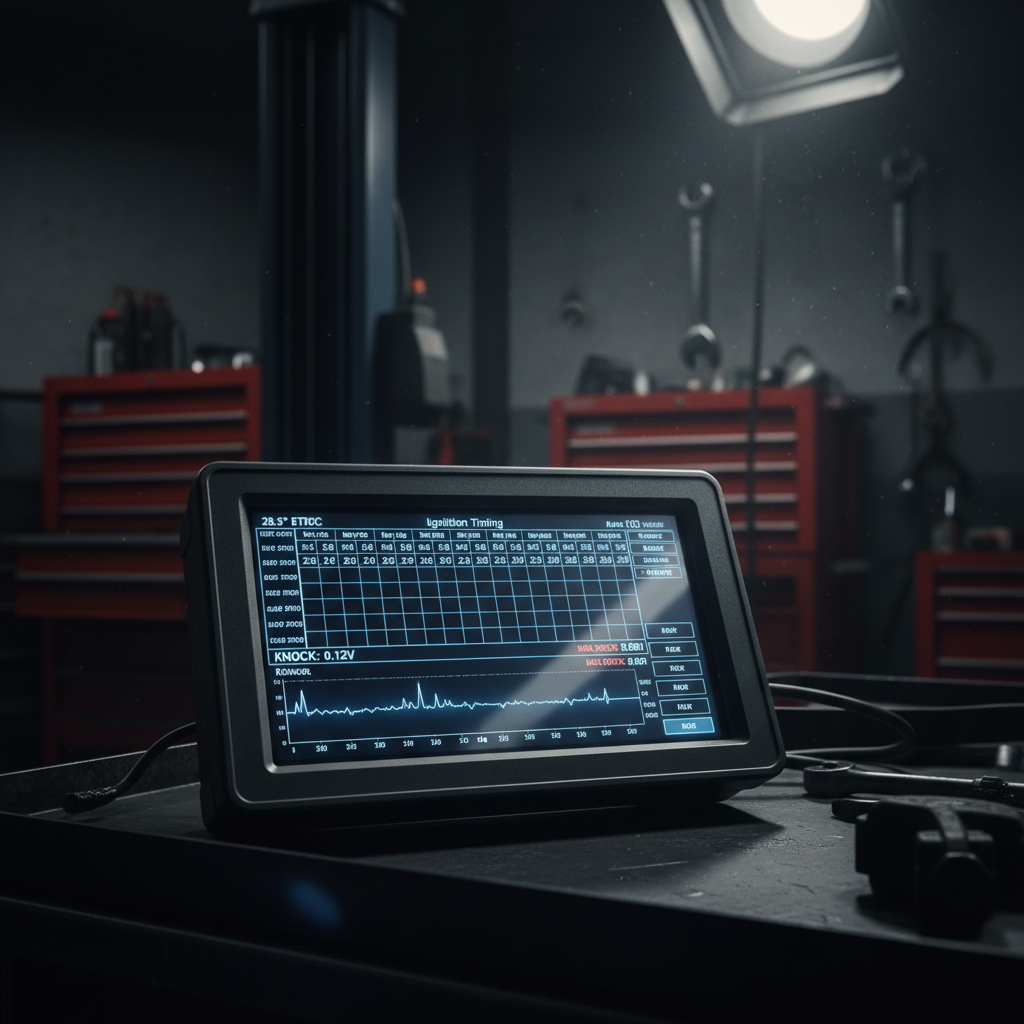
- Your datalog shows knock events long before catastrophic failure, most people just don’t know how to read it
Stage 2 tune: A modified engine calibration designed to work with basic bolt-on modifications like a cold air intake, catted or catless downpipe, and upgraded intercooler. The tune adjusts fuel maps, boost targets, and ignition timing to extract additional power from these hardware changes.
What Stage 2 Actually Means for Your Engine
Stage 2 isn’t just “more boost.” It’s a complete recalibration of how your engine manages air, fuel, and spark timing with upgraded hardware in the mix. The typical Stage 2 setup on a WRX or Civic Type R adds an intake, downpipe, and intercooler, then bumps boost from the factory 14-16psi to 18-22psi.
Here’s where it gets interesting. The hardware changes alter your engine’s breathing characteristics, but they don’t change its fundamental knock sensitivity. That cast iron block in your WRX still has the same combustion chamber design, the same compression ratio, and the same tendency to knock under aggressive timing. The intercooler helps with charge temps, sure, but it doesn’t magically allow your engine to tolerate 20° of timing advance if it was borderline at 16°.
Most tuners understand this. The problem is scale. When you’re selling hundreds of Stage 2 maps, you can’t custom-tune each one. You build a map that works on most engines, add some safety margin, and ship it. That “works on most engines” part is where people get burned.
Your engine might be the one that starts seeing knock activity at 17° instead of 19°. The off-the-shelf tune doesn’t know this. It’s going to keep pushing timing until your knock sensors start screaming, and by then you’re already walking the line.
What Your Datalog Shows Before Things Go Bad
The data always tells the story before the engine does. A properly logged Stage 2 car shows specific patterns when the timing map is too aggressive for that particular engine. You’ll see knock counts climbing above 2-3 per pull, timing corrections pulling more than 4-5 degrees consistently, and knock retard values that don’t return to baseline between runs.
On a healthy Stage 2 setup, knock counts should stay at zero or occasionally tick to 1 under the heaviest load. Timing corrections should be minimal, maybe 2-3 degrees under peak boost, returning to zero as load decreases. If you’re seeing sustained knock counts of 4-6 and timing getting pulled back 6-8 degrees from the base map, that’s your engine telling you the timing curve is too aggressive.
The really telling parameter is knock retard recovery. A well-tuned engine will see timing corrections under heavy load but return to the base timing map within a few seconds of backing out of boost. If your timing stays retarded for 10-15 seconds after a pull, or never fully recovers to base timing, your knock sensors are working overtime to keep detonation in check.
EGTs tell another part of the story. Stage 2 cars running appropriate timing typically see exhaust gas temperatures in the 1500-1650°F range under sustained load. If you’re consistently hitting 1700°F or higher, excessive timing advance is creating more heat than your engine can efficiently manage. Combined with persistent knock activity, high EGTs are often the canary in the coal mine.
How to Actually Tune Stage 2 for Reliability
Real Stage 2 tuning starts with establishing your specific engine’s knock threshold, not with installing a generic map and hoping for the best. This means starting conservative and building timing advance gradually while monitoring knock response in real-time. Most engines show their limits clearly if you know how to read the data.
Begin with a timing map that’s 3-4 degrees more conservative than the “standard” Stage 2 profile. Make incremental timing adjustments, 1-2 degrees at a time, while datalogging each change. Your knock threshold is the timing advance where knock counts consistently exceed 1-2 per pull or where timing corrections become persistent rather than momentary.
The key insight most people miss: your maximum reliable timing advance might be 15° when the off-the-shelf tune is running 19°. That doesn’t make your engine defective, it makes it different. A properly calibrated tune accounts for this difference and builds power through optimized fueling and boost control rather than pushing timing to the edge.
Boost control becomes critical at this point. If your engine can’t handle aggressive timing, you extract power by running slightly higher boost with more conservative timing. Many successful Stage 2 builds run 20-21psi with 16° of timing rather than 18psi with 19° of timing. The power output is similar, but the knock margin is much healthier.
Why Generic Stage 2 Tunes Create Failure Patterns
The failure pattern is predictable because the underlying problem is systematic. Generic Stage 2 tunes optimize for peak dyno numbers, not longevity. They’re designed to make impressive power on a healthy engine during a brief dyno session, not to run reliably for 20,000 miles of daily driving and weekend canyon runs.
This creates a specific type of engine damage. Instead of catastrophic failure from obvious over-boost or lean conditions, you get progressive deterioration from chronic low-level knock. The engine doesn’t explode dramatically, it slowly beats itself apart over months of operation. Ringlands develop stress fractures, rod bearings show accelerated wear, and cylinder walls start to show scuffing patterns.
The cruel irony is that these failures often happen after the car has been running “fine” for 6-12 months. The owner assumes the tune is solid because nothing immediately broke. Meanwhile, the datalog has been showing warning signs the entire time, elevated knock counts, persistent timing corrections, and gradually increasing oil consumption as ring seal deteriorates.
Insurance against this pattern requires understanding that Stage 2 isn’t just about adding power, it’s about adding power within your engine’s specific tolerance window. That window varies significantly between individual engines, even within the same model year and production batch.
FAQ
Why do some Stage 2 cars run fine with aggressive timing while others blow up?
Individual engine tolerance varies significantly due to manufacturing tolerances, carbon buildup, and component wear patterns. Two identical cars can have knock thresholds that differ by 3-4 degrees of timing. The engines that “run fine” with aggressive timing are simply on the tolerant end of the spectrum, but they’re still operating closer to their limits than necessary. Over time, even these engines typically show accelerated wear patterns compared to more conservatively tuned examples.
How can I tell if my Stage 2 tune is too aggressive before something breaks?
Monitor knock counts during normal driving, they should rarely exceed 1-2 per pull under any conditions. Watch for timing corrections that persist for more than 5-10 seconds after backing out of boost, and track your oil consumption over time. Gradually increasing oil usage combined with persistent knock activity indicates progressive ring wear from chronic detonation. EGTs consistently above 1650°F under load also suggest timing that’s too aggressive for reliable operation.
Is it worth paying extra for custom tuning over an off-the-shelf Stage 2 map?
Absolutely, especially if you plan to keep the car long-term. A proper custom tune establishes your engine’s actual knock threshold and builds the timing map around that limit, rather than hoping your engine tolerates a generic profile. The cost difference between custom tuning and off-the-shelf maps is typically $300-500, while engine rebuilds start around $8,000. Custom tuning also extracts more reliable power by optimizing boost and fueling for your specific combination of modifications.
Can upgraded internals fix Stage 2 reliability issues caused by aggressive timing?
Forged internals increase your engine’s mechanical strength but don’t change its fundamental knock characteristics. A motor with forged pistons and rods can still experience detonation damage if the timing map is too aggressive. The upgraded components provide more margin before catastrophic failure, but chronic knock still causes accelerated wear and reduced longevity. Proper tuning remains more important than upgraded internals for Stage 2 reliability.
Your Stage 2 build doesn’t have to be a reliability gamble. Understanding how timing maps interact with your engine’s specific knock threshold turns bolt-on modifications into a sustainable performance upgrade. Ready to see what your datalog actually shows about your current tune? Try TorqueMetrics free and get the insights your engine has been trying to tell you.