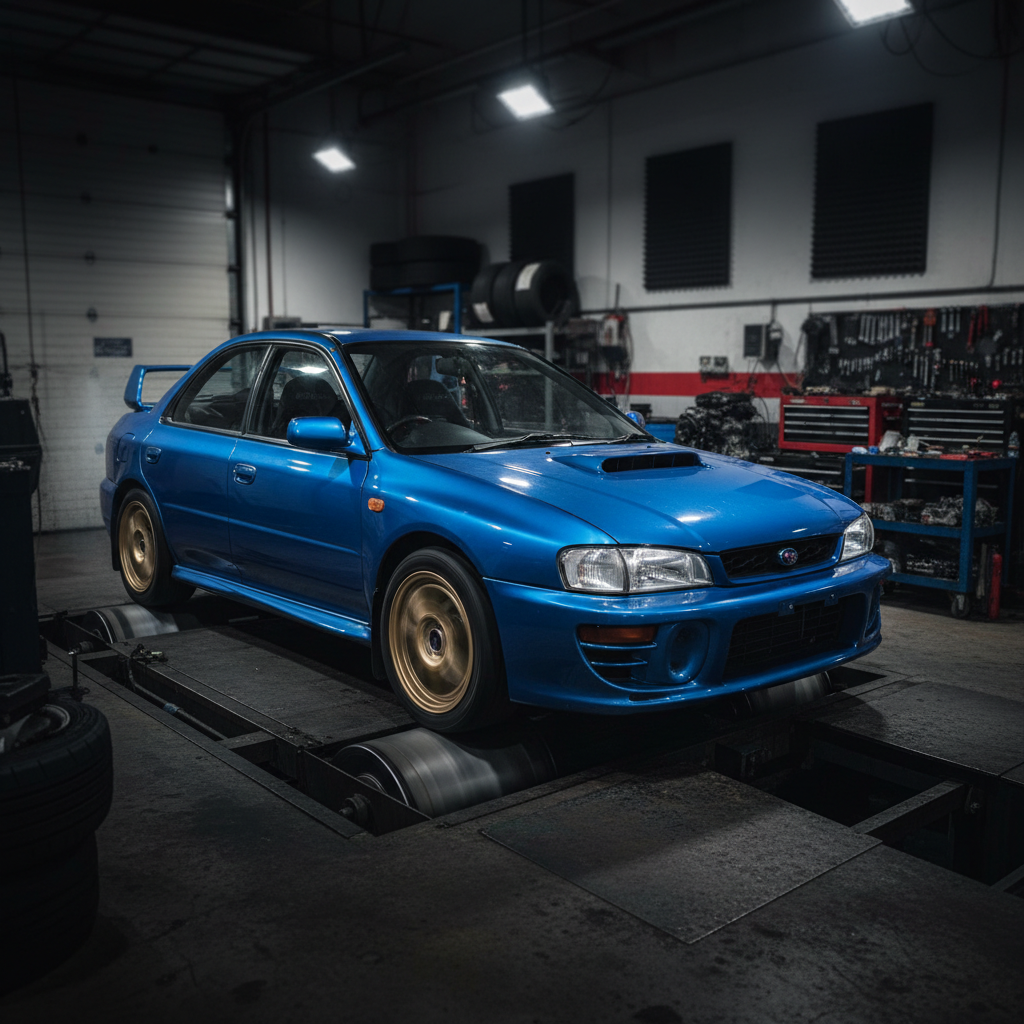
Why Dyno Numbers Don’t Tell the Whole Story for Tuning
Your dyno sheet’s peak horsepower number is marketing material. The real performance story lives in the curves most people ignore, boost consistency through the rev range, AFR stability under sustained load, and how your knock count behaves when the engine’s actually working. A 400whp peak that falls off a cliff at 6500rpm won’t pull like a 375whp curve that stays flat to redline.
Quick Answer:
- Peak dyno numbers vary 15-20% between different dyno brands due to correction factors and load simulation
- Boost curve consistency matters more than peak boost, look for smooth ramp rates and stable hold pressure
- AFR should stay within 0.2 points throughout the pull, not just hit target at peak torque
- Progressive knock retard under load indicates tuning headroom, sudden spikes mean trouble
- Area under the curve predicts real-world performance better than peak numbers
Dyno result discrepancies: Variations in peak power readings between different dyno shops due to equipment differences, correction factors, environmental controls, and load simulation methods, often ranging 15-20% for the same vehicle.
What Dyno Numbers Actually Mean in Context
Every dyno measures something different. DynoJet dynos read higher because they use a lighter load simulation. Mustang dynos load the engine harder and typically read 10-15% lower. A Dynapack hub dyno eliminates driveline losses entirely and reads different from both. Your 400whp on a DynoJet might be 340whp on a Mustang dyno, same car, same tune, same day.
The correction factors make it worse. SAE correction assumes standard atmospheric conditions that don’t exist in your garage. STD correction is more conservative but still can’t account for your specific air density, fuel quality, or how heat-soaked your intercooler gets during back-to-back pulls. Weather stations help, but they’re measuring conditions miles away from your engine bay.
This is why comparing dyno numbers between shops is mostly pointless unless you’re using the same dyno with the same operator on the same day. The number that matters is the difference between your baseline and your current state on the same equipment.
What the Data Actually Shows Beyond Peak Numbers
Look at your boost curve first. Peak boost means nothing if it spikes to 22psi at 3500rpm then bleeds to 16psi by redline. You want smooth ramp rate, typically 2-4psi per 1000rpm depending on your turbo, and stable hold pressure within 1psi of target throughout your power band. Boost spikes indicate poor wastegate control or undersized plumbing. Gradual bleed-off means your turbo is out of its efficiency range.
AFR stability tells you if your fueling system can keep up. Your target might be 11.0 under full boost, but if you’re seeing 11.3 at peak torque and 10.6 at redline, your fuel system is struggling. E85 should hold within 0.2 AFR points throughout the pull. Pump gas can be more forgiving, but swings wider than 0.3 points indicate inadequate fuel flow or poor injector response.
Timing advance progression reveals your tune’s safety margin. Aggressive tunes might start with 18 degrees of advance at low RPM and end with 12 degrees at redline as cylinder pressures climb. Conservative tunes hold steadier timing. Watch for sudden timing pulls, a jump from 15 degrees to 8 degrees between data points means your ECU detected knock or hit a safety limit.
How to Read Power Curves for Real-World Performance
Area under the curve predicts acceleration better than peak numbers. A broad, flat torque curve from 3000-6500rpm will out-accelerate a peaky curve that makes more peak power but only holds it for 500rpm. Calculate the average horsepower across your usable RPM range, this number correlates better with quarter-mile times than peak horsepower.
Power delivery rate matters for traction-limited cars. A tune that builds power smoothly will hook better than one that hits like a switch. Look at the slope of your torque curve. Sharp rises can overwhelm your tires and suspension. Gradual builds let you apply power progressively.
Consider your shift points against your power curve. If your engine makes peak power at 6800rpm but your torque curve crosses the next gear’s torque curve at 6200rpm, you should shift early. The dyno sheet shows you exactly where each gear change should happen for optimal acceleration.
What Goes Wrong When You Only Chase Peak Numbers
Peak power tunes often sacrifice drivability and reliability. Pushing timing advance to maximum safe levels might gain 15whp at redline but create knock sensitivity on pump gas or hot days. Running lean AFRs for maximum power output reduces engine longevity and increases the risk of detonation under varying conditions.
Boost controller tuning focused on peak pressure often creates poor spool characteristics. Setting your wastegate duty cycle to hit maximum boost at redline might cause boost spikes at lower RPM that stress your engine components and create inconsistent power delivery.
Ignoring the supporting data leads to expensive failures. Your dyno might show 450whp, but if your EGTs are climbing past 1650°F, your AFRs are wandering, and your knock counts are accumulating, you’re heading for engine damage. Peak power without data validation is gambling with your engine’s life.
Street tuning becomes problematic when chasing dyno numbers. A tune optimized for dyno conditions, controlled temperature, premium fuel, back-to-back pulls, might not handle real-world variables like traffic, varying fuel quality, or sustained highway pulls where heat soak becomes a factor.
How TorqueMetrics Turns Raw Data Into Readable Reports
TorqueMetrics processes your raw datalog files to show the complete performance picture. Instead of just displaying peak numbers, it identifies boost curve inconsistencies and flags AFR stability issues. You get actionable insights about where your tune is working and where it needs attention.
Frequently Asked Questions
Why do different dynos show different power numbers for the same car?
Dynos measure power differently based on their loading method, correction factors, and calibration. DynoJet dynos use inertia-based measurement and typically read 10-15% higher than Mustang dynos, which apply steady-state load. Environmental corrections for temperature, humidity, and barometric pressure also vary between facilities. The same car can easily show 20% variation between different dyno types and operators.
What dyno metrics actually predict quarter-mile performance?
Area under the torque curve from your launch RPM to shift points correlates better with acceleration than peak power numbers. Calculate average horsepower across your usable RPM band, typically 3000-6500rpm for most builds. Power delivery rate and boost response also matter significantly for traction-limited launches. A smooth, progressive power curve will often out-accelerate a peaky tune with higher peak numbers.
How much power variation between dyno pulls indicates a problem?
Consecutive pulls on the same dyno should vary less than 2-3% in peak power if your tune is consistent and your cooling system is adequate. Larger variations indicate heat soak, inconsistent boost control, or fueling issues. AFR readings should stay within 0.2 points between pulls on E85 and 0.3 points on pump gas. Progressive power loss across multiple pulls suggests inadequate cooling or fuel delivery problems.
Should I tune for peak power or area under the curve?
Tune for area under the curve unless you’re building a dedicated drag car that only needs power at specific RPM points. Broad, flat torque curves provide better real-world performance and drivability. Most street and track applications benefit more from consistent power delivery across a wide RPM range than from maximizing peak numbers that only occur briefly during acceleration.
Your dyno sheet contains the complete story of your engine’s performance, but peak power is just the headline. TorqueMetrics helps you read between the lines to understand what your data actually means for real-world driving. Upload your logs to see the full picture of your tune’s performance characteristics.