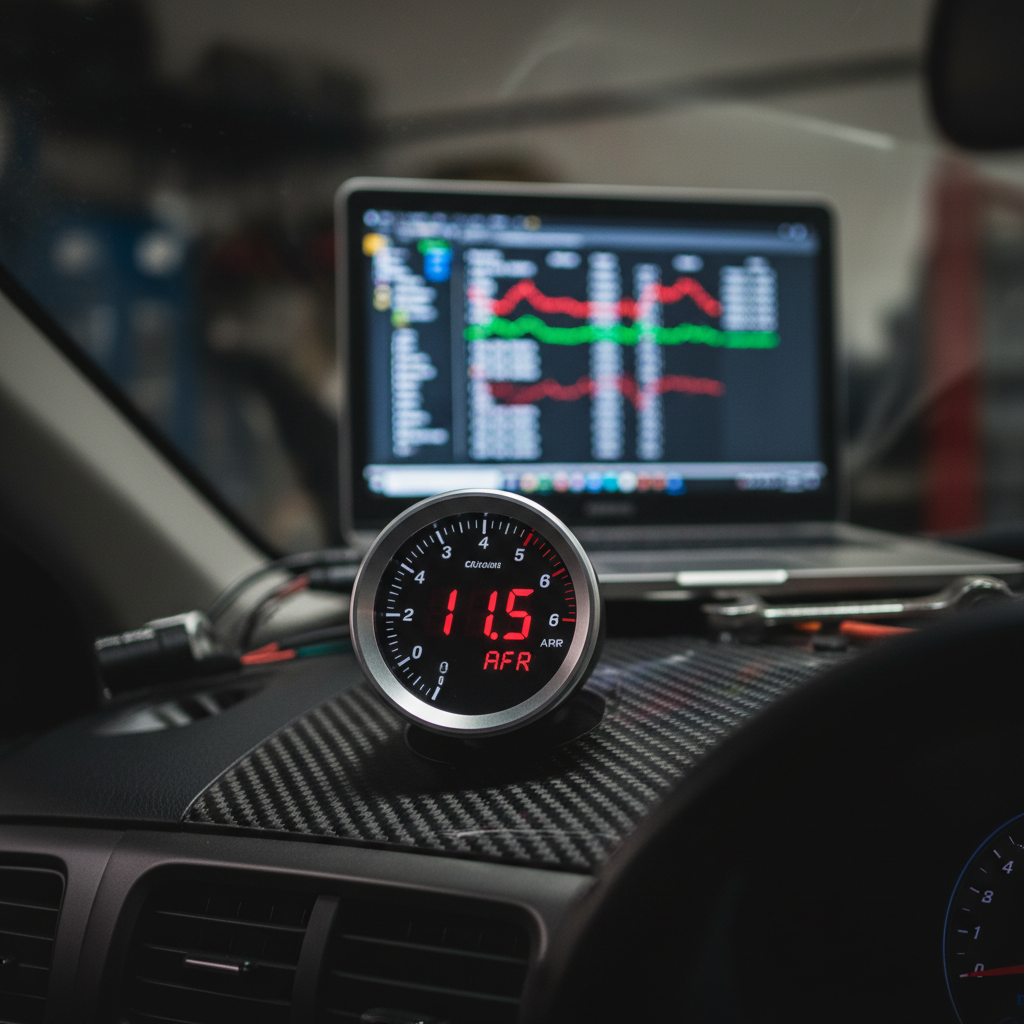
Why Your WRX STI Wideband Shows 11.5 AFR But ECU Logs 12.8
Your wideband gauge reads 11.5 AFR under full boost, but your ECU datalog shows 12.8 for the same pull. This isn’t a sensor failure or tuning error, it’s the reality of how different AFR measurement points work on Stage 2 WRX STI builds. The ECU reading from the factory narrowband upstream is what’s actually controlling fuel delivery and protecting your EJ257.
Quick Answer
- ECU AFR readings control fuel delivery, wideband readings are for monitoring only
- Sensor placement creates 0.5-1.5 AFR difference between upstream (ECU) and downstream (wideband) locations
- Factory narrowband sensors drift by 0.3-0.8 AFR points after 40,000+ miles, requiring calibration updates
- Wideband response time is 100-200ms faster than factory sensors under transient conditions
- Trust ECU AFR for tune safety, use wideband AFR for steady-state verification
AFR sensor discrepancy: The difference in air-fuel ratio readings between your ECU’s factory narrowband sensor and aftermarket wideband sensor, caused by sensor placement, calibration differences, and response time variations.
What Creates AFR Reading Differences in Stage 2 STI Builds
The EJ257 measures AFR at two different points in the exhaust system, and each sensor type responds differently. Your ECU reads from the factory narrowband oxygen sensor mounted in the up-pipe, roughly 18 inches from the exhaust port. This sensor directly controls the ECU’s fuel delivery calculations. Your aftermarket wideband sits in the divorced wastegate dump or main exhaust, typically 24-36 inches downstream from the turbo outlet.
This placement difference creates measurable AFR variations. Exhaust gases cool and mix as they travel downstream, which affects the oxygen content your wideband sees. On a typical Stage 2 STI pushing 18 PSI (124 kPa), the upstream factory sensor might read 12.8 AFR while a downstream wideband shows 11.5 AFR for the same combustion event. The downstream location sees richer readings because residual fuel continues burning in the hot exhaust gases.
Temperature compensation adds another layer. Factory narrowband sensors include built-in temperature correction based on Subaru’s calibration tables. Aftermarket widebands use their own compensation algorithms, which may not match Subaru’s correction factors for the EJ257’s exhaust gas temperatures under boost.
What Your Datalog Actually Shows
Real-world STI datalogs reveal consistent patterns. During steady-state 4th gear pulls at 15-18 PSI (103-124 kPa), ECU AFR typically reads 0.8-1.3 points leaner than wideband AFR. The gap narrows under light load conditions to 0.3-0.5 AFR difference, and widens during aggressive transient events where boost climbs rapidly.
Response time differences become obvious during quick throttle transitions. Wideband sensors respond in 100-150ms, while factory narrowbands take 200-300ms to reflect AFR changes. This creates temporary reading gaps during boost spikes or quick throttle lifts. Your wideband will show the AFR change first, followed by the ECU reading catching up 100-200ms later.
Sensor drift affects long-term accuracy. Factory narrowband sensors on high-mileage STIs (60,000+ miles) commonly read 0.5-0.8 AFR leaner than actual values. This drift happens gradually and isn’t always obvious without comparing to a calibrated reference. Meanwhile, quality wideband sensors maintain accuracy within 0.1-0.2 AFR points for 30,000+ miles when properly maintained.
Which Reading Actually Protects Your Engine
The ECU AFR reading controls fuel delivery, period. Your tune’s safety margins and fuel maps reference the factory sensor location and calibration. When your tuner sets a target AFR of 11.2 for full boost, they’re targeting that value at the ECU sensor, not your wideband location. This is why professional tuners always datalog ECU AFR values, not rely solely on wideband readings.
However, wideband readings provide valuable verification data. If your ECU shows 12.0 AFR and your wideband shows 13.5 AFR, that 1.5+ point gap suggests potential issues. Either your wideband calibration is off, you have exhaust leaks affecting readings, or your factory sensor has drifted significantly and needs attention.
For knock protection, ECU AFR matters most. The factory knock sensors and timing maps correlate with the upstream AFR readings. If your tune pulls 4 degrees of timing due to knock while ECU AFR shows 12.5, richening the mixture to bring ECU AFR down to 11.8 will typically reduce knock activity. Your wideband reading during this same scenario is secondary information.
Use both readings strategically. ECU AFR for tune safety and fuel delivery verification, wideband AFR for steady-state confirmation and detecting long-term sensor drift patterns. Experienced STI tuners typically see ECU AFR readings 0.5-1.0 points leaner than wideband readings as normal for downstream sensor placement.
What Goes Wrong When You Trust the Wrong Reading
Tuning to wideband AFR values instead of ECU AFR creates dangerous lean conditions. If your wideband shows 11.5 AFR and you assume that’s what the ECU sees, you might skip fuel adjustments while the ECU actually sees 12.8 AFR, which is lean enough to cause knock or detonation under high boost. This mistake has killed more than a few EJ257s.
Ignoring large AFR discrepancies leads to missed sensor failures. When the gap between readings exceeds 2.0 AFR points, something’s wrong. Common causes include vacuum leaks downstream of the MAF sensor, exhaust leaks near sensor bungs, or factory sensor contamination from oil consumption. These issues compound over time and affect tune reliability.
Over-relying on wideband response time during tuning creates unstable fuel maps. Widebands react faster to AFR changes, so using them for closed-loop fuel corrections can create oscillating fuel delivery as the system overcompensates for changes the factory sensor hasn’t detected yet. This shows up as AFR hunting during steady cruise conditions.
Calibration neglect causes gradual tune degradation. Factory sensors drift lean over time, especially on modified STIs running higher EGTs. If you don’t account for this drift in tune revisions, your actual AFR becomes progressively leaner than target values, increasing knock risk and reducing the safety margin your tuner originally built into the fuel maps.
Which AFR sensor controls fuel delivery on my STI?
The factory narrowband oxygen sensor in the up-pipe controls fuel delivery through the ECU’s fuel maps. This sensor’s readings directly influence injector pulse width and fuel trim corrections. Your aftermarket wideband sensor provides monitoring data but doesn’t control fuel delivery unless specifically wired into the ECU for closed-loop operation, which requires custom tuning setup.
Why does my wideband read richer than my ECU AFR logs?
Downstream wideband placement typically reads 0.5-1.5 AFR points richer than upstream ECU sensors due to continued combustion in hot exhaust gases and gas mixing effects. The further downstream your wideband sensor sits, the richer the reading becomes compared to the ECU’s upstream measurement. This difference is normal and consistent across most STI builds.
How much AFR difference between sensors indicates a problem?
AFR differences exceeding 2.0 points suggest sensor calibration issues, vacuum leaks, or exhaust leaks affecting readings. Normal differences range from 0.5-1.5 AFR points depending on sensor placement and boost levels. Sudden changes in the typical difference pattern often indicate sensor drift or developing mechanical issues that need investigation.
Should I tune based on wideband AFR or ECU AFR readings?
Always tune based on ECU AFR readings since they control actual fuel delivery and correlate with factory knock protection systems. Use wideband readings for verification and steady-state monitoring, but fuel map adjustments should target ECU AFR values. Professional tuners establish the normal difference between your sensors, then use both readings to verify tune consistency and detect sensor drift over time.
Understanding the relationship between your ECU and wideband AFR readings prevents confusion and protects your engine investment. Track both values in your datalogs, but remember which one actually controls fuel delivery when making tuning decisions. TorqueMetrics makes it easy to overlay both AFR sources in your datalog analysis, helping you spot trends and verify sensor accuracy across multiple pulls.