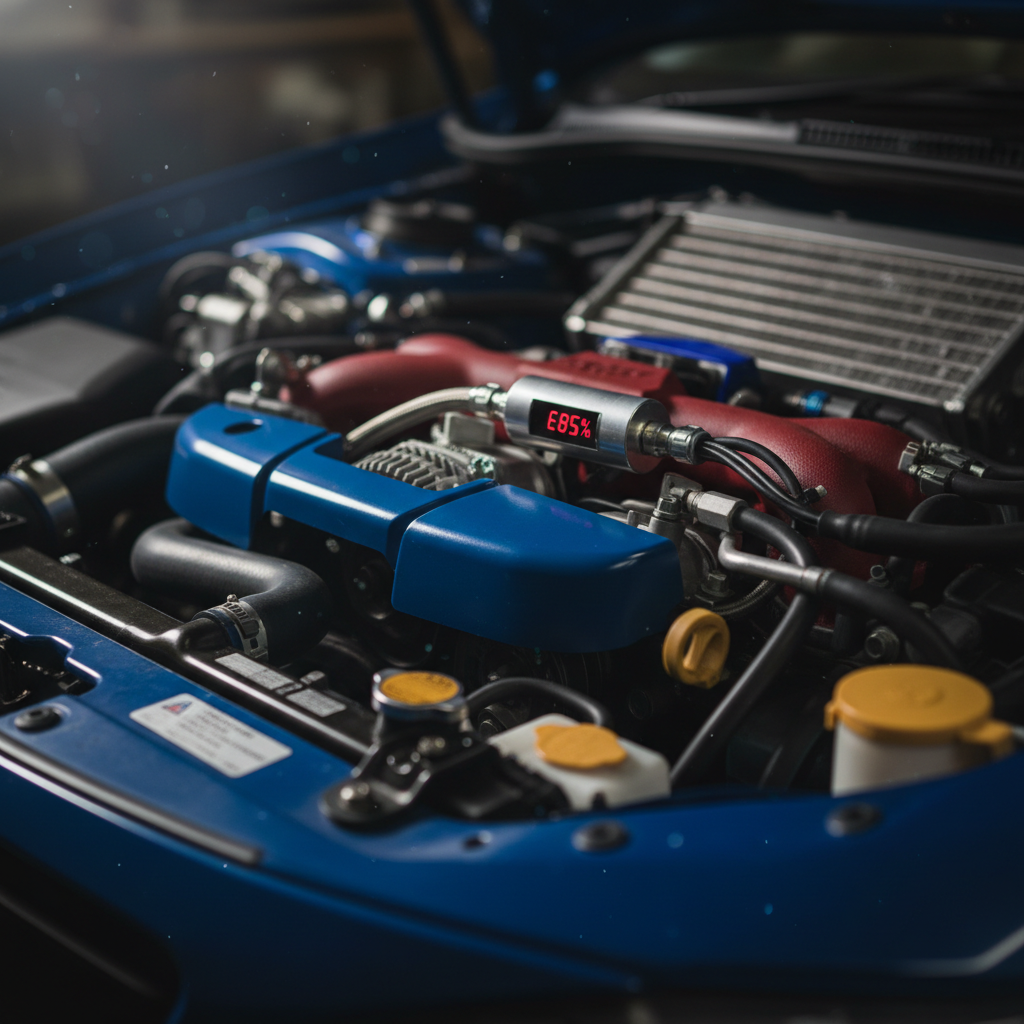
Is E85 Worth It for STI? Real Data on Power vs Complexity
E85 conversion on your STI delivers 15-20% power gains and dramatically better knock resistance, but the fuel’s variable ethanol content (51-83%) demands sophisticated monitoring to realize these benefits safely. Most owners focus on peak power numbers and miss the real advantage: being able to run 2-3 degrees more timing advance at 20 PSI boost without pulling timing.
- E85 typically adds 15-20% power on STI but varies with actual ethanol content
- Real benefit is knock resistance allowing 2-3° more timing advance at high boost
- Ethanol content varies 51-83% seasonally, requiring constant monitoring
- Without proper flex fuel sensing, you’re tuning blind on inconsistent fuel
- Installation costs $2,500-4,000 plus ongoing fuel availability challenges
E85 flex fuel conversion: A fuel system modification that allows your engine to run on any blend of ethanol (E0 to E85) by adjusting fuel delivery and ignition timing based on real-time ethanol content measurement.
What E85 Actually Changes in Your STI’s Combustion
The power gains everyone talks about are secondary to what E85 does to your knock threshold. On pump gas, your STI starts pulling timing around 18-19 PSI. With proper E85 (70%+ ethanol), that threshold jumps to 22-24 PSI before you see consistent knock events.
This happens because ethanol has an octane rating around 108-110 compared to 91-93 pump gas. More importantly, it has a much higher heat of vaporization, cooling your intake charge by 15-20°C. Your IATs drop from 45°C on a hot day with pump gas to around 25-30°C on E85 at the same boost level.
The timing advance potential is where you actually make power. On 93 octane at 20 PSI, most STI tunes run 12-14 degrees of timing advance. The same setup on E70 can safely run 16-18 degrees, and that’s where your 40-60 wheel horsepower gain actually comes from. The extra fuel flow helps, but timing is doing the heavy lifting.
What Your Datalog Shows on E85 vs Pump Gas
Pull a datalog on pump gas at 20 PSI and you’ll see knock counts climbing past 2-3 events per second, timing getting pulled 4-6 degrees, and your ECU fighting to keep the engine alive. Switch to E70 and those same conditions show zero knock events, timing staying at target values, and IATs that actually matter.
Here’s what the numbers look like in practice: on a 2015 STI making 280 wheel horsepower on 93 octane, switching to E70 typically yields 320-340 wheel horsepower. That’s not just from running richer (E85 runs around 9.8-10.2 AFR vs 11.8-12.2 on gas). It’s from being able to run the timing the engine actually wants.
Your fuel trims tell the real story. On pump gas, you might see long-term fuel trims at +8 to +12% as your ECU compensates for timing being pulled. On E85, those trims drop to +2 to -2% because the engine is running the timing it was designed for, just with different fuel.
The catch is ethanol content variation. That E85 pump might be dispensing E51 in winter or E83 in summer. A 30% swing in ethanol content changes your AFR by 2-3 points and your octane rating by 15+ points. Without flex fuel sensing, you’re essentially running a different tune every fill-up.
Making E85 Work: Monitoring and Tuning Strategy
Proper E85 setup requires three components: larger injectors (typically 1050-1200cc), a flex fuel sensor, and a tune that adjusts for ethanol content in real time. The sensor reads ethanol percentage and adjusts fuel delivery and timing automatically.
Your target AFR should adjust with ethanol content. E70 wants 9.8-10.2 AFR under boost. E60 needs 10.4-10.8 AFR. Running E70 AFRs on E60 fuel leaves you lean and vulnerable to knock. Running E60 AFRs on E70 costs you 10-15 wheel horsepower.
Timing maps need similar flexibility. E70 can handle 16-18 degrees of advance at 20 PSI. E55 starts knocking past 14-15 degrees. A good flex fuel tune adjusts timing based on ethanol content, not just load and RPM.
Monitor your knock counts religiously. E85’s knock resistance isn’t unlimited. Poor-quality fuel, carbon buildup, or running too much timing will still cause knock events. The difference is E85 gives you a 4-5 degree buffer before things go wrong.
Where E85 Conversions Go Wrong
Most failed E85 setups skip the flex fuel sensor and try to run a fixed E85 tune. This works until you get E60 fuel and lean out under boost, or E83 fuel and lose 20 horsepower because your timing is too conservative.
Undersized fuel pumps cause the next most common failure. E85 requires 30-40% more fuel flow than gasoline. Your stock fuel pump might handle 350 wheel horsepower on pump gas but fails at 320 wheel horsepower on E85 because it can’t move enough volume.
Ignoring fuel availability is the third mistake. Running out of E85 and having to put in 93 octane means your tune is now dangerously aggressive. You need either a conservative pump gas backup map or the discipline to trailer your car home when stations run dry.
Cold weather compounds these issues. E85 has poor cold-start characteristics below 10°C. You need a cold-start enrichment strategy and often a small amount of gasoline blended in during winter months. Many owners discover this the hard way when their car won’t start in their garage.
Frequently Asked Questions
How much power does E85 actually add to a stock STI?
A properly tuned STI gains 15-20% wheel horsepower on E85, typically 40-60 wheel horsepower on an otherwise stock car. The gains come primarily from increased timing advance (16-18° vs 12-14° on pump gas) enabled by E85’s higher octane and cooling effect. Peak gains require ethanol content above 70% and proper flex fuel monitoring to maintain safe AFR targets.
What’s the real cost of E85 conversion including installation?
Total conversion cost runs $2,500-4,000 including flex fuel sensor, larger injectors (1050-1200cc), fuel pump upgrade, and professional tuning. Ongoing costs include E85 fuel at $0.50-1.00 more per gallon and reduced fuel economy (20-30% worse mpg). Factor in potential fuel availability issues requiring backup transportation or conservative pump gas maps.
Is E85 safe for daily driving an STI?
E85 is safe for daily driving with proper setup and monitoring, but requires more attention than pump gas. You need to monitor ethanol content at every fill-up, check for fuel availability on long trips, and have backup plans for cold weather starting. The fuel’s corrosive properties also mean more frequent fuel system maintenance and potential issues with rubber seals over time.
How often does ethanol content actually vary at the pump?
Ethanol content varies significantly by season and region, typically ranging from E51-E60 in winter to E75-E83 in summer. Some regions see 30+ point swings throughout the year. Without flex fuel sensing, these variations change your effective AFR by 2-3 points and octane rating by 15+ points, making consistent tuning impossible and potentially dangerous.
E85 conversion makes sense if you understand what you’re getting into: meaningful power gains, better knock resistance, and the ability to run timing your engine actually wants. But it demands respect, proper monitoring, and accepting the complexity that comes with variable fuel quality. TorqueMetrics can help you track performance data that makes E85 worth the investment.