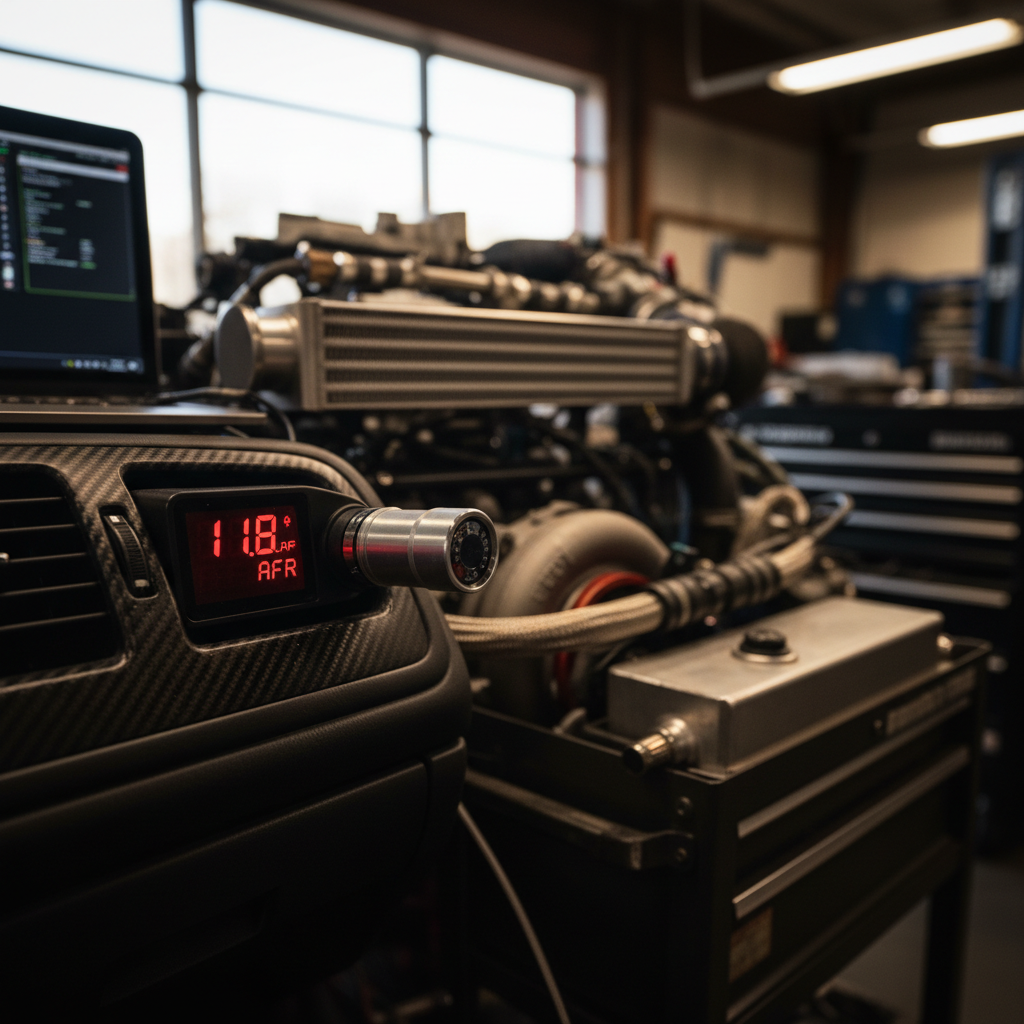
Why 11.8 AFR on E85 Melts Honda Civic Si Pistons
Your wideband shows 11.8 AFR on E85 and you think you’re safe. You’re not. That reading sits directly in the danger zone between 11.5 and 12.0 that creates uneven burn patterns and melted K20Z3 pistons in Honda Civic Si builds.
Quick Answer
- 11.5-12.0 AFR on E85 creates incomplete combustion and uneven burn patterns
- Target 10.8-11.2 AFR under boost for complete E85 combustion
- Wideband readings don’t show cylinder-to-cylinder variations or burn quality
- EGT data reveals hotspots that AFR readings miss
- Civic Si K20Z3 engines are particularly sensitive to E85 burn inconsistencies
E85 AFR danger zone: The 11.5-12.0 air-fuel ratio range on ethanol where incomplete combustion creates uneven burn patterns, leading to cylinder hotspots and piston damage despite seemingly safe wideband readings.
Why 11.8 AFR Creates Uneven Burn Patterns on E85
E85 needs more fuel than gasoline to achieve complete combustion. At 11.8 AFR, you’re giving the ethanol just enough fuel to ignite but not enough for a complete, even burn across the entire combustion chamber. This creates pockets of lean combustion mixed with areas of proper burn, resulting in uneven heat distribution.
The problem gets worse under boost. Your K20Z3 is pushing 18-20 PSI (124-138 kPa) and that 11.8 AFR reading represents an average across all four cylinders. Cylinder 3 might be running 11.5 while cylinder 1 sits at 12.1. The lean cylinder develops hotspots while the others burn normally.
E85’s higher octane rating masks the problem initially. You won’t see knock retard because the fuel can handle the combustion pressure. But those hotspots are still there, slowly degrading your ring lands and piston crowns. By the time you notice power loss or rough idle, the damage is done.
Complete E85 combustion requires 10.8-11.2 AFR under full load. This range ensures every molecule of ethanol gets the oxygen it needs for clean, complete burning. The difference between 11.8 and 11.0 might seem small, but it’s the difference between partial and complete combustion.
What Your Wideband Isn’t Telling You
Wideband O2 sensors measure exhaust gas composition, not combustion quality. A reading of 11.8 AFR tells you the average fuel-to-air ratio that made it to the exhaust, but it doesn’t reveal how that combustion actually happened inside each cylinder.
Real-world example: I’ve logged Civic Si builds showing steady 11.7 AFR on the wideband while individual cylinder EGTs varied by 80°C. Cylinder 2 was running 720°C while cylinder 4 hit 800°C. Same AFR reading, completely different combustion quality.
The wideband also can’t detect combustion timing issues. E85 burns slower than gasoline, requiring more ignition advance for complete combustion. If your timing is optimized for pump gas, that 11.8 AFR represents fuel that’s still burning as the exhaust valve opens. You’re measuring unburned hydrocarbons, not successful combustion.
Individual cylinder AFR monitoring would solve this, but most Civic builds run a single wideband in the collector. You’re seeing the average of four different combustion events, smoothed out by exhaust gas mixing. The cylinder running 12.2 AFR gets hidden by the one running 11.4.
EGT monitoring reveals what AFR readings hide. Install individual cylinder EGT probes and you’ll see the real story. Consistent temperatures across all cylinders at 10.9 AFR versus wildly varying temps at 11.8, even though the wideband reading looks safer.
How to Tune Civic Si E85 Builds Safely
Start with 10.8 AFR under full boost and work from there. This gives E85 the fuel it needs for complete combustion while leaving margin for variations between cylinders. Monitor EGTs if possible, individual cylinder lambda if you’re serious about the build.
Timing is critical with E85. Add 4-6 degrees of advance compared to your pump gas tune. E85’s slower burn rate means ignition needs to start earlier for complete combustion by the time the piston reaches bottom dead center. Without proper timing, even 10.8 AFR won’t burn completely.
Fuel system upgrades matter more than you think. Stock Civic Si injectors max out around 280whp on E85, but they start losing spray pattern quality well before that. Poor atomization creates uneven fuel distribution, making cylinder-to-cylinder AFR variations worse.
Upgrade to 650cc injectors minimum for serious E85 builds. The improved spray pattern and reduced duty cycle help maintain consistent fuel delivery across all cylinders. Match this with a proper fuel pump, 255lph minimum for K20Z3 turbo builds targeting 300+ whp.
Log everything during tuning. AFR, timing, EGT, individual cylinder knock counts if your ECU supports it. The K20Z3 will tell you exactly what’s happening if you’re listening to the right data channels. Most piston failures come from ignoring early warning signs that show up in the logs weeks before catastrophic failure.
Common Mistakes That Destroy K20Z3 Engines
The biggest mistake is trusting AFR readings without considering burn quality. Tuners see 11.8 and think it’s conservative compared to the 12.5-13.0 they’d run on pump gas. But E85 doesn’t follow gasoline rules. That conservative-looking number is actually aggressive for ethanol.
Ignoring individual cylinder data kills engines. Your wideband shows 11.7 AFR, but cylinder 3 is actually running 12.3 because of a partially clogged injector or uneven intake manifold design. That one lean cylinder develops hotspots while the others run rich, creating uneven expansion and stress.
Inadequate fuel system upgrades create the worst problems. Guys throw E85 at stock fuel systems and wonder why they’re melting pistons at AFRs that should be safe. Inadequate fuel pressure or flow creates lean spikes during acceleration that don’t show up on steady-state dyno pulls.
Poor E85 quality compounds every other issue. That E70 blend from the questionable station down the street behaves differently than true E85. Lower ethanol content means different fuel requirements, but most tuners don’t adjust for blend variations. Test your fuel and adjust accordingly.
Rushing the tuning process destroys more engines than aggressive power targets. E85 requires more dyno time and more careful monitoring than pump gas. The fuel’s forgiving nature with knock doesn’t mean it forgives poor combustion quality. Take the time to get it right.
What AFR should I run on E85 in my Civic Si turbo build?
Target 10.8-11.2 AFR under full boost for safe E85 operation. This range ensures complete combustion and provides safety margin for cylinder-to-cylinder variations. Anything above 11.5 AFR risks incomplete combustion and uneven burn patterns. Monitor individual cylinder EGTs if possible to verify consistent combustion quality across all cylinders.
Why does my wideband show safe AFR but my engine still has problems?
Wideband sensors measure average exhaust gas composition, not individual cylinder combustion quality. Your 11.7 AFR reading might hide one cylinder running 12.3 AFR while others run 11.2 AFR. This creates uneven combustion that damages pistons despite seemingly safe overall readings. Individual cylinder monitoring or EGT data reveals these hidden variations.
How much timing advance does E85 need compared to pump gas?
Add 4-6 degrees of ignition advance when switching to E85. Ethanol burns slower than gasoline and requires earlier ignition timing for complete combustion. Without proper timing advance, even rich AFR mixtures won’t burn completely, creating unburned hydrocarbons and reduced power. Always verify timing changes with knock monitoring and EGT data.
What fuel system upgrades are needed for Civic Si E85 conversion?
Minimum upgrades include 650cc injectors and a 255lph fuel pump for turbo builds targeting 300+ whp. Stock injectors lose spray pattern quality before reaching maximum flow, creating uneven fuel distribution. Inadequate fuel pressure causes lean spikes during acceleration that don’t show up in steady-state tuning but destroy engines under real-world driving conditions.
The data doesn’t lie, but you need to know what data to trust. Your AFR gauge is one piece of the puzzle, not the complete picture. TorqueMetrics helps you analyze all the channels that matter, not just the obvious ones. Because melted pistons are expensive lessons in incomplete data analysis.