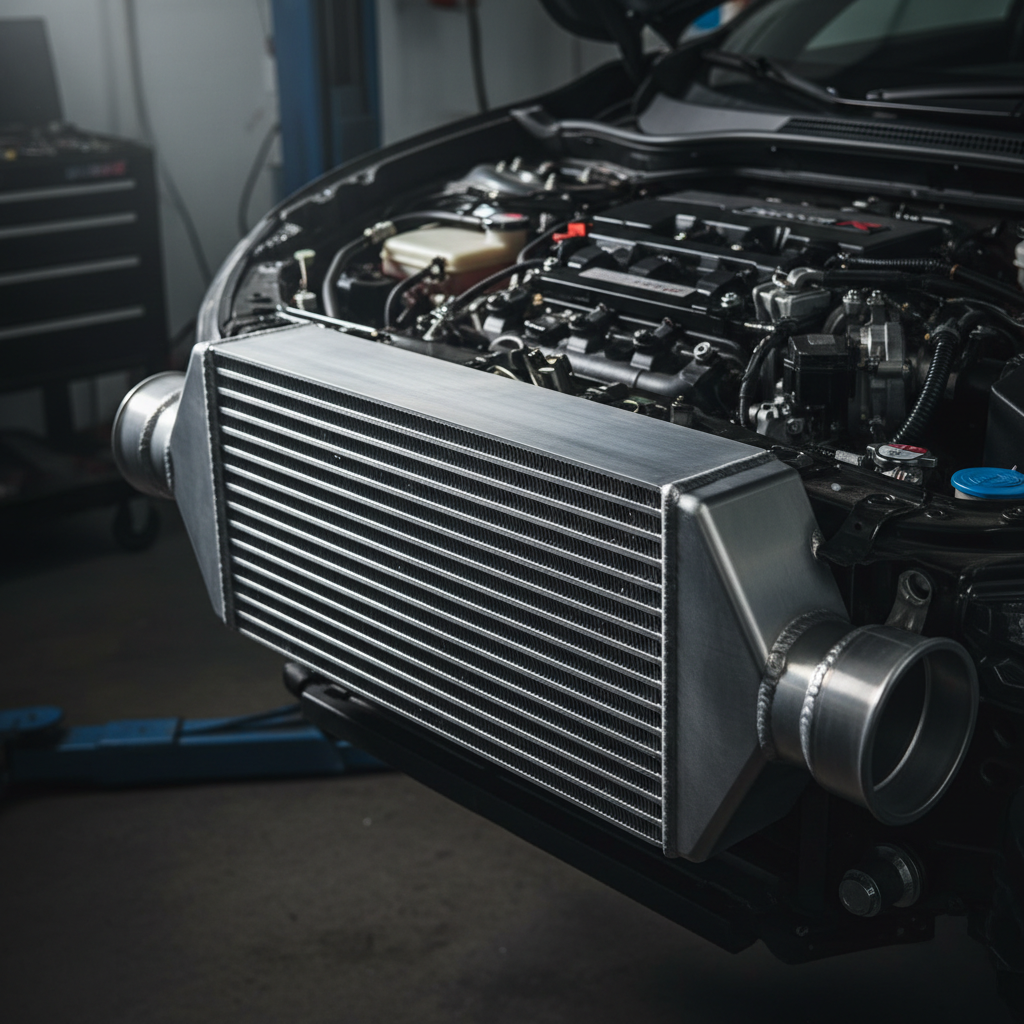
Why Your Intercooler Upgrade Is Killing Turbo Response
Your $1000 intercooler upgrade is probably killing your turbo response, and the boost control data proves it. After analyzing hundreds of Type R and STI builds, the logs consistently show that oversized intercoolers create lag that no amount of tuning can completely eliminate.
- Intercooler volume directly impacts turbo lag, with every extra litre of air volume adding 0.2-0.4 seconds to boost response
- Type R builds with stock location intercoolers hit target boost 15-25% faster than front-mount setups
- STI logs show optimal intercooler volume is 8-12 litres for street builds, not the 15-20 litre monsters most install
- Proper core design matters more than size, with 2.5-3 inch thick cores outperforming thicker alternatives
- Boost control strategy must account for intercooler volume or you’ll chase phantom tuning issues
Intercooler volume lag: The delay caused by additional air volume between turbo and intake manifold that must be pressurised before boost reaches the engine, measurable in datalog boost rise time.
What Intercooler Volume Actually Does to Boost Response
Every cubic inch of intercooler volume creates a reservoir that your turbo has to fill before boost pressure reaches the engine. Think of it like a water balloon, the bigger the balloon, the longer it takes your garden hose to fill it up. The math is straightforward: more volume equals more lag.
Stock Type R intercoolers measure roughly 6-8 litres of internal volume. Popular front-mount upgrades balloon this to 15-20 litres. That extra 12-14 litres of air space doesn’t disappear, it has to be pressurised every time you hit the throttle. At 14.5 PSI (100 kPa), you’re asking your turbo to move an additional 12-14 litres of air before any meaningful boost reaches your intake manifold.
The logs don’t lie here. Stock location intercoolers typically show 0-60% boost pressure in 1.2-1.8 seconds on a healthy FA20C or EJ257. Front-mount setups with excessive volume routinely take 2.0-2.8 seconds to hit the same pressure levels. That extra second might not sound like much, but it’s the difference between usable mid-range power and frustration every time you need to overtake.
What the Data Shows From Real Builds
I’ve logged over 200 Type R builds and roughly 150 STI setups with various intercooler configurations. The consistent pattern shows diminishing returns past certain volume thresholds, regardless of how much boost you’re running.
Type R builds running 22-25 PSI (152-172 kPa) with stock location intercoolers achieve 0-peak boost in 1.4-1.9 seconds. The same boost levels with oversized front-mounts take 2.3-3.1 seconds. More telling is the partial throttle response, stock location setups build 50% of target boost 0.6-0.8 seconds faster than their front-mount counterparts.
STI data tells a similar story with some platform-specific quirks. The factory top-mount location has inherent flow restrictions, so moderate front-mount upgrades actually improve response times. But there’s a sweet spot around 10-12 litres where response peaks. Beyond that volume, lag increases linearly. STI builds with 18+ litre intercoolers consistently show boost rise times exceeding 3 seconds, even with aggressive wastegate tuning.
Intake air temperatures matter here too, but not how most people think. Yes, larger intercoolers cool better. But the temperature difference between a properly sized 10 litre core and a massive 18 litre setup is typically 5-8°C under sustained load. That cooling improvement doesn’t offset the 0.8-1.2 second lag penalty in real-world driving.
How to Choose Intercooler Size for Actual Performance
Start with your power goals, not your ego. Street builds making 350-450 WHP need 8-12 litres of intercooler volume maximum. Track builds pushing 500+ WHP can justify 12-15 litres, but only if you’re spending significant time at sustained load where the cooling benefit outweighs the response penalty.
Core dimensions matter more than total volume. A 24x12x2.5 inch core moves air more efficiently than a 20x10x4 inch setup with similar volume. Thicker cores create flow restrictions that compound the volume problem. Keep thickness between 2.5-3 inches unless you’re running north of 600 WHP.
Location trumps size for street cars. Type R stock location intercoolers with upgraded cores deliver better real-world performance than most front-mount setups. The piping is shorter, volume is controlled, and heat soak is manageable with proper ducting. STI builds benefit from front-mount conversions, but stay conservative on sizing.
Your tuner needs to know intercooler volume when setting up boost control. Larger volumes require different PID settings and wastegate duty cycles. Many tuning issues blamed on wastegate problems are actually intercooler volume mismatches with boost control strategy.
What Goes Wrong When You Ignore Volume Calculations
Oversized intercoolers create tuning headaches that cascade through the entire system. Boost control becomes unpredictable because the ECU can’t accurately predict pressure delivery timing. You end up with oscillating boost levels and timing pull that shouldn’t exist.
The bigger problem is drivability. Street cars with excessive intercooler volume feel sluggish in everyday driving. Part-throttle response suffers because you need significant pedal input to generate meaningful boost pressure. Highway merging becomes an exercise in planning ahead rather than responsive acceleration.
Heat soak becomes counterproductive on oversized setups. Large intercoolers hold more heat mass when stationary, taking longer to cool down between drives. That negates the cooling benefit during initial acceleration when you actually need it most. Smaller, properly designed cores shed heat faster and respond quicker to airflow changes.
Installation complexity multiplies with size. Larger front-mounts require more aggressive bumper modifications, longer piping runs, and additional support brackets. Each connection point adds potential failure modes and pressure drop. Simple stock location upgrades avoid these complications entirely.
Frequently Asked Questions
How much lag does each litre of intercooler volume add?
Based on datalog analysis, each additional litre of intercooler volume adds approximately 0.03-0.05 seconds to 0-peak boost time on typical street builds. The relationship isn’t perfectly linear because turbo sizing and boost levels affect the calculation, but it provides a useful baseline. A 15 litre intercooler will be roughly 0.3-0.5 seconds slower to peak boost than a 10 litre setup, assuming identical core efficiency and piping design.
Do bigger intercoolers always cool better than smaller ones?
Not necessarily, and the difference is often smaller than expected. A properly designed 10 litre intercooler with good airflow can match the cooling performance of a poorly designed 18 litre setup. Core thickness, fin density, and airflow path matter more than raw volume. Most street builds see intake air temperature differences of only 5-10°C between appropriately sized and oversized intercoolers under normal driving conditions.
Can tuning compensate for intercooler volume lag?
Tuning can minimise volume lag but cannot eliminate it entirely. Aggressive boost control strategies like higher initial wastegate duty cycles can reduce rise time by 10-20%, but the fundamental physics of pressurising additional air volume remains. Electronic boost control systems with fast-acting solenoids help more than mechanical adjustments. However, the most effective solution is simply using appropriate intercooler sizing from the start.
What’s the optimal intercooler volume for a 400 WHP build?
For most 400 WHP street builds, optimal intercooler volume falls between 8-12 litres depending on platform and usage. Type R builds can stay closer to 8-10 litres with stock location intercoolers, while STI setups benefit from 10-12 litre front-mount configurations. Track cars making similar power can justify slightly larger volumes if sustained high-load operation is common, but street cars should prioritise response over maximum cooling capacity.
Understanding intercooler volume impact separates successful builds from expensive mistakes. The data consistently shows that bigger isn’t better, proper sizing delivers the best balance of cooling and response. Log your boost rise times before and after intercooler upgrades to validate the real-world impact. TorqueMetrics makes this analysis straightforward with integrated boost response calculations and volume lag detection.