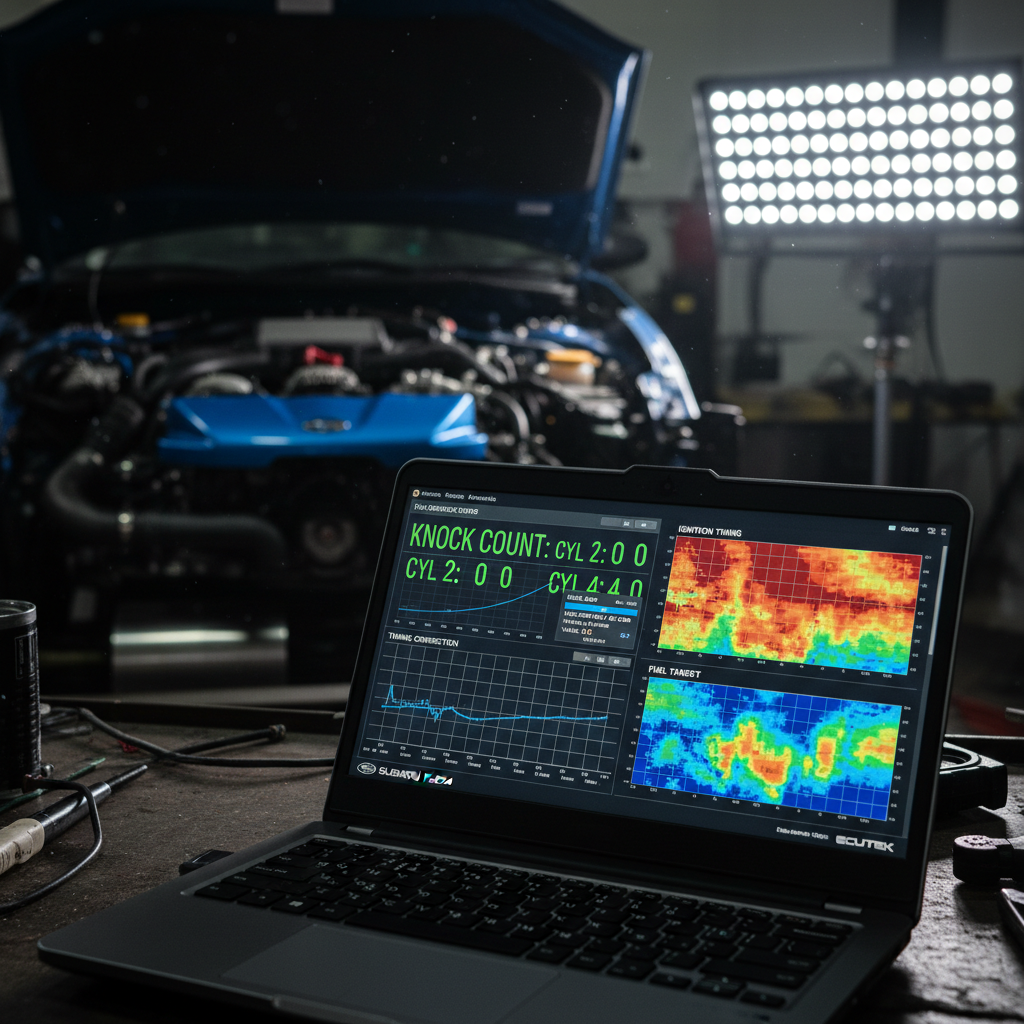
FA24 Knock Detection: Why the 2022+ WRX Tunes Differently Than EJ
The FA24 in your 2022+ WRX handles knock detection completely differently than the EJ engines most tuners grew up with. Direct injection changes the knock threshold, timing pull response, and even what AFR ranges are actually safe under boost. Most shops are still tuning FA24s like they’re EJ257s, and the datalogs show it.
Quick Answer
- FA24 knock sensors detect higher frequency events (6-8 kHz) vs EJ engines (5-6 kHz)
- Direct injection allows leaner AFRs under boost (11.5-12.0) without knock risk
- Timing pull strategies need 2-3 degree steps instead of 4-6 degree EJ pulls
- Knock count thresholds should be set 40% lower than equivalent EJ tunes
- Intake temps above 35°C cause false knock detection more frequently than port injection engines
FA24 knock detection: The process by which the 2022+ WRX’s engine management system identifies and responds to detonation events using different frequency ranges and response strategies than previous EJ engines due to direct injection combustion characteristics.
What Makes FA24 Knock Detection Different
The FA24’s direct injection system creates a fundamentally different combustion event than port injection. The fuel spray pattern and mixture preparation change how knock manifests in the cylinder, which changes what the knock sensors actually detect.
Where EJ engines typically show knock events in the 5-6 kHz range, the FA24’s knock signature sits higher at 6-8 kHz. This isn’t just academic. Your knock sensor is calibrated for these frequencies, and the ECU’s knock detection algorithm uses different thresholds to determine when timing pull is necessary.
The direct injection also changes mixture stratification during combustion. EJ engines with port injection create a more homogeneous mixture that knocks predictably. The FA24’s stratified charge burns differently, creating knock patterns that don’t always trigger the same ECU response. You’ll see this in datalogs as intermittent knock counts that don’t result in timing pull, even when audible knock is present.
Intake manifold design compounds this. The FA24’s plastic intake manifold has different acoustic properties than the EJ’s aluminum manifold. Some knock events that would be clearly audible in an EJ engine get dampened before reaching the knock sensor. This creates situations where the ECU doesn’t pull timing when it should, or pulls timing when knock isn’t actually occurring.
What Your FA24 Datalogs Actually Show
FA24 datalogs reveal knock patterns that look wrong if you’re used to EJ data. A properly tuned FA24 at 18 PSI (124 kPa) on 93 octane will show occasional knock counts in the 1-2 range without timing pull. This would indicate a problem on an EJ engine, but it’s normal FA24 behavior.
The AFR targets tell the real story. While EJ engines need 10.8-11.2 AFR under full boost to prevent knock, the FA24’s direct injection allows 11.5-12.0 AFR at the same boost levels. The fuel’s injection timing and spray pattern provide knock resistance that port injection can’t match. Tuners who target EJ-style AFRs are leaving 15-20 horsepower on the table.
Timing advance numbers also differ significantly. Where an EJ might run 16-18 degrees of advance at 4000 RPM under boost, the FA24 can safely run 20-22 degrees at the same load point. The direct injection’s cooling effect and improved mixture control allow more aggressive timing without knock.
Temperature sensitivity shows up differently too. EJ engines start pulling timing aggressively above 40°C intake temps. The FA24 maintains timing until 45°C, but when it starts pulling timing, the response is more dramatic. You’ll see 4-6 degree pulls where an EJ would pull 2-3 degrees incrementally.
How to Actually Tune FA24 Knock Response
Set your knock count threshold at 3 instead of the 5-7 range you’d use for EJ engines. The FA24’s knock signature is cleaner, so lower thresholds catch real knock events without triggering on normal combustion noise. Most FA24s show 0-1 knock counts per pull on a properly calibrated tune.
Timing pull strategy needs to be more conservative in step size but more aggressive in threshold. Use 2-3 degree timing pull increments instead of the 4-6 degree steps common in EJ tunes. The FA24 responds better to smaller corrections applied earlier in the knock progression.
Target AFR should start at 11.8 under full boost and lean out based on knock response, not the other way around. Many tuners start rich and lean out until they see knock, but the FA24’s direct injection masks early knock signs. Start at the lean end of the safe range and add fuel only if knock counts climb above 2-3 consistently.
Ignition timing maps need platform-specific base timing. Don’t port EJ timing tables to FA24s. The combustion chamber design, compression ratio, and injection timing create different optimal advance curves. Base timing should be 2-4 degrees more aggressive than comparable EJ maps, with steeper advance curves through the midrange.
Why Most FA24 Tunes Fail the Knock Test
The biggest mistake is treating FA24s like EJ engines with different fuel delivery. Tuners who learned on EJ platforms apply the same knock detection thresholds, AFR targets, and timing strategies. The result is overly conservative tunes that give up power for safety margins that don’t apply to direct injection engines.
Knock sensor calibration gets overlooked entirely. Many shops use EJ knock sensor scaling in FA24 tunes. The frequency response is different, so the ECU either ignores real knock events or pulls timing on normal combustion noise. You’ll see this as erratic timing corrections that don’t correlate with actual engine conditions.
Fuel delivery timing creates another common failure point. The FA24’s high-pressure fuel pump and direct injection system need different fuel pressure targets than port injection setups. Tuners who don’t adjust fuel system parameters create situations where fuel delivery timing conflicts with ignition timing, causing knock that shows up as fueling issues in the logs.
Temperature compensation often uses EJ-based correction factors that don’t account for direct injection’s thermal characteristics. The result is timing maps that pull too much advance in cold conditions and not enough when heat-soaked. You’ll see inconsistent power delivery and knock events that only occur at specific intake temperatures.
Frequently Asked Questions
Can I use my EJ tuner for FA24 engine tuning?
Only if they understand FA24-specific knock detection and fueling requirements. Many experienced EJ tuners struggle with FA24 platforms because the direct injection changes fundamental tuning assumptions. Ask specifically about their FA24 experience and request sample datalogs from similar builds. A good FA24 tune will show different AFR targets, timing advance curves, and knock thresholds than EJ tunes.
Why does my FA24 show knock counts but no timing pull?
The FA24’s knock detection algorithm uses different thresholds than EJ engines due to direct injection combustion characteristics. Occasional knock counts in the 1-2 range are normal and don’t trigger timing pull. However, consistent counts above 3 or any audible knock should result in timing corrections. If you’re hearing knock but seeing no ECU response, your knock sensor calibration needs adjustment.
What AFR should I target on a stock turbo FA24 with 93 octane?
Start with 11.8 AFR under full boost and monitor knock response. The FA24’s direct injection allows leaner mixtures than port injection EJ engines, with most stock turbo builds running safely between 11.5-12.0 AFR. Going richer than 11.5 typically costs power without improving knock resistance. Always verify with knock counts and timing pull data rather than just AFR numbers.
Do FA24 engines need different knock sensor scaling than EJ engines?
Yes, the FA24’s knock signature occurs at higher frequencies (6-8 kHz vs 5-6 kHz for EJ engines) and the plastic intake manifold affects acoustic transmission differently than aluminum EJ manifolds. Using EJ knock sensor calibration can result in missed knock events or false detection. Proper FA24 knock sensor scaling should be 30-40% more sensitive in the 6-8 kHz range compared to EJ calibrations.
Understanding FA24 knock detection isn’t just about getting more power. It’s about building reliable power that doesn’t grenade your engine six months later. The platform’s direct injection system offers advantages over EJ engines, but only if you tune for them specifically. TorqueMetrics can help you analyze your FA24 datalogs with platform-specific knock detection algorithms and thresholds designed for direct injection engines.