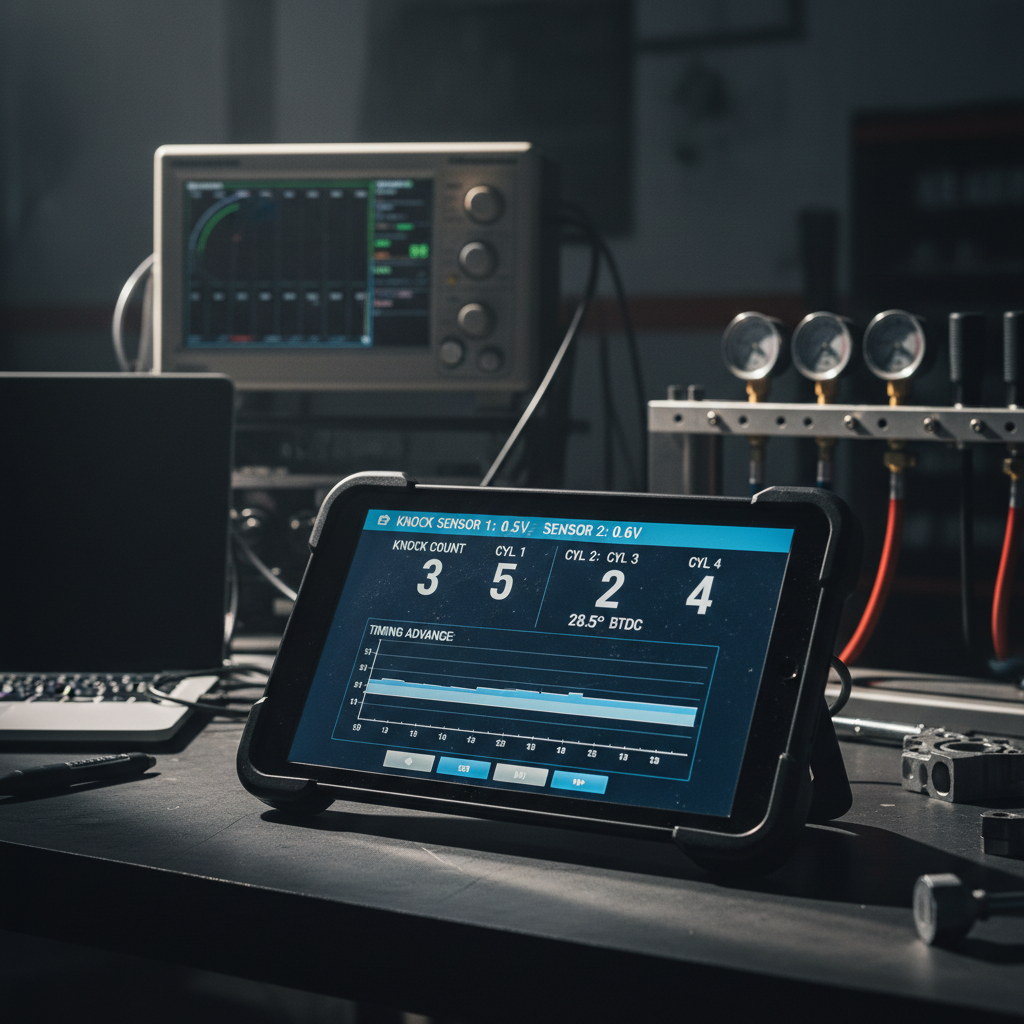
Knock Sensor False Positives: Why You’re Losing 20+ HP to Bad Data
Your knock sensor isn’t lying to you, but it’s not telling the whole truth either. Modern piezoelectric knock sensors will flag activity from exhaust resonance, fuel slosh, A/C compressor cycling, and half a dozen other sources that have nothing to do with actual detonation. Pull timing every time that sensor spikes and you’re leaving 20+ horsepower on the table.
Key Takeaways:
- Real knock shows consistent patterns across multiple load cells and RPM ranges, not random spikes
- False positives from exhaust resonance typically occur at specific RPM harmonics, usually 3000-4500 RPM
- Fuel slosh knock counts happen during aggressive cornering or hard braking, not steady-state pulls
- A/C compressor cycling creates knock counts every 8-12 seconds at idle and low load
- Proper knock detection requires correlating sensor data with AFR, timing, and load conditions
Knock sensor false positives: Piezoelectric vibration readings that register as detonation activity but originate from mechanical noise, fuel movement, or accessory operation rather than actual combustion knock.
What Real Knock Actually Looks Like in Your Logs
Real knock has a signature. It shows up consistently under load, correlates with timing advance, and gets worse as you lean out the AFR or increase boost pressure. You’ll see it in the same RPM and load cells every pull, not scattered randomly across your log.
True detonation typically starts showing up around 4000-6500 RPM under heavy load. The pattern is predictable: knock counts climb as timing advances, drop when you pull timing back 2-3 degrees, and correlate directly with your boost curve. If you’re seeing 15 PSI (103 kPa) of boost with 22 degrees of timing and your knock counts jump from 0 to 8, that’s real knock telling you to back it down.
The frequency signature matters too. Actual knock registers in the 6-15 kHz range on most OEM sensors. Your ECU’s knock detection algorithm filters for this specific frequency band, but it can’t distinguish between detonation and other mechanical noise in that same range. This is where the problems start.
The False Positive Culprits Stealing Your Power
Exhaust resonance is the biggest offender. Your exhaust system has natural resonant frequencies that align with engine harmonics at specific RPM ranges. Most aftermarket exhausts resonate hardest between 3000-4500 RPM, right where you’re building boost and advancing timing. The vibration travels through the block and triggers knock sensors even though combustion is clean.
Fuel slosh creates another category of false positives. Hard cornering or aggressive braking moves fuel around in the tank, and that sloshing motion creates vibrations that register as knock. You’ll see these counts during track sessions but not on the dyno. The dead giveaway is timing: fuel slosh knock happens during deceleration or cornering, not under steady acceleration.
A/C compressor cycling is easier to spot but often missed. The compressor kicks on every 8-12 seconds, creating a mechanical vibration pulse that shows up as 1-3 knock counts. Check your logs at idle or cruise, especially in summer. If you’re seeing regular knock activity every few seconds with no load or timing change, that’s your A/C system.
Injector noise becomes a factor on high-flow setups. Large injectors create more mechanical noise when opening and closing, especially at low duty cycles. You’ll see this as scattered knock counts at idle and light load that disappear under heavy acceleration when injector duty cycle climbs above 60%.
How to Separate Real Knock from Background Noise
The correlation test is your best tool. Real knock correlates with three conditions: timing advance, lean AFR, and high cylinder pressure. Plot your knock counts against timing advance across multiple pulls. True knock shows a clear relationship, false positives show random scatter.
Check your AFR correlation next. Real knock gets worse as you lean out from optimal AFR. If you’re seeing knock counts at 10.8 AFR that disappear at 11.5 AFR, that’s backwards from actual detonation behavior. Real knock would be worse at 11.5 AFR.
Load cell consistency is the third filter. Map your knock counts across the entire load range. Real knock appears in high-load cells, usually above 80% load. If you’re seeing knock at 30% load with conservative timing, that’s mechanical noise, not detonation.
Time-based analysis helps with intermittent false positives. A/C cycling shows regular intervals, fuel slosh correlates with cornering g-forces, and exhaust resonance hits the same RPM ranges every pull. Random mechanical noise creates scatter with no pattern.
What Happens When You Chase Every False Positive
Conservative timing maps cost real power. Every degree of timing you pull unnecessarily loses 3-5 horsepower per 1000 RPM. If you’re running 18 degrees of timing instead of 22 degrees across your 4000-7000 RPM power band, you’re giving up 20+ horsepower to phantom knock.
The compounding effect hits harder on boosted applications. Timing and boost work together, and conservative timing maps force you to run lower boost levels to maintain the same safety margin. You end up with a 300 horsepower tune that should be making 330+ horsepower.
Track performance suffers most. False positive timing pulls create inconsistent power delivery. Your car makes different power depending on ambient temperature, A/C usage, and fuel level. That inconsistency shows up as unpredictable lap times and handling characteristics.
The psychological factor matters too. Once you start chasing false positives, every sensor spike becomes a reason to pull more timing. You end up with timing maps that are 4-6 degrees more conservative than necessary because you’ve been fighting ghosts in the data.
Frequently Asked Questions
How do I know if my knock sensor is giving false positives?
Check for knock counts that don’t correlate with timing, load, or AFR changes. Real knock gets worse with more timing advance and leaner AFR mixtures. False positives show up randomly or correlate with non-engine events like A/C cycling or cornering forces. Also look for knock counts at low load or idle, where actual detonation is physically impossible with proper fuel.
Can aftermarket exhausts cause knock sensor false positives?
Yes, aftermarket exhausts frequently cause false positives through resonance. Most aftermarket systems have different resonant frequencies than OEM exhausts, often creating vibrations in the 6-15 kHz range that knock sensors monitor. This is especially common with straight-pipe or high-flow catalytic converter setups. The false positives typically occur at specific RPM ranges, usually 3000-4500 RPM where exhaust harmonics are strongest.
What timing advance should I run if I’m seeing inconsistent knock counts?
Start with timing maps that are 2-3 degrees more conservative than maximum safe advance, then correlate knock counts with actual combustion conditions. If knock counts appear randomly without correlation to timing, AFR, or load changes, you’re likely seeing false positives. Real knock requires consistent timing reduction, while false positives can often be ignored if they don’t correlate with actual engine conditions. Always verify with multiple datalog pulls under identical conditions.
Do knock sensor false positives happen more on certain engine platforms?
Yes, some platforms are more prone to false positives. Subaru EJ engines commonly show false positives from exhaust resonance and fuel slosh. BMW N54/N55 engines frequently trigger from high-pressure fuel pump operation. Honda K-series engines show false positives from VTEC engagement. The common factor is usually the knock sensor location relative to noise sources and the ECU’s knock detection sensitivity settings.
Understanding the difference between real knock and sensor noise is what separates amateur tuning from professional-level optimization. Your datalogs contain the truth, but only if you know how to read the patterns. TorqueMetrics helps you visualize these correlations across multiple parameters, making it easier to spot the real knock hiding among the false positives.