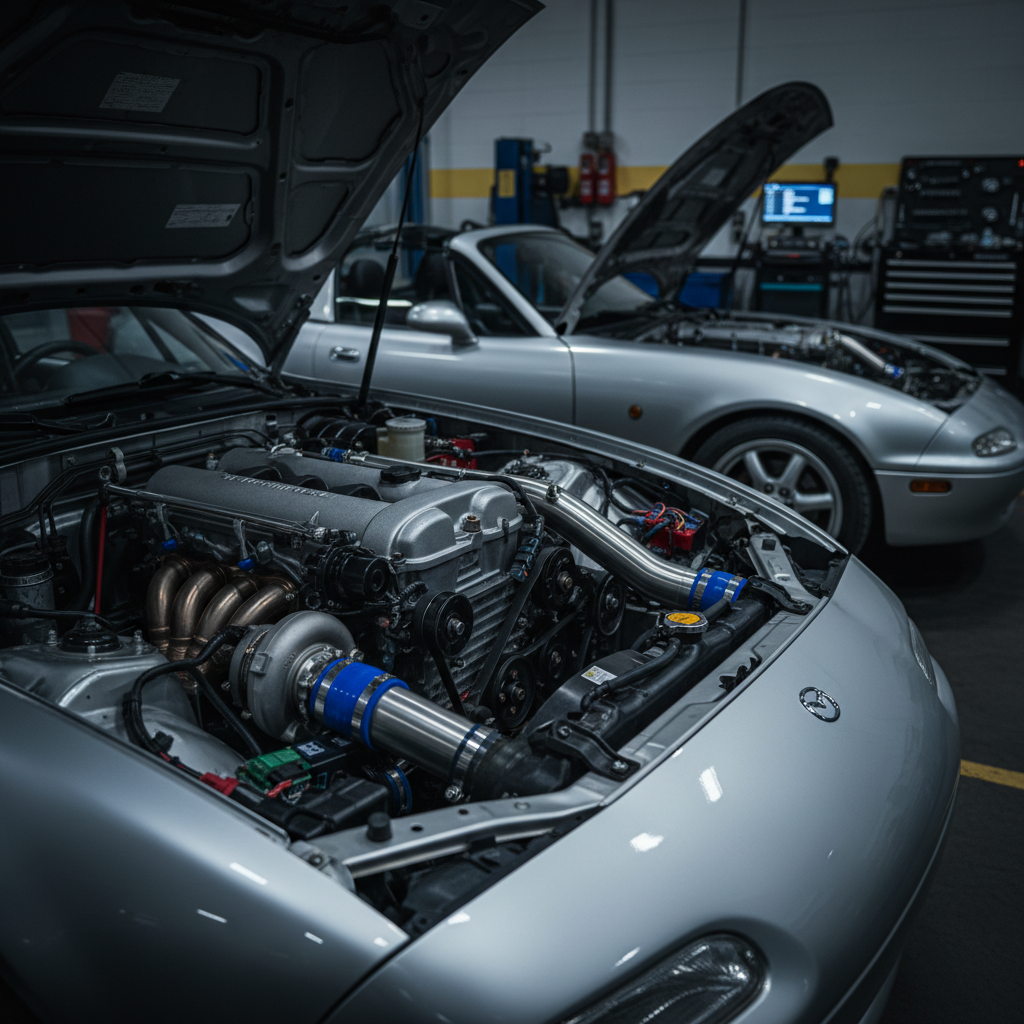
Why Identical Miata Turbo Kits Make 170-220hp: Hidden Variables
Two identical MX-5s with the same turbo kit, same tune, same boost levels. One makes 170hp, the other hits 220hp. Your datalog holds the answers, and they’re not what most people expect.
- Factory compression ratios vary 0.3-0.7 points between engines, affecting power output by 15-25hp
- Engine tolerances create 8-12% variation in volumetric efficiency from factory
- Intake manifold casting differences alter airflow by 10-15% on identical setups
- Fuel injector flow rates vary ±4% from spec, limiting power on lean engines
- Ring seal quality affects cylinder pressure and timing tolerance under boost
Miata turbo power variation: The difference in power output between identical turbo installations on MX-5s, caused by factory engine tolerances, compression ratio variations, and component manufacturing inconsistencies that affect how each engine responds to forced induction.
What Factory Tolerances Actually Mean for Your Turbo Build
Mazda built millions of MX-5 engines, and no two are identical. The BP engine in your NA or NB has a compression ratio spec of 9.0:1, but that’s a target, not a guarantee. Real-world measurements show factory ratios ranging from 8.7:1 to 9.4:1 across different engines.
That 0.7 point spread matters under boost. A higher compression engine builds more cylinder pressure at the same boost level, advancing the knock threshold and limiting timing advance. Lower compression engines can run more aggressive timing maps, making significantly more power with identical boost levels.
Engine tolerances extend beyond compression ratios. Piston ring end gaps vary by 0.002-0.005 inches from factory. Tighter gaps mean better ring seal and higher cylinder pressures. Looser gaps allow more blowby, reducing effective compression and power output. Your datalog’s crankcase pressure readings reveal which camp your engine falls into.
Intake manifold casting variations create another hidden variable. The BP’s intake runners vary in cross-sectional area by 8-12% between castings. Smaller runners increase velocity but limit peak flow. Larger runners flow more air but lose low-end torque. These differences show up as variation in volumetric efficiency across the RPM band, directly affecting power curves despite identical turbo systems.
What Your Datalog Reveals About Power Differences
Look at your knock count logs first. Engines making less power typically show knock activity starting at 12-14 PSI (83-97 kPa), while higher-output engines stay clean until 16-18 PSI (110-124 kPa). This isn’t random. It’s compression ratio variation showing up in your data.
Check your timing advance at peak torque. Low-power engines typically run 18-22 degrees of advance under boost. High-power engines safely run 24-28 degrees with the same octane fuel. That 6-degree difference translates directly to the 50hp power spread you’re seeing.
Your MAF sensor readings tell another story. Identical boost levels should show similar airflow, but casting variations create 15-20% differences in actual airflow at the same manifold pressure. An engine flowing 240 g/s at 15 PSI will make more power than one flowing 200 g/s at the same boost level.
Fuel injector duty cycle reveals fueling limitations. OEM injectors are rated at 265cc/min, but real-world flow varies ±4% from spec. Injectors flowing 255cc/min hit 95% duty cycle at 200hp, limiting power. Injectors flowing 275cc/min stay at 85% duty cycle, supporting higher power levels safely.
Lambda readings under boost show the complete picture. Engines making less power often run 0.78-0.80 lambda (10.8-11.1 AFR) because their injectors are maxed out. Higher-output engines maintain 0.75-0.77 lambda (10.4-10.7 AFR), extracting more power from the same fuel flow.
How to Extract Maximum Power from Your Specific Engine
Start with a compression test under boost conditions, not static compression. Build boost to 10 PSI and measure cylinder pressures with a gauge threaded into the spark plug hole. Cylinders reading within 5% of each other indicate good ring seal. Variations beyond 10% suggest ring issues limiting power potential.
Datalog your knock activity across the entire RPM and boost range. Map your engine’s knock threshold precisely. If knock starts at 14 PSI with pump gas, you need race fuel or water injection to safely run higher boost levels. If your engine stays clean to 18 PSI, you can push boost higher for more power.
Measure your actual injector flow rates on a flow bench or through duty cycle calculations. Divide your target horsepower by 10 to get required injector size in cc/min. If your OEM injectors flow less than required, upgrade them before chasing more boost.
Port-match your intake manifold to the head. Even small mismatches create turbulence that costs 8-12 hp. Remove the manifold and check runner alignment with the intake ports. File or grind mismatched areas smooth.
Optimize your timing map for your specific engine. Generic tunes leave power on the table. Start conservative and advance timing in 2-degree increments while monitoring knock activity. Back off 2 degrees when knock appears consistently.
What Goes Wrong When You Ignore Engine-Specific Variables
Most Miata owners install turbo kits expecting the advertised power figures. When their engine makes 170hp instead of 220hp, they assume the kit or tune is defective. They start throwing parts at the problem, upgrading turbos, injectors, and fuel systems that aren’t actually limiting their power.
Running a generic tune on a high-compression engine causes detonation damage. Owners report blown head gaskets, cracked ringlands, and melted pistons after pushing boost levels their specific engine can’t handle. The advertising claims assumed a best-case engine, not their particular combination of tolerances.
Conversely, owners with low-compression engines often run overly conservative tunes, leaving 30-40hp on the table. They upgrade to larger turbos seeking more power when their OEM turbo could easily support higher output with proper tuning for their engine’s capabilities.
Fuel system sizing becomes problematic when based on advertised power rather than actual engine requirements. An engine making 170hp needs different injector sizing than one making 220hp. Running oversized injectors on a lower-output engine creates idle issues and poor part-throttle driveability.
Cooling system capacity gets mismatched to actual heat load. Higher-output engines need more cooling capacity, while lower-output builds can run smaller heat exchangers. Mismatched cooling leads to heat soak and timing pull under sustained load.
Frequently Asked Questions
Why does my Miata make less power than advertised with the same turbo kit?
Turbo kit power claims assume best-case engine tolerances, including optimal compression ratios, tight ring seal, and efficient intake manifold casting. Your engine may have higher compression limiting timing advance, looser ring gaps reducing cylinder pressure, or intake manifold flow restrictions. Check your datalog for knock activity, timing advance, and actual airflow compared to advertised figures.
Can I make my low-power Miata match the high-output examples?
Possibly, depending on the limiting factors. If high compression is causing knock, race fuel or water injection can allow more timing advance. If poor ring seal is the issue, an engine rebuild is required. If intake flow is limited, porting the manifold and head can help. Datalog your engine to identify the specific limitations before modifying anything.
How much power variation is normal between identical Miata turbo setups?
15-25hp variation is common due to factory tolerances. Differences beyond 30hp typically indicate specific issues like worn rings, intake restrictions, or fueling problems. Compression ratio variations of 0.5 points can create 20hp differences at the same boost level. This is normal manufacturing variance, not a defective kit or tune.
Should I tune my Miata based on my specific engine or use a generic map?
Always tune for your specific engine. Generic maps assume average tolerances and leave power on the table while potentially causing damage on engines outside the normal range. Professional tuning costs 500-800 dollars but extracts maximum safe power from your particular combination of factory tolerances and component specifications.
Understanding your engine’s specific characteristics eliminates the frustration of power variations and helps you build a reliable, properly optimized turbo Miata. TorqueMetrics makes it easy to analyze your datalogs and identify the variables affecting your power output, helping you tune for your engine’s actual capabilities rather than internet benchmarks.