Why E85 Rich Spikes Kill Engines (Not Lean AFRs)
The biggest E85 conversion mistake isn’t running too lean, it’s the rich transients that happen when your ECU’s pump gas maps meet ethanol fuel. Those brief 12.5-13.5 AFR spikes during acceleration wash cylinder walls clean of oil film and destroy ring seal within thousands of miles, not the gradual lean condition everyone obsesses over.
Quick Answer
- Rich AFR spikes (12.5-13.5) during E85 transitions cause immediate cylinder wash and ring seal damage
- Target 10.8-11.2 AFR on pure E85 under boost, 11.5 at part throttle for safety margin
- Fuel map transitions create dangerous rich zones where pump gas timing meets E85 fuel delivery
- Cylinder wall washing from rich conditions kills engines faster than lean knock damage
- Professional E85 tune costs $800-1200 but prevents $8000+ engine rebuilds
E85 rich spikes: Dangerous AFR excursions to 12.5-13.5 that occur when ECU fuel maps designed for pump gasoline encounter ethanol’s different stoichiometric requirements, causing excessive fuel delivery that washes protective oil film from cylinder walls.
Why Rich AFRs Destroy E85 Engines Faster Than Lean Conditions
Here’s what actually kills E85 engines: fuel washing the oil film off your cylinder walls. When your AFR drops below 12.0 during acceleration, you’re dumping raw ethanol onto hot cylinder walls. That ethanol dissolves the boundary layer of oil that keeps your rings sealed and your pistons lubricated.
The physics are straightforward. Ethanol is a solvent. At 12.5 AFR, you’re running 15% richer than E85’s stoichiometric point of 9.8. That excess fuel has to go somewhere, and it’s coating your cylinder walls. Within 2000-3000 miles of repeated rich excursions, your ring seal degrades enough to drop compression 10-15 PSI per cylinder. By the time you notice the power loss, you’re looking at a rebuild.
Lean conditions kill engines through knock and detonation, but that’s a gradual process you can hear and measure. Rich wash happens silently. Your engine runs smooth, makes decent power, and slowly dies from the inside. Most people only catch it during a compression test months later when they’re chasing a mysterious power loss.
What Your Datalogs Actually Show During E85 Transitions
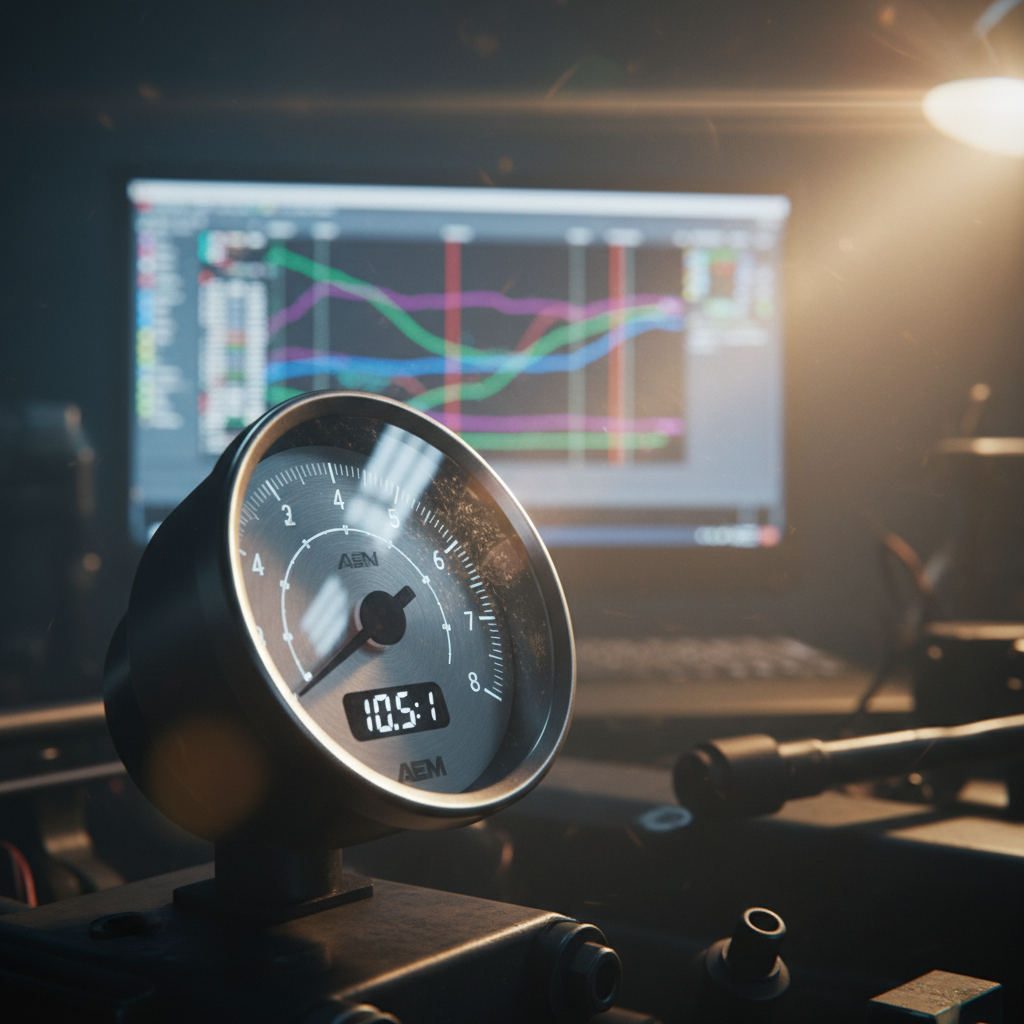
Pull a datalog during your first E85 tank and watch what happens during part-throttle acceleration. Your ECU is still running pump gas fuel maps, but now it’s trying to meter E85. The result is predictable: rich spikes to 12.8-13.2 AFR every time you transition from closed-loop to open-loop fueling.
The danger zone lives between 2500-4000 RPM at 40-60% throttle. Your ECU exits closed-loop control and jumps to its pre-programmed fuel map. That map was calibrated for 91 octane at 14.7 AFR stoichiometric. Feed it E85 and you’re suddenly dumping 30% more fuel than the engine can burn efficiently.
Look for these specific patterns in your logs: AFR dropping from 14.5 in closed-loop to 12.5-13.0 during the transition, then settling to whatever your WOT map targets. That transition spike lasts 0.5-1.5 seconds, but it happens dozens of times per drive. Multiply that by daily driving and you’re washing your cylinders clean every few hundred miles.
Temperature makes it worse. Cold E85 doesn’t atomize as well as pump gas, so your ECU adds extra fuel during warm-up. I’ve logged AFRs as rich as 11.8 on cold E85 startups with stock tune files. That’s engine-killing territory right there.
How to Actually Tune E85 Without Destroying Your Engine
Target 10.8-11.2 AFR under full boost on pure E85. That’s rich enough for knock protection but lean enough to avoid cylinder washing. At part throttle, aim for 11.5 AFR, not the 14.7 your pump gas tune uses. E85’s stoichiometric point is 9.8, so 11.5 gives you a proper safety margin without going dangerously rich.
The critical work happens in the transition zones. Your tuner needs to smooth the fuel delivery between closed-loop and open-loop operation. That means custom fuel maps at every load point from 20% throttle up. Skip this step and you’ll have rich spikes no matter how perfect your WOT tune is.
Timing advance is where E85 shines. You can typically add 4-6 degrees over your pump gas maps without knock. But add that timing gradually as you lean out the fuel delivery. Rich AFR with aggressive timing creates a different problem: carbon fouling from incomplete combustion.
Don’t run flex fuel sensors unless your tuner knows how to calibrate them properly. Most off-the-shelf flex fuel setups create exactly the rich spike problem we’re trying to avoid. They see ethanol content and dump fuel before adjusting the timing and closed-loop targets.
The Expensive Mistakes That Kill E85 Conversions
The worst mistake is running E85 on your pump gas tune “just to try it.” Your ECU will add fuel when it sees knock, creating exactly the rich conditions that destroy engines. I’ve seen $15,000 builds destroyed by owners who thought they could run a few tanks of E85 on stock maps.
Piggyback tuners make it worse. Most bolt-on E85 “solutions” just add fuel across the board. They don’t address the transition zones or optimize the timing maps. You end up with an engine that makes decent power but slowly dies from fuel wash. The kit costs $400, the rebuild costs $8000.
Cheap E85 tunes are almost as dangerous as no tune at all. A proper E85 calibration takes 8-12 hours on the dyno to get the transition zones right. Tuners who promise E85 maps for $300 are cutting corners somewhere, usually in the part-throttle areas where you spend 90% of your driving time.
The blend variation problem kills consistency. E85 ranges from E70 to E85 depending on season and station. Your tune needs to handle that 15% variation without creating rich or lean excursions. Most people ignore this until their engine runs like garbage on a bad batch of fuel.
How do I know if my E85 tune is washing my cylinders?
Pull datalogs and look for AFR readings below 12.0 during part-throttle acceleration, especially in the 2500-4000 RPM range. Rich spikes that drop to 12.5 AFR or lower for more than 0.5 seconds indicate fuel washing. You’ll also see black smoke from the exhaust during acceleration and potentially spark plug fouling after a few hundred miles. A compression test showing uneven readings across cylinders confirms ring seal damage from fuel wash.
What AFR should I target on E85 for daily driving?
Target 10.8-11.2 AFR under full boost conditions and 11.5 AFR at part throttle for daily driving. E85’s stoichiometric ratio is 9.8, so 11.5 provides a safe margin without going dangerously rich. Avoid AFR readings below 12.0 during normal acceleration, as this creates fuel washing conditions that destroy ring seal over time.
Can I run E85 on my stock tune temporarily?
Never run E85 on a pump gas tune, even temporarily. Stock ECU calibration will create dangerous rich spikes as low as 12.5 AFR when it encounters ethanol’s different stoichiometric requirements. These rich conditions wash oil film from cylinder walls and can damage ring seal within 1000-2000 miles. Get a proper E85 tune before putting ethanol in your tank.
How much does a proper E85 tune cost?
Expect to pay $800-1200 for a complete E85 tune that includes custom fuel maps, timing optimization, and proper transition zone calibration. This requires 8-12 hours of dyno time to get right. Cheaper E85 tunes under $500 typically skip the critical part-throttle calibration work where fuel washing occurs. The cost difference between a proper tune and engine rebuild makes this an easy choice.
E85 delivers incredible performance when tuned correctly, but the margin for error is smaller than most people realize. The rich transients that destroy engines happen in everyday driving conditions, not just track days. Get the tune right from the start, and your engine will reward you with years of knock-free power. Cut corners on the calibration work, and you’ll be pricing engine rebuilds sooner than you think. TorqueMetrics helps you monitor those critical AFR transitions and catch problems before they become expensive failures.