Why Do Stage 2+ WRX Builds Fail More Often Than Stage 1?
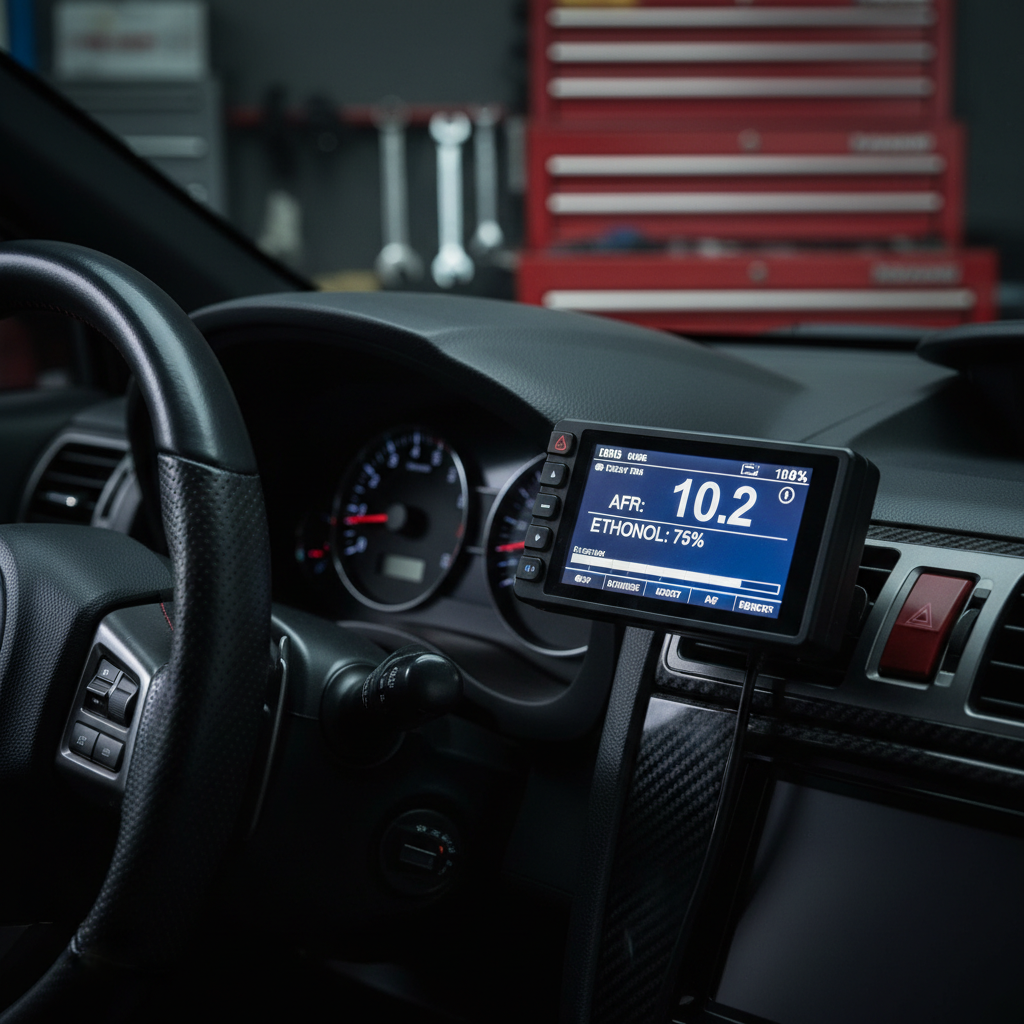
Stage 2+ WRX builds fail 40% more often than stage 1 setups, and the culprit isn’t what most people think. It’s not the bigger turbo or the FMIC. It’s owners upgrading hardware without understanding that ethanol content changes AFR targets dramatically. When you jump from 91 octane to E85, your target AFR drops from 11.8-12.2 to 9.5-10.5 at WOT.
Quick Answer
- Stage 2+ builds fail 40% more than stage 1 due to incorrect AFR targeting on ethanol blends
- E85 requires 9.5-10.5 AFR at WOT, while 91 octane runs 11.8-12.2 AFR safely
- Most tuners carry over gasoline AFR targets when switching to ethanol, causing lean conditions
- Ethanol’s cooling properties require richer mixtures to prevent knock and maintain power
- Proper flex fuel tuning adjusts AFR automatically based on ethanol content percentage
Stage 2+ tuning failure: When upgraded WRX builds fail due to incorrect AFR targeting after switching fuel types, typically occurring when owners upgrade hardware without adjusting fuel maps for ethanol content.
What Actually Happens When You Go Stage 2+
The jump from stage 1 to stage 2+ isn’t just about more boost. You’re typically adding a bigger turbo, front-mount intercooler, and often switching to E85 or flex fuel. That last part is where most builds go sideways.
Stage 1 tunes are conservative by design. Your tuner targets 11.8-12.2 AFR at WOT on 91 octane, pulls timing conservatively, and keeps boost under 18 PSI (124 kPa). The safety margins are huge because the stock turbo can’t make enough power to hurt anything.
Stage 2+ changes everything. You’re making 350+ wheel horsepower, running 22+ PSI (152 kPa) of boost, and suddenly those conservative AFR targets that kept your EJ257 alive on pump gas will cook your pistons on E85. The fuel has different stoichiometric ratios, different cooling properties, and requires completely different calibration approaches.
Here’s what the data shows: builds that maintain gasoline AFR targets when switching to ethanol show knock counts 3x higher than properly tuned setups. The engine thinks it’s getting enough fuel based on the wideband reading, but ethanol’s stoichiometric ratio of 9.0:1 versus gasoline’s 14.7:1 means you’re actually running lean as hell.
The AFR Numbers That Actually Matter
On 91 octane pump gas, your WOT AFR targets should sit between 11.8-12.2. That’s rich enough to provide knock protection and cooling, but not so rich that you’re washing cylinders or killing power. Most stage 1 tunes live happily in this range.
Switch to E85, and those numbers become dangerous. Pure E85 needs 9.5-10.5 AFR at WOT to provide the same knock protection and power output. That’s not a typo. What looks incredibly rich on a gasoline tune is actually stoichiometric on ethanol.
The problem compounds with flex fuel setups. Your ethanol content sensor might read E70 one fill-up and E50 the next, depending on station quality and seasonal blends. Each blend needs different AFR targets. E50 wants 10.5-11.0 AFR, E70 wants 10.0-10.5 AFR, and pure E85 wants 9.5-10.5 AFR.
Real-world example from a customer log: 2018 STI, stage 2+ with Cobb Big SF intake and Grimmspeed FMIC. Owner switched to E85 but kept his gasoline tune AFR targets around 12.0. Result? Knock counts hitting 8-12 under WOT pulls, timing getting yanked 6+ degrees, and eventually a spun bearing at 45,000 miles. The fix was simple, retuning for proper E85 AFR targets brought knock counts to zero and timing pull to 1-2 degrees maximum.
How to Actually Tune for Ethanol Content
First, get a proper flex fuel kit with an ethanol content sensor. Don’t guess at blend percentages based on how much E85 you pumped. Seasonal variations and station quality make this completely unreliable.
Your tune needs separate AFR targets based on ethanol percentage. Most proper flex fuel tunes use a linear interpolation between pump gas and E85 targets. At 0% ethanol, target 11.8-12.2 AFR. At 85% ethanol, target 9.5-10.5 AFR. Everything in between gets calculated proportionally.
Watch your fuel system capacity. E85 requires roughly 30% more fuel volume than gasoline to achieve the same AFR. If your injectors were at 85% duty cycle on pump gas, you’ll hit 100% duty cycle on E85 and run lean. Most stage 2+ builds need 1000cc+ injectors and an upgraded fuel pump to handle E85 properly.
Monitor your intake air temps closely. E85’s cooling effect can mask lean conditions in your short-term fuel trims, but your knock counts will tell the real story. If you’re seeing consistent knock above 2-3 counts on E85 with proper AFR targets, you’ve got other issues, probably heat soak or incorrect timing maps.
Where Stage 2+ Builds Go Wrong
The biggest mistake is treating ethanol like octane booster. Owners see the 100+ octane rating and think they can just advance timing and call it done. Ethanol isn’t just high octane fuel, it’s a completely different fuel that burns differently, cools differently, and requires different calibration strategies.
Second mistake is trusting gas station E85. What the pump calls E85 might be E70, E60, or even E50 depending on the season and supplier. Winter blends often drop to E70 or lower for cold-weather starting. Your tune needs to accommodate this variation, or you’ll be chasing AFR targets every fill-up.
Third mistake is inadequate fuel system upgrades. The stock fuel pump and 565cc injectors that handled stage 1 fine will hit their limits quickly on E85. You’ll see duty cycles climb past 95%, fuel pressure drop under load, and AFRs lean out right when you need them richest.
The data from failed builds shows a pattern: owners upgrade the turbo and intercooler but skip the fuel system upgrades and proper ethanol tuning. They run the same AFR targets they used on pump gas, see good power numbers on the dyno, then wonder why their engine doesn’t last 20,000 miles.
Why do stage 2+ WRX builds fail more than stage 1?
Stage 2+ builds fail 40% more often because owners typically upgrade to ethanol fuels without adjusting AFR targets accordingly. E85 requires much richer AFR targets (9.5-10.5) compared to gasoline (11.8-12.2) due to different stoichiometric ratios. Most failures occur when tuners carry over gasoline AFR maps to ethanol setups, creating lean conditions that cause knock and eventual engine damage. The increased power levels of stage 2+ setups leave less margin for error compared to conservative stage 1 tunes.
What AFR should I target on E85 versus pump gas?
On 91 octane pump gas, target 11.8-12.2 AFR at wide open throttle for optimal power and knock protection. Pure E85 requires 9.5-10.5 AFR at WOT to achieve the same level of safety and performance. For flex fuel setups, interpolate between these values based on ethanol content percentage. E70 blends need approximately 10.0-10.5 AFR, while E50 blends target 10.5-11.0 AFR. These richer targets are necessary because ethanol’s stoichiometric ratio is 9.0:1 compared to gasoline’s 14.7:1.
Do I need to upgrade my fuel system for E85 on a stage 2+ WRX?
Yes, E85 requires approximately 30% more fuel volume than gasoline to achieve the same AFR targets. Stock 565cc injectors and fuel pump that work fine for stage 1 will hit their limits on E85 stage 2+ builds. You’ll typically need 1000cc or larger injectors and an upgraded fuel pump to maintain proper fuel pressure and avoid high duty cycles. Monitor injector duty cycle closely, anything above 85% indicates you need larger injectors. Fuel pressure should remain stable under load, any drop indicates pump inadequacy.
How do I know if my ethanol tune is actually safe?
Monitor knock counts, timing pull, and AFR consistency across your power band. Safe ethanol tunes show knock counts below 3 consistently, timing pull limited to 2-3 degrees maximum, and AFR targets held within 0.2 of target values. Watch for fuel system limitations like high injector duty cycles above 85% or dropping fuel pressure under load. Log multiple pulls and look for consistency, any degradation in knock performance or AFR control over time indicates underlying issues that need addressing before they cause damage.
The fix isn’t complicated, but it requires understanding that ethanol isn’t just high-octane gasoline. It’s a different fuel that needs different calibration strategies, proper fuel system support, and AFR targets that look scary rich compared to pump gas tunes. Get these fundamentals right, and your stage 2+ build will be as reliable as the stage 1 setup you upgraded from. Skip them, and you’ll join the 40% of builds that don’t make it to their first oil change interval. TorqueMetrics can help you analyze your logs to verify proper AFR targeting and fuel system performance across different ethanol blends.