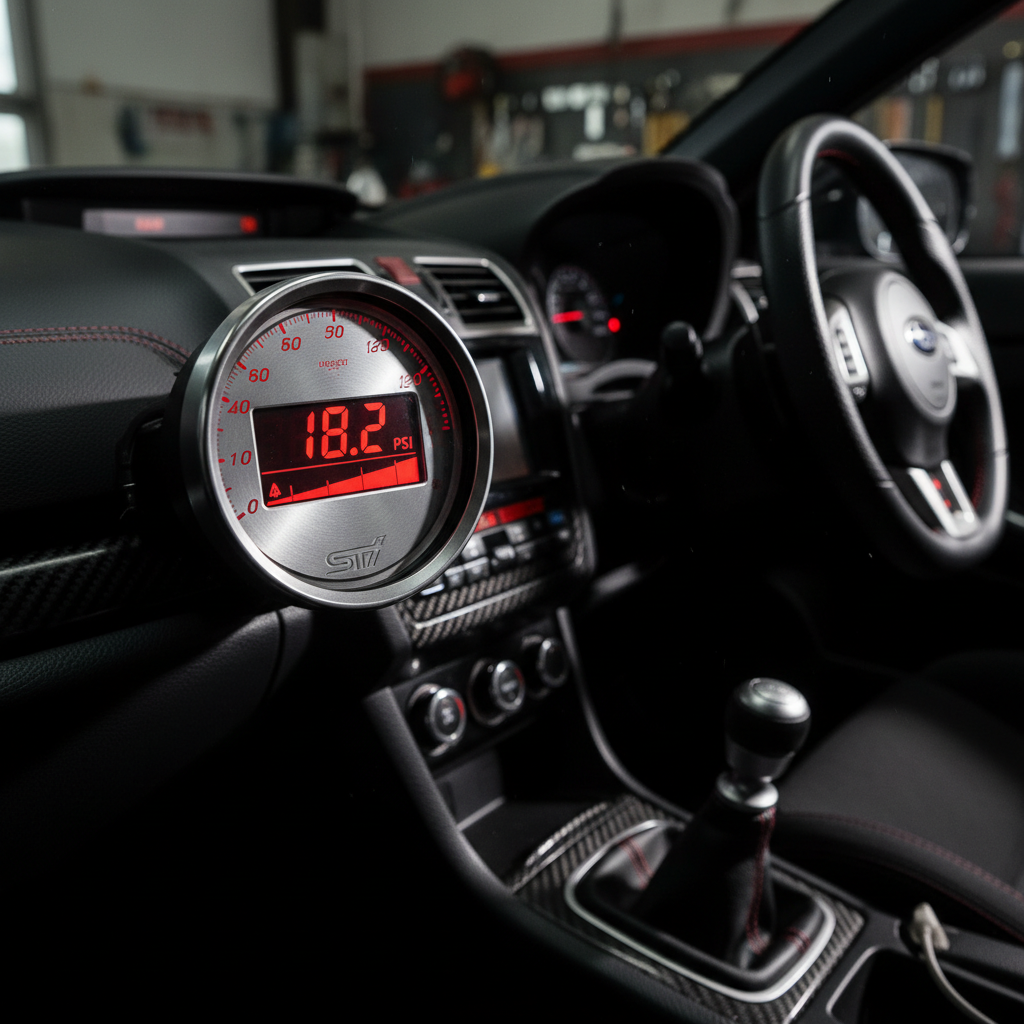
Do Aftermarket Boost Controllers Actually Improve STI Response?
Aftermarket boost controllers improve STI response by eliminating the 2-4 PSI overshoots that stock solenoids create during gear changes. Your factory boost control system can’t react fast enough to prevent these pressure spikes, which stress ringlands and bearings every time you shift under load.
Quick Answer
- Stock STI boost control overshoots target by 2-4 PSI during gear changes
- Aftermarket controllers use faster solenoid response to maintain precise pressure
- Overshoots create cylinder pressure spikes that stress ringlands and rod bearings
- Data shows 15-20% faster boost recovery with quality aftermarket units
- Electronic controllers offer closed-loop feedback stock systems lack
Boost controller: A device that regulates turbocharger wastegate operation to control manifold pressure. Aftermarket units use faster solenoids and closed-loop feedback to maintain more precise pressure control than factory systems.
What Actually Happens During Gear Changes
The factory boost control system on STIs uses a relatively slow-responding solenoid that can’t keep up with the rapid pressure changes during shifts. When you lift off the throttle to shift, manifold pressure drops instantly. But when you get back on the gas, the turbo is still spooled and the wastegate takes time to respond to the new duty cycle signal.
This creates a brief window where manifold pressure overshoots your target by 2-4 PSI before the wastegate opens enough to bring it back down. On a car targeting 18 PSI (124 kPa), you might see spikes to 22 PSI (152 kPa) for 200-300 milliseconds during the 2nd to 3rd shift under full acceleration.
The problem compounds with higher boost levels. Run 20 PSI (138 kPa) and those overshoots can hit 24 PSI (165 kPa). Your tune accounts for 20 PSI worth of cylinder pressure, not 24. That extra pressure translates directly to higher combustion chamber stress, increased knock likelihood, and more load on your connecting rods and ringlands.
Aftermarket controllers solve this with faster-responding solenoids, typically 50-100Hz versus the 10-20Hz response of factory units. They also use closed-loop feedback, reading actual manifold pressure and adjusting wastegate duty cycle in real time rather than running a predetermined map.
What the Data Actually Shows
Comparing stock versus aftermarket boost control data reveals the difference immediately. Stock systems show sawtooth pressure patterns during acceleration runs, with clear overshoots after every gear change. Quality aftermarket units maintain flat pressure lines within 0.5 PSI of target throughout the pull.
The specific numbers matter here. A properly tuned STI with a Grimmspeed or AEM boost controller will show boost recovery times of 0.8-1.2 seconds after shifts, compared to 1.5-2.0 seconds with the stock solenoid. Peak overshoot drops from 3-4 PSI to under 1 PSI. That’s the difference between cylinder pressures your tune was designed for and pressure spikes it wasn’t.
Temperature data shows the thermal impact too. Exhaust gas temperatures during pulls with stock boost control often show 50-80°C spikes corresponding to the pressure overshoots. These thermal cycles stress your turbo bearings and exhaust valves. Aftermarket controllers maintain steadier EGT patterns because combustion chamber conditions stay consistent.
The knock count difference is where it gets serious. Stock boost control on a Stage 2+ STI might show 2-4 knock events per pull, usually corresponding to the overshoot windows. The same car with proper boost control typically shows zero knock counts on identical runs with identical timing maps.
What to Do With This Information
First, log your current boost control behavior before making changes. Set up channels for manifold pressure, wastegate duty cycle, and knock count. Do several 3rd gear pulls and look for the overshoot pattern after the 2nd to 3rd shift. If you’re seeing consistent overshoots above 2 PSI, your stock system is the limiting factor.
For STI applications, electronic boost controllers work better than manual units. The Grimmspeed Electronic Boost Controller and AEM Tru-Boost are proven options that integrate well with factory ECU tuning. Avoid cheap manual controllers, they create more problems than they solve on modern turbocharged cars.
Plan for a retune when you install the controller. Your tuner needs to adjust the boost control maps to work with the new hardware’s response characteristics. Most experienced STI tuners will reduce wastegate duty cycle values by 10-15% initially, then fine-tune based on logged data.
Set realistic targets. A good aftermarket controller should maintain your target boost within 1 PSI throughout the power band. If you’re still seeing overshoots above 1.5 PSI after tuning, either the controller isn’t set up properly or you need to look at wastegate sizing and plumbing.
What Goes Wrong When People Miss This
The most common mistake is ignoring boost overshoots because peak power numbers look good on the dyno. Dyno pulls don’t replicate the rapid throttle transitions that create overshoots during actual driving. Your car might make perfect power in steady-state conditions while still spiking pressure dangerously during gear changes on the street.
Running aggressive timing maps without addressing boost control creates a recipe for engine damage. Those 2-4 PSI overshoots combined with timing advance optimized for lower pressure create perfect knock conditions. You might get away with it for months, then lose ringlands on a hot day when everything comes together wrong.
Cheap manual boost controllers cause more problems than they solve on STIs. The factory ECU expects to control boost through the stock solenoid. Manual controllers that bypass this system completely can create boost cut conditions, inconsistent pressure delivery, and tuning headaches that cost more to fix than buying proper electronic control initially.
Some owners install boost controllers but never tune for them properly. The controller hardware is only half the solution. Without ECU calibration changes to match the new response characteristics, you often end up with slower spool and inconsistent pressure control, negating the benefits entirely.
Does a boost controller actually increase power on an STI?
Boost controllers don’t directly increase peak power, but they improve power delivery consistency and protect against pressure-related engine damage. The real benefit is maintaining precise boost pressure throughout the power band, which allows tuners to run more aggressive timing maps safely. You might see 5-10 WHP gains from improved boost control allowing slightly more timing advance, but the main value is reliability and consistent performance.
Which boost controller works best with the STI factory ECU?
Electronic boost controllers like the Grimmspeed EBC or AEM Tru-Boost integrate best with factory STI ECUs because they work with the existing boost control strategy rather than bypassing it. These units replace the factory solenoid while maintaining ECU communication, allowing proper closed-loop operation. Manual controllers often create boost cut issues and inconsistent operation on modern Subarus.
How do I know if my STI needs a boost controller upgrade?
Log your manifold pressure during acceleration runs, focusing on pressure behavior immediately after gear changes. If you see consistent overshoots above 2 PSI that last more than 200 milliseconds, your stock boost control is limiting performance and potentially creating stress on internals. Knock counts that correspond to these overshoot periods confirm the problem is affecting combustion quality.
Can I install a boost controller without retuning my STI?
No, electronic boost controllers require ECU calibration changes to work properly. The factory boost control maps are designed for the stock solenoid’s response characteristics. Installing a faster-responding aftermarket unit without adjusting duty cycle values and control parameters will result in inconsistent boost delivery and potentially dangerous overshoots. Budget for professional tuning when upgrading boost control hardware.
Boost control upgrades make sense when your data shows the stock system is the limiting factor. If you’re logging consistent overshoots and knock counts that correlate with pressure spikes, an aftermarket controller eliminates a significant stress source while improving overall tune quality. The investment pays for itself in engine longevity and consistent performance.