Why Your Stage 2 WRX Boost Spikes: 3 Sensor Readings That Reveal Wastegate Failure
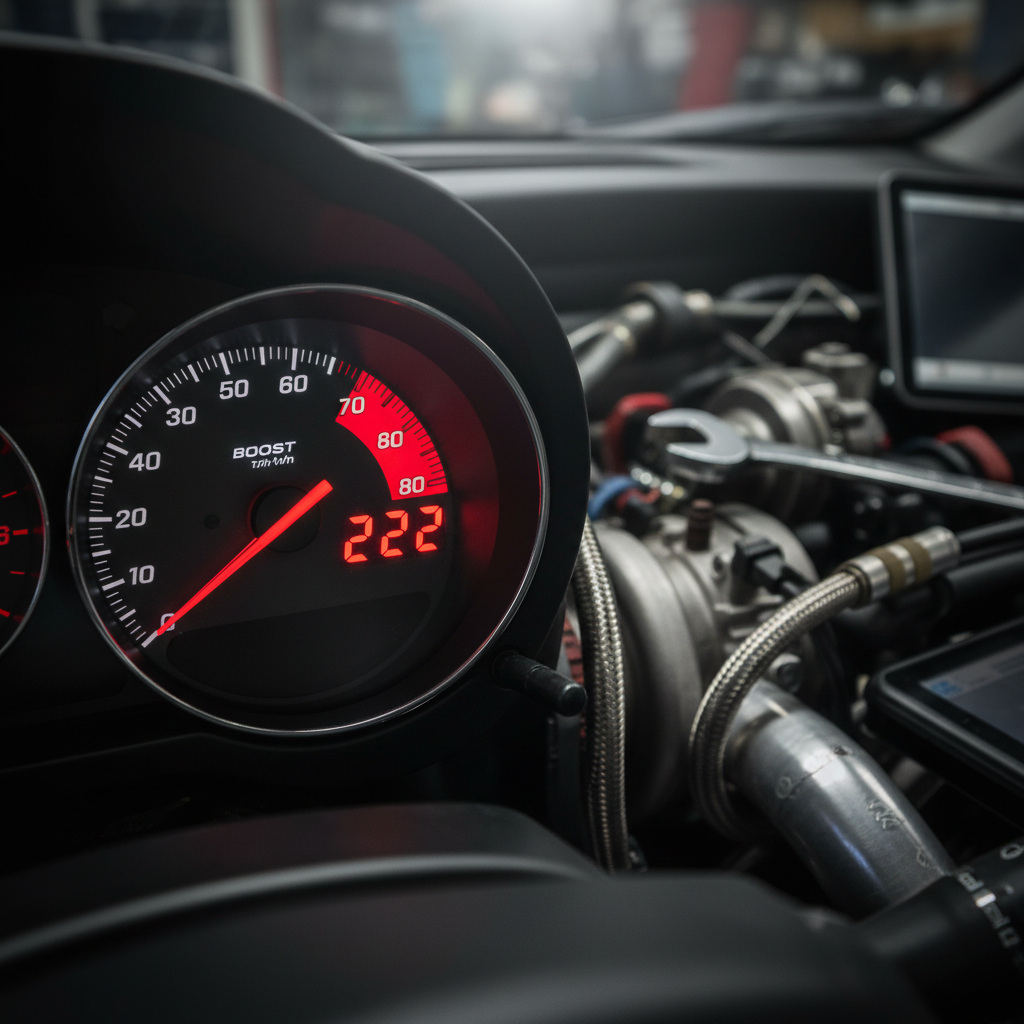
Your Stage 2 WRX is spiking to 22 PSI (152 kPa) when your tune calls for 18 PSI (124 kPa), and it’s not consistent. Three specific datalog readings will tell you if your wastegate actuator is failing before it costs you a motor: manifold pressure variance exceeding 2 PSI, wastegate duty cycle drift beyond 15%, and solenoid response time delays over 300ms.
Quick Answer
- Manifold pressure variance over 2 PSI between pulls indicates actuator binding or diaphragm wear
- Wastegate duty cycle drift beyond 15% from target reveals control valve degradation
- Solenoid response delays over 300ms show vacuum line leaks or actuator mechanical failure
- All three readings together confirm wastegate system failure requiring immediate attention
- Catching these early prevents overboosting that can destroy pistons or rod bearings
Wastegate actuator failure: Progressive degradation of the pneumatic or electronic actuator system that controls turbo boost pressure, typically showing as inconsistent boost control, pressure spikes, and eventually complete loss of boost regulation leading to engine damage.
What Wastegate Actuator Failure Actually Looks Like in Your Data
The EJ25 in your Stage 2 WRX runs a pneumatic wastegate actuator that’s essentially a spring-loaded diaphragm fighting boost pressure. When it starts failing, your datalog shows specific patterns that most people miss until it’s too late.
First symptom: manifold pressure variance between identical pulls. Your tune targets 18 PSI (124 kPa) but one pull hits 17.2 PSI while the next spikes to 20.8 PSI. Same conditions, same throttle position, different boost. That variance over 2 PSI tells you the actuator isn’t responding consistently to the same control inputs.
The wastegate duty cycle starts drifting. A healthy system holds steady duty cycles, maybe fluctuating 5-8% during transients. When your actuator diaphragm tears or the control valve sticks, the ECU compensates by changing duty cycle more aggressively. You’ll see 15% or greater swings as the system tries to hit target boost. The ECU knows something’s wrong, even if you don’t yet.
Response time degrades last. Log your wastegate solenoid command versus actual manifold pressure response. A good actuator responds within 200ms. When internal seals fail or vacuum lines leak, response stretches past 300ms. The delay creates boost overshoot because the ECU can’t react fast enough to pressure changes.
The Three Critical Readings That Reveal Actuator Health
Pull three consecutive WOT logs in third gear from 3000 to 6500 RPM. Same ambient conditions, same fuel load. Compare these specific parameters across all three pulls.
Manifold Absolute Pressure variance: Calculate the difference between peak boost on each pull. Healthy actuators show less than 1 PSI variance. Between 1-2 PSI indicates early wear. Over 2 PSI confirms mechanical failure. I’ve seen failing actuators swing 4-5 PSI between identical pulls, which will absolutely destroy pistons.
Wastegate Duty Cycle drift: Compare duty cycle at the same RPM point across pulls. At 4500 RPM under full boost, your duty cycle should be nearly identical pull to pull. Variance over 15% indicates the control valve isn’t sealing properly or the actuator arm is binding. The ECU compensates by changing duty cycle to hit the same boost target.
Solenoid Response Time: Measure time between wastegate duty cycle command and manifold pressure response. Log both parameters at 10Hz minimum. Calculate the delay from duty cycle change to pressure change. Under 200ms is excellent. 200-300ms shows wear but manageable. Over 300ms means replace it before your next track day.
These readings compound. A failing actuator rarely shows just one symptom. When you see pressure variance AND duty cycle drift AND slow response, that’s confirmation. Don’t wait for complete failure.
What to Do When Your Data Shows Actuator Failure
Replace the wastegate actuator before adjusting your tune. Too many people try to tune around failing hardware, which masks the problem temporarily while creating bigger issues. You can’t software your way out of mechanical failure.
For EJ25 engines, the OEM actuator typically fails between 60,000-80,000 miles on Stage 2 setups. The increased duty cycles and boost pressure accelerate diaphragm wear. Aftermarket actuators like the Turbosmart IWG75 handle the abuse better, but they require recalibration of your wastegate duty cycle tables.
Before replacement, check your vacuum lines. A 2mm vacuum leak creates the same symptoms as actuator failure. Pull each line and inspect for cracks, especially where they connect to the manifold. Replace any questionable lines, they’re $15 versus $300 for an unnecessary actuator.
After actuator replacement, your tuner needs to recalibrate the wastegate duty cycle tables. Different actuators have different spring rates and response characteristics. Running old duty cycle values on new hardware creates inconsistent boost control and premature wear.
Set conservative boost targets during break-in. New actuators need 500-1000 miles to seat properly. Running maximum boost immediately can cause premature failure or inconsistent response. Start at 16 PSI (110 kPa) for the first few hundred miles, then gradually increase to your target.
What Goes Wrong When People Ignore These Warning Signs
The most expensive mistake is continuing to drive on a failing wastegate actuator. That 22 PSI (152 kPa) spike on a motor tuned for 18 PSI (124 kPa) creates cylinder pressures the internals can’t handle. Piston ring land failure is common. Rod bearing damage follows shortly after.
People try to tune around the problem by reducing boost targets or adding boost cuts. This masks the inconsistency temporarily but doesn’t fix the root cause. The actuator continues degrading until complete failure, often during a high-load situation when you can least afford it.
Ignoring duty cycle drift leads to solenoid burnout. The ECU drives the wastegate solenoid harder to compensate for actuator failure. Solenoids aren’t designed for constant high duty cycles. When the solenoid fails, you lose all boost control. That’s when people discover their actuator problem the expensive way.
Some owners disable boost control entirely when they notice inconsistencies. Running open wastegate seems safer, but it’s not. Without active boost control, you’re relying entirely on wastegate spring pressure. Temperature changes affect spring rates. Hot weather reduces boost, cold weather increases it. You’ll run lean in summer and potentially overboost in winter.
The failure mode that destroys engines is complete actuator diaphragm rupture during boost. No boost control, full exhaust pressure to the turbine, manifold pressure climbing until something breaks. Usually the something that breaks is expensive internal engine components.
FAQ
How much boost variance is normal on a Stage 2 WRX?
Less than 1 PSI variance between identical pulls is normal for a healthy wastegate system. Between 1-2 PSI indicates early actuator wear that should be monitored closely. Over 2 PSI variance confirms mechanical failure requiring immediate replacement. Temperature and atmospheric changes can cause 0.5 PSI natural variance, but anything beyond that indicates actuator problems.
Can I keep driving my WRX if the wastegate actuator is failing gradually?
No, continuing to drive on a failing wastegate actuator risks catastrophic engine damage. Even gradual failure can cause sudden boost spikes exceeding safe cylinder pressure limits. The cost of actuator replacement is minor compared to internal engine damage from uncontrolled overboosting. Replace the actuator as soon as your data confirms failure symptoms.
Will an aftermarket boost controller fix my wastegate actuator problems?
An electronic boost controller cannot fix mechanical actuator failure, though it may temporarily mask symptoms through more aggressive control algorithms. The underlying mechanical problem continues to worsen regardless of control strategy. Replace the failed actuator first, then consider electronic boost control for improved consistency and features. Trying to control boost electronically with a failing mechanical actuator creates unpredictable and potentially dangerous boost behavior.
How long does a replacement wastegate actuator last on a Stage 2 setup?
OEM actuators typically last 60,000-80,000 miles on Stage 2 WRX setups before showing failure symptoms. Aftermarket actuators like Turbosmart or Precision units often exceed 100,000 miles due to stronger diaphragms and better materials. Proper tuning, quality vacuum lines, and avoiding excessive boost levels extend actuator life significantly. Track use and aggressive driving reduce service life by approximately 30-40%.
Your datalog tells the story of every component in your boost system. These three readings give you early warning before your wastegate actuator fails catastrophically. TorqueMetrics makes tracking these parameters simple with automated alerts when readings exceed safe thresholds, giving you the data you need to keep your WRX running strong.