Why Your Stage 2+ WRX Knocks Despite Conservative Tunes & Premium Fuel
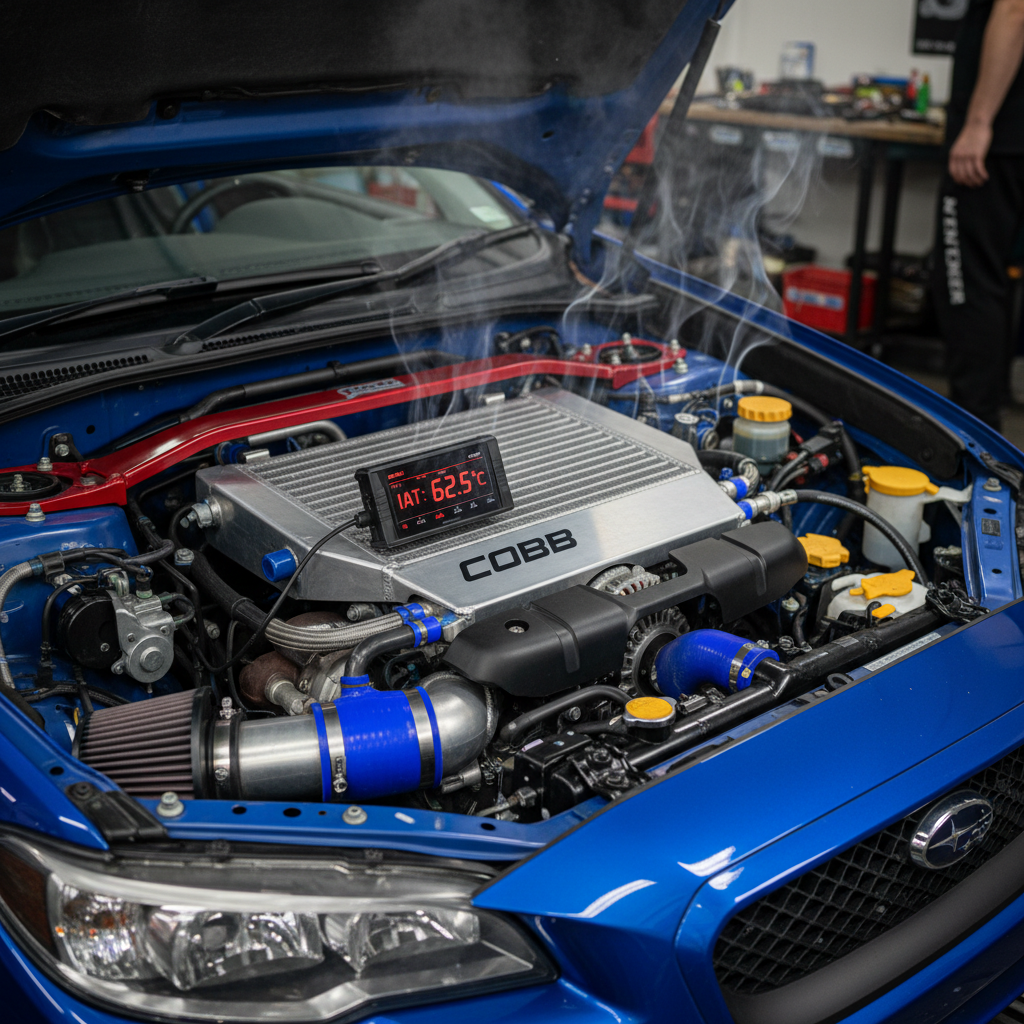
You’ve done everything right. Stage 2+ WRX running a conservative tune from a reputable shop, premium 98 octane fuel, proper AFRs around 11.2:1 under boost. Yet your knock sensor keeps lighting up like a Christmas tree, and that dreaded fine knock learn is creeping into negative territory. Before you start second-guessing your tuner or swapping fuel brands, check your Intake Air Temperature logs.
The Heat Soak Reality: When Physics Beats Premium Fuel
Most WRX owners focus on the obvious knock culprits: octane rating, timing advance, and boost levels. But intercooler heat soak creates a perfect storm that even conservative tunes can’t overcome. When your top-mount intercooler sits in the engine bay after spirited driving, it becomes a heat reservoir rather than a cooling device.
The critical threshold is 60°C (140°F) IAT. Beyond this point, even 98 octane fuel loses its knock resistance dramatically. Your ECU might be pulling timing and enriching the mixture, but if the intake charge is superheated, detonation becomes inevitable regardless of your tune’s safety margins.
What Your Data Logs Actually Show
A healthy Stage 2+ WRX should maintain IATs within specific windows during performance driving:
- Ambient + 15-25°C: Normal operating range for a functioning intercooler
- 40-50°C: Acceptable under sustained load with good airflow
- 50-60°C: Warning zone – knock sensitivity increases significantly
- Above 60°C: Danger zone – knock likely even with conservative timing
The sequence typically looks like this in your logs: IATs climb gradually during pulls, reaching 55-65°C by the third consecutive run. Your AFRs remain stable at 10.8-11.2:1, timing is conservative at -2° to -4° from MBT, but knock events start appearing. The ECU responds with fine knock learn values of -1.41° to -2.81°, further retarding timing and killing power.
What’s particularly insidious is that this often happens during dyno tuning or track sessions—exactly when you think your car should be performing its best. The intercooler simply can’t reject heat fast enough in stop-and-go conditions or multiple back-to-back pulls.
What to Watch Out For
Heat soak knock has specific characteristics that differentiate it from fuel or tune-related knock:
- Progressive timing: Knock events worsen with each successive pull
- Temperature correlation: IAT and knock severity track together perfectly
- Recovery behavior: Let the car cool for 10-15 minutes, and knock disappears
- Load independence: Occurs even at moderate boost levels (15-18 psi)
The danger signs in your data:
- IAT climbing above 50°C during normal driving
- Delta between ambient and IAT exceeding 30°C
- Fine knock learn accumulating during consecutive pulls
- Knock events clustering in higher RPM ranges where cylinder filling is most efficient
The TorqueMetrics Approach to Heat Soak Detection
This is exactly why continuous data logging matters more than dyno sheets. TorqueMetrics tracks the relationship between IAT, ambient temperature, and knock events over time—not just peak numbers. Our platform identifies heat soak patterns before they cause engine damage.
Key metrics we monitor:
- IAT delta trends: How quickly your intercooler saturates
- Knock correlation analysis: Linking temperature spikes to timing retard
- Recovery rates: How long your intercooler takes to return to baseline
- Atmospheric compensation: Adjusting thresholds for ambient conditions
The data doesn’t lie: most Stage 2+ WRXs with top-mount intercoolers will experience heat soak knock above 60°C IAT, regardless of fuel quality or tune conservatism. Front-mount intercooler upgrades typically reduce peak IATs by 15-20°C under identical conditions.
Don’t let intercooler heat soak fool you into chasing tuning ghosts or rebuilding perfectly healthy engines. Start logging your IATs alongside knock sensors, and you’ll quickly see the correlation that’s costing WRX owners thousands in unnecessary repairs. Try TorqueMetrics for comprehensive temperature and knock analysis that reveals what’s really happening under your hood.