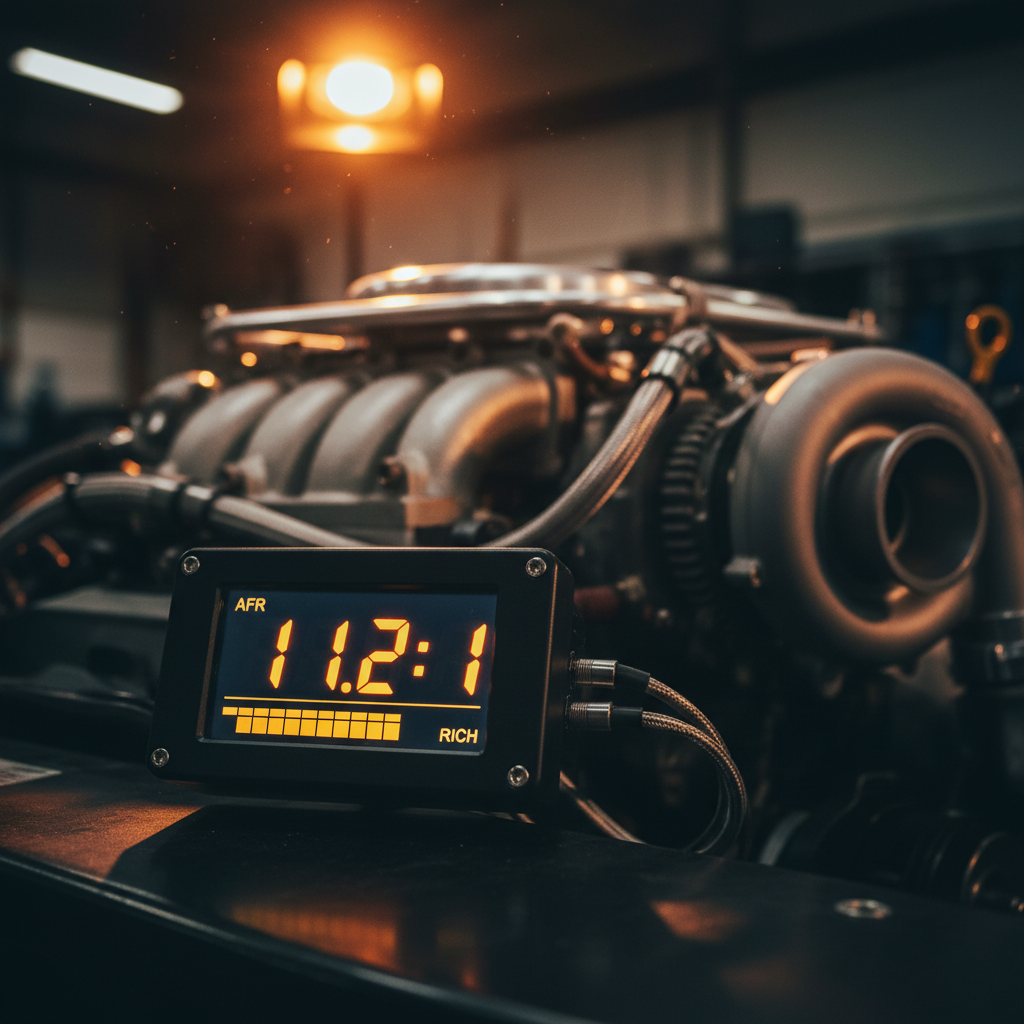
AFR Targets That Actually Work: Beyond the 11.5:1 Myth
Walk into any tuning forum and someone will tell you to target 11.5:1 AFR under boost. It’s become gospel among weekend warriors, but here’s the problem: that number comes from nowhere meaningful. Real tuning requires understanding how boost pressure, fuel octane, timing advance, and combustion chamber design all interact to determine your actual safe AFR window.
Why Generic AFR Targets Don’t Work
Air-fuel ratio isn’t just about preventing knock – it’s about managing combustion temperature, flame speed, and detonation threshold under specific conditions. A built 2JZ running 25psi on E85 with aggressive timing needs completely different fueling than a stock EJ257 on 93 octane at 18psi.
The 11.5:1 myth likely comes from naturally aspirated applications where it represented a good balance between power and safety. But forced induction changes everything. Higher cylinder pressures, elevated intake temperatures, and increased heat load all shift your safe AFR window significantly richer.
Combustion chamber design matters too. Direct injection motors can often run leaner than port injection because of better fuel atomization and charge cooling. A Golf R with its high-pressure direct injection system might safely target 12.2:1 at moderate boost levels, while an STI with its port injection setup needs 11.0:1 under similar conditions.
What the Data Actually Shows
Professional tuners use boost-specific AFR targets based on fuel type and engine architecture. Here’s what actual dyno data reveals:
- E85 applications: 10.2-10.6:1 at 20+ psi, 10.6-11.0:1 at 15-19 psi
- Premium pump gas (91-93 octane): 11.0-11.4:1 at 18+ psi, 11.4-11.8:1 at 12-17 psi
- Race fuel (100+ octane): 11.2-11.6:1 at high boost, depending on specific gravity
- Methanol injection: Allows 0.2-0.4 AFR points leaner than straight gasoline
These ranges assume proper timing maps – typically 18-22 degrees at peak torque for pump gas, 24-28 degrees for E85. If you’re running conservative timing due to fuel quality concerns, you’ll need richer AFR to compensate for the reduced combustion efficiency.
Temperature correction is critical too. A motor making peak power at 11.2:1 AFR in 60-degree weather might need 10.8:1 when ambient temps hit 95 degrees. Intake air temperature above 100°F typically requires 0.1-0.2 AFR points richer to maintain the same knock margin.
What to Watch Out For
The biggest mistake is chasing lean AFR for power without considering your knock threshold. A motor that’s happy at 11.6:1 on the dyno might detonate at 11.4:1 on a hot summer day with pump gas that’s been sitting in underground tanks for months.
Fuel quality varies dramatically. That 93 octane you bought yesterday might test at 91 octane next week, especially in summer months when refineries switch to different blends. Smart tuners build in safety margin by targeting richer AFR than the absolute minimum the motor can handle.
Watch for these red flags in your logs:
- Knock activity increasing as IATs rise – you need richer fueling
- EGT readings climbing above 1650°F sustained – lean condition under load
- Lambda wandering during steady-state cruise – fuel system struggling
- Power dropping off at higher RPM despite rich AFR – possible fuel delivery issue
Don’t ignore closed-loop correction either. If your short-term fuel trims are constantly pulling fuel (negative numbers) during part-throttle operation, your base fuel map is too rich. But if they’re adding fuel (positive numbers) under boost, you might be running dangerously lean in the areas that matter most.
TorqueMetrics Take
Raw AFR numbers mean nothing without context – boost pressure, timing, IAT, and knock activity all tell the complete story. TorqueMetrics automatically correlates these parameters, showing you exactly where your AFR targets are working and where they’re not.
Stop guessing at AFR targets based on forum wisdom. Upload your logs to TorqueMetrics and see what your motor actually needs for safe, consistent power. Your pistons will thank you.